

Correction of Various Nasal Tip Deformities #3: Triangular Nostril (Revision Rhinoplasty)
A distinctive feature of our clinic is that many patients, after a first surgery at another clinic went wrong,
come to us for revision surgery.
Patients therefore come with a wide range of problems, and among them “nasal tip deformity” is, within rhinoplasty,
the most demanding area, and one in which good results are not easy to achieve.
The reason is that “nasal tip deformity”
i) takes many different forms and is complex because the deformity appears in 3 dimensions.
ii) also has a complex course of development and causes, including “contracture,” “damage to and deformation of the tip cartilage from repeated surgery,” and “inflammation,”
among others, which makes the surgery very demanding and difficult.
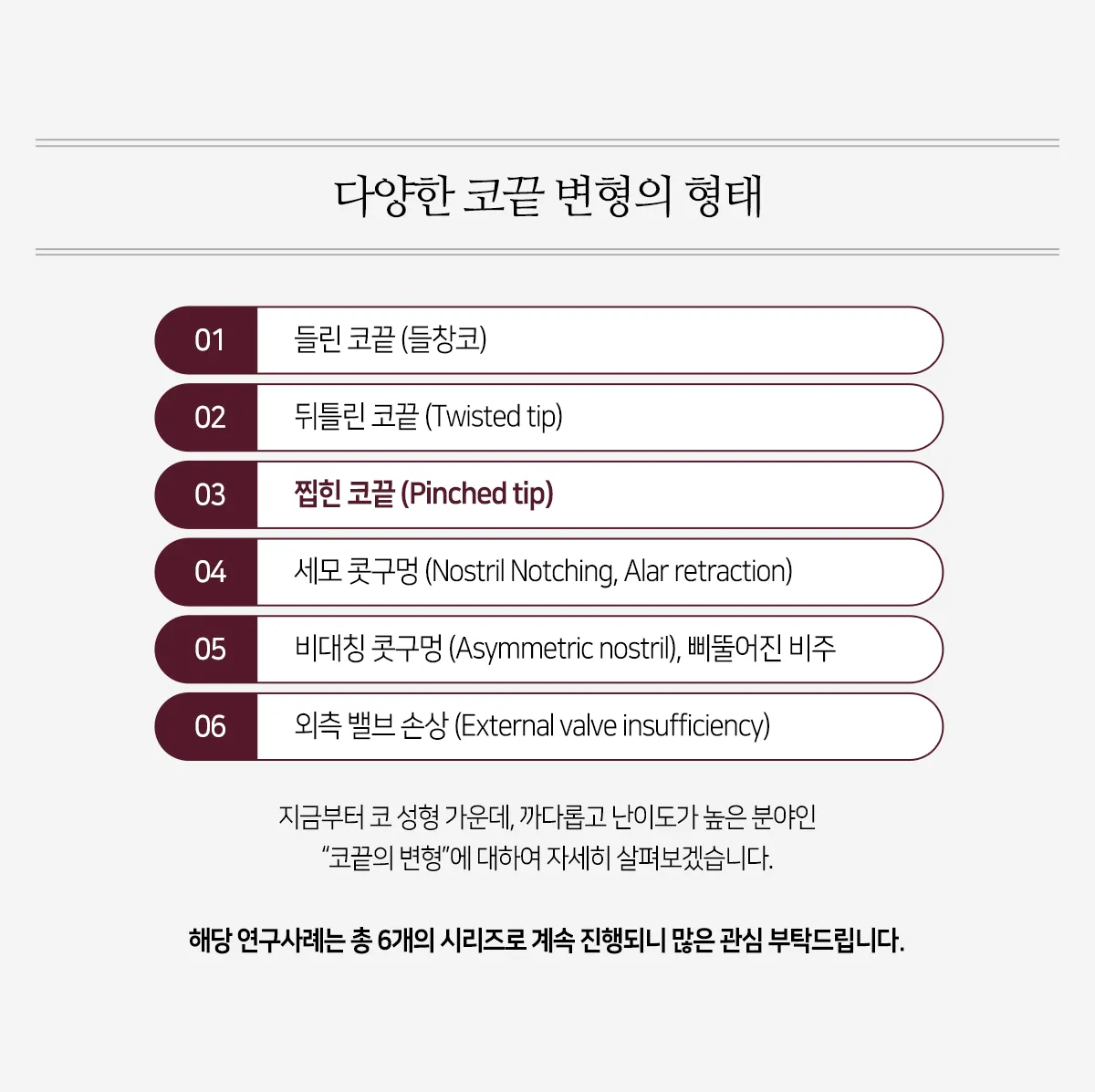
01 Upturned Tip (Upturned Nose)
02 Twisted Tip
03 Pinched Tip
04 Triangular Nostril (Nostril Notching, Alar Retraction)
05 Asymmetric Nostrils, Deviated Columella
06 External Valve Insufficiency
From here, we turn to a demanding and highly difficult area of rhinoplasty,
“nasal tip deformity,” and examine it in detail.
This case study continues as a series of 6 parts in total; we hope you will follow along.
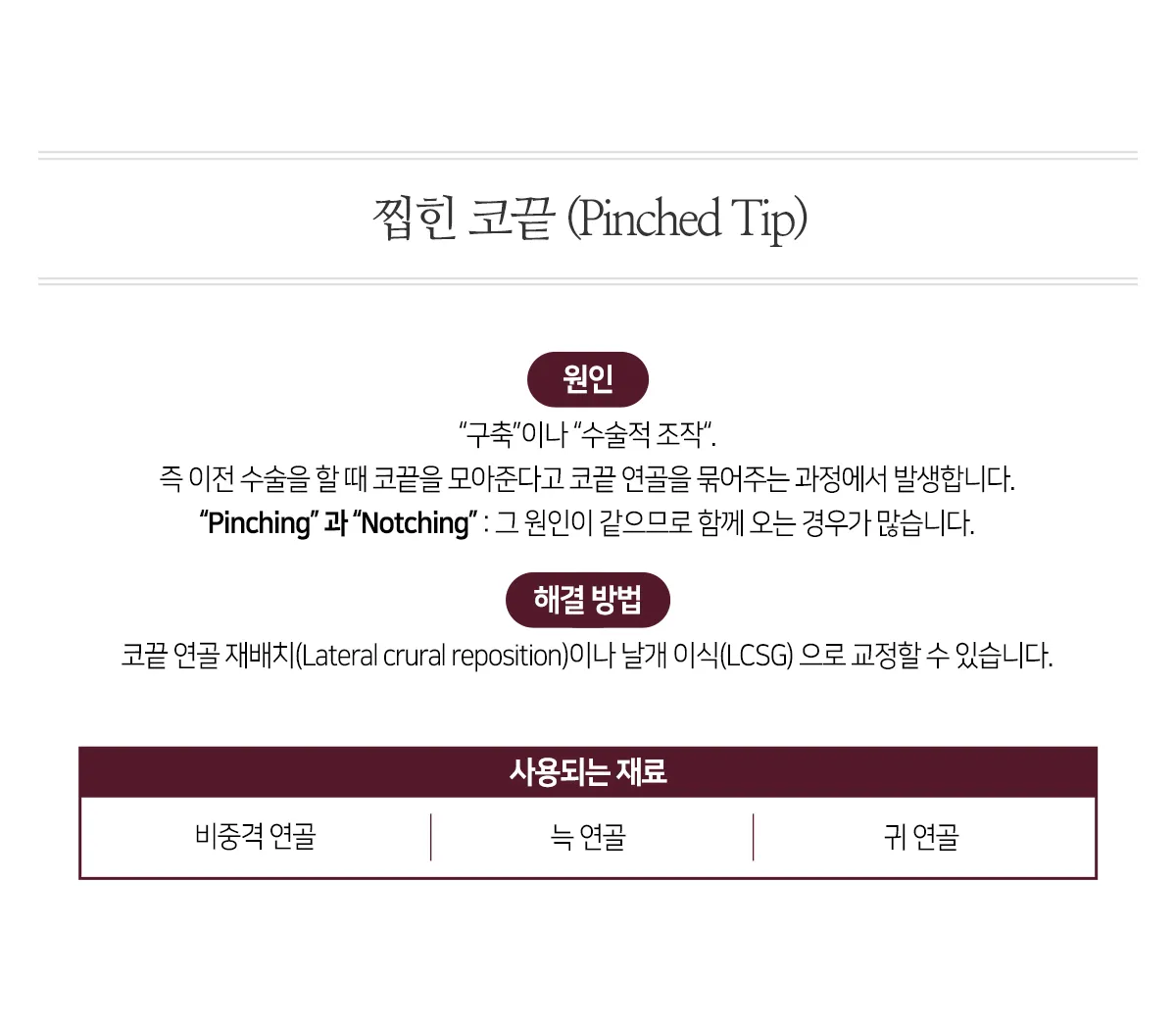
Pinched Tip
“Contracture” or “surgical manipulation.”
That is, it arises when the tip cartilages were sutured together in a previous surgery in order to narrow the tip.
“Pinching” and “Notching”: because they share the same cause, they often occur together.
It can be corrected with tip cartilage repositioning (lateral crural repositioning) or a lateral crural strut graft (LCSG).
Septal cartilage / Costal cartilage / Ear cartilage

Pinched Tip & Nostril Notching
Tip Pinching (Pinched Tip)
As in the photo on the left, this refers to a groove forming as the tip cartilages are drawn together, making the tip look as if pinched with a clip.
The cause is contracture, or manipulation that draws the tip cartilages together to slim the tip;
the deformity arises as they are crowded toward the midline.
Nostril Notching
Nostril notching refers to the rim of the nostril being pulled up into a point, like the apex of a triangle.
It, too, is a deformity caused by contracture and improper suturing of the tip cartilages.
This patient had tip plasty with ear cartilage through an open approach at another clinic 7-8 years ago,
with silicone placed on the dorsum; contracture has now led to
a pinched tip, nostril notching, and an upturned nose, among other changes.
This patient had tip plasty with ear cartilage and bridge augmentation with silicone at another clinic 5 years ago,
and developed a shifted columella, nostril notching, and an upturned tip due to contracture.
The pinching is relatively mild.
So far we have looked at what tip pinching, alar rim retraction (nostril notching), and the upturned nose are;
let us now look at the appearance before and after surgery, case by case.

PH
This patient underwent rhinoplasty with silicone and ear cartilage at another clinic 8 years ago.
cc
Because of intermittent tightness and throbbing pain in the tip beginning 1 month earlier,
the patient wanted the silicone implant removed but was very worried that tip deformity might follow removal.
P/E
The silicone implant was in its proper position, the tip was rather large and bulbous,
and an “L”-shaped silicone implant was in place, with ear cartilage resting on the tip.
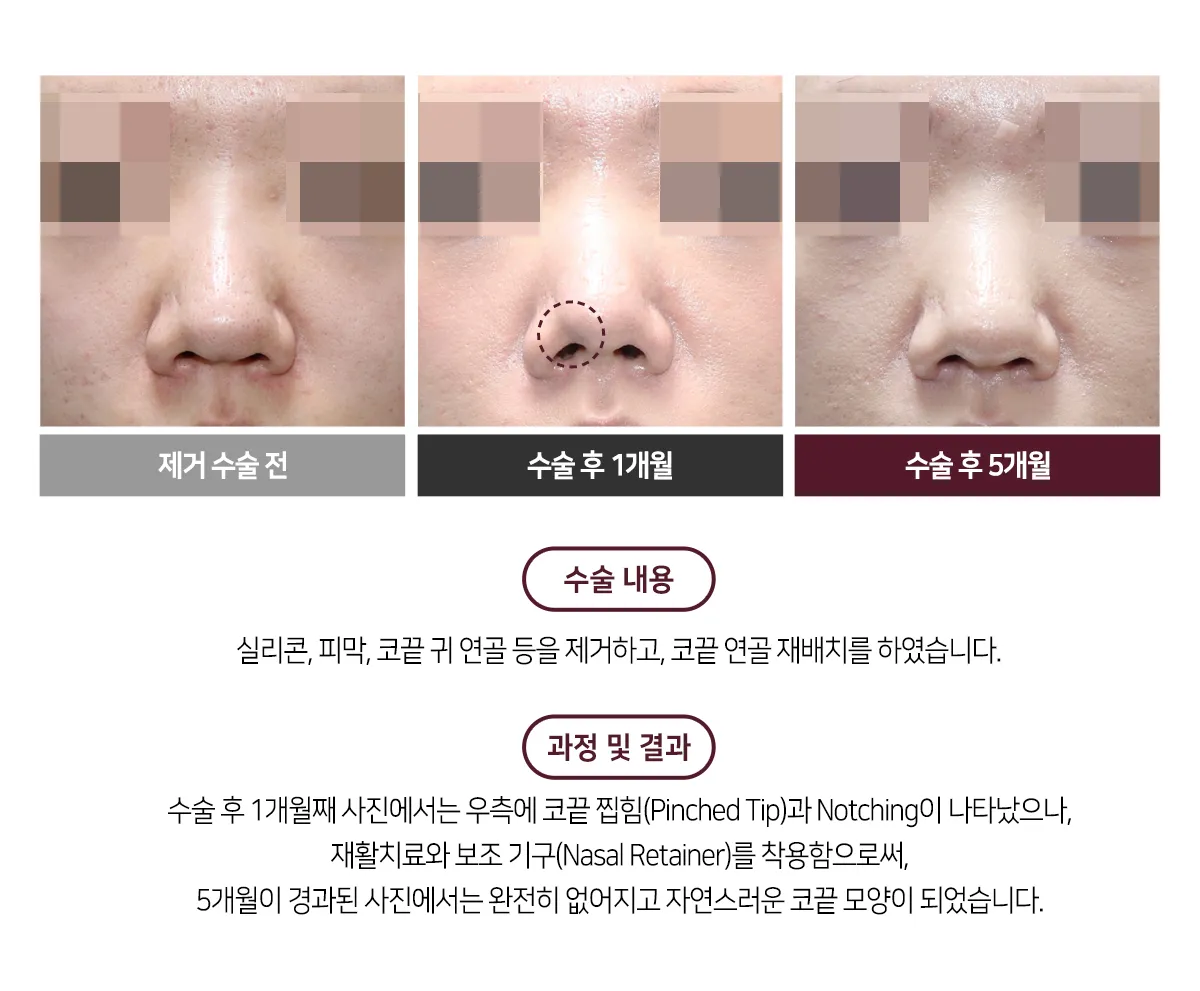
(Surgery Performed)
The silicone, capsule, and ear cartilage on the tip were removed, and tip cartilage repositioning was performed.
(Course and Results)
In the photo at 1 month after surgery, a pinched tip and notching had appeared on the right side,
but with rehabilitation therapy and the wearing of a supportive device (nasal retainer),
these had disappeared completely in the photo at 5 months, leaving a natural tip shape.
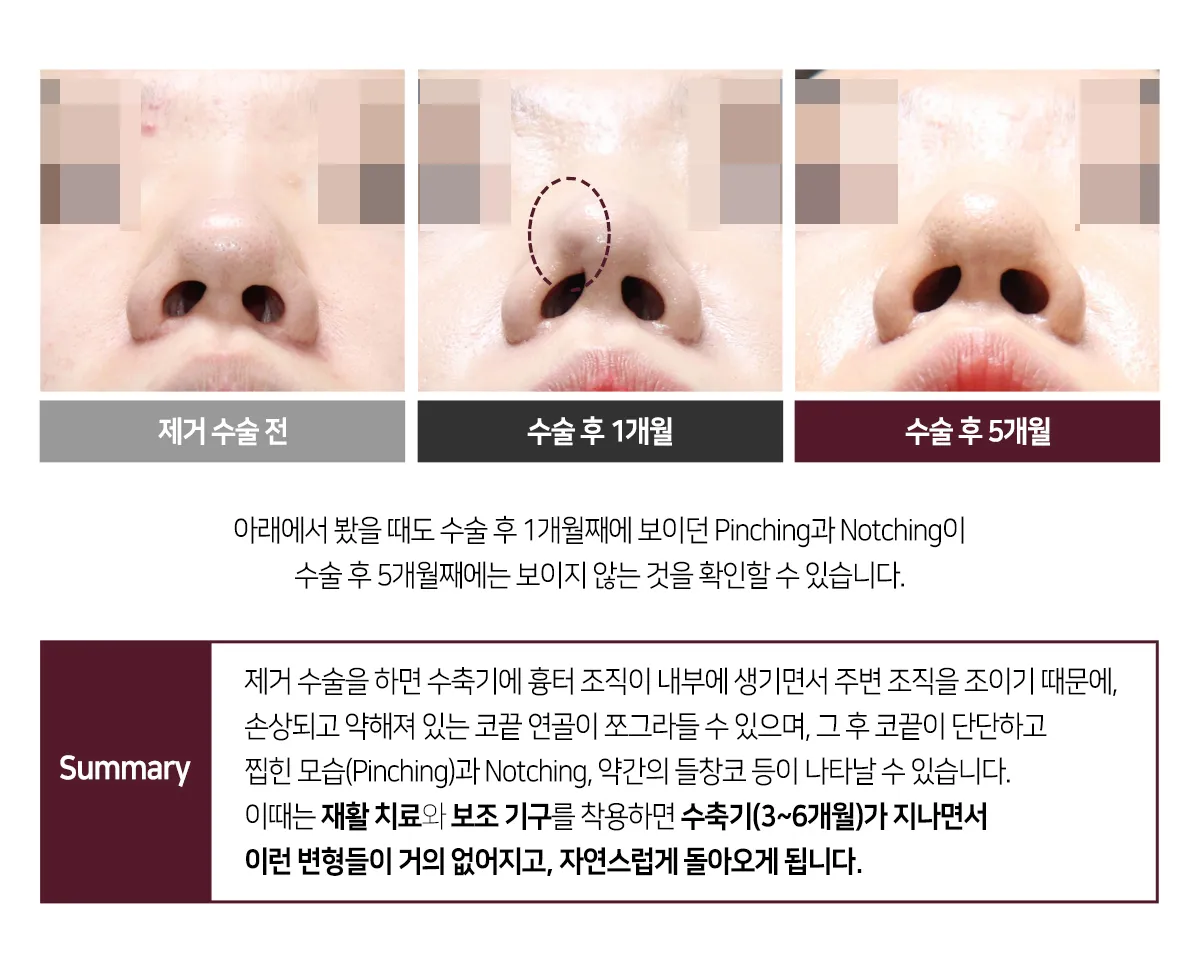
Viewed from below as well, the pinching and notching seen at 1 month after surgery
are no longer visible at 5 months after surgery.
Summary
After removal surgery, scar tissue forms inside during the contraction phase and tightens the surrounding tissue,
so the damaged, weakened tip cartilage may shrink, after which the tip may become firm and
show pinching, notching, and a slightly upturned nose.
In that case, with rehabilitation therapy and a supportive device, as the contraction phase (3-6 months) passes,
these deformities largely disappear and the nose returns to a natural state.
PH
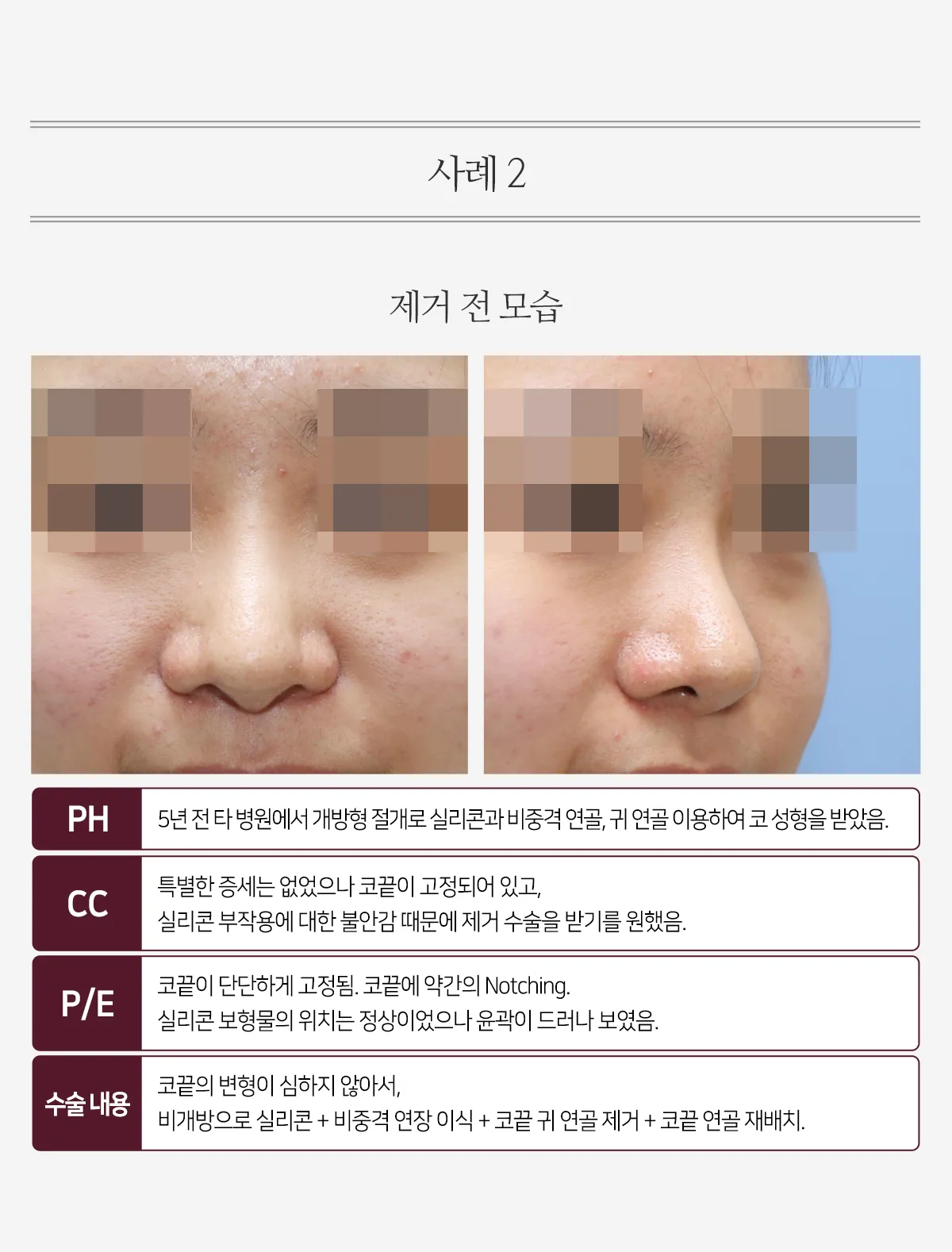
Underwent rhinoplasty with silicone, septal cartilage, and ear cartilage through an open approach at another clinic 5 years ago.
cc
There were no particular symptoms, but the tip was fixed in place, and
the patient wanted removal surgery because of anxiety about silicone side effects.
P/E
The tip was firmly fixed. Slight notching at the tip.
The silicone implant was in a normal position, but its outline was visible.
(Surgery Performed)
(Course and Results)
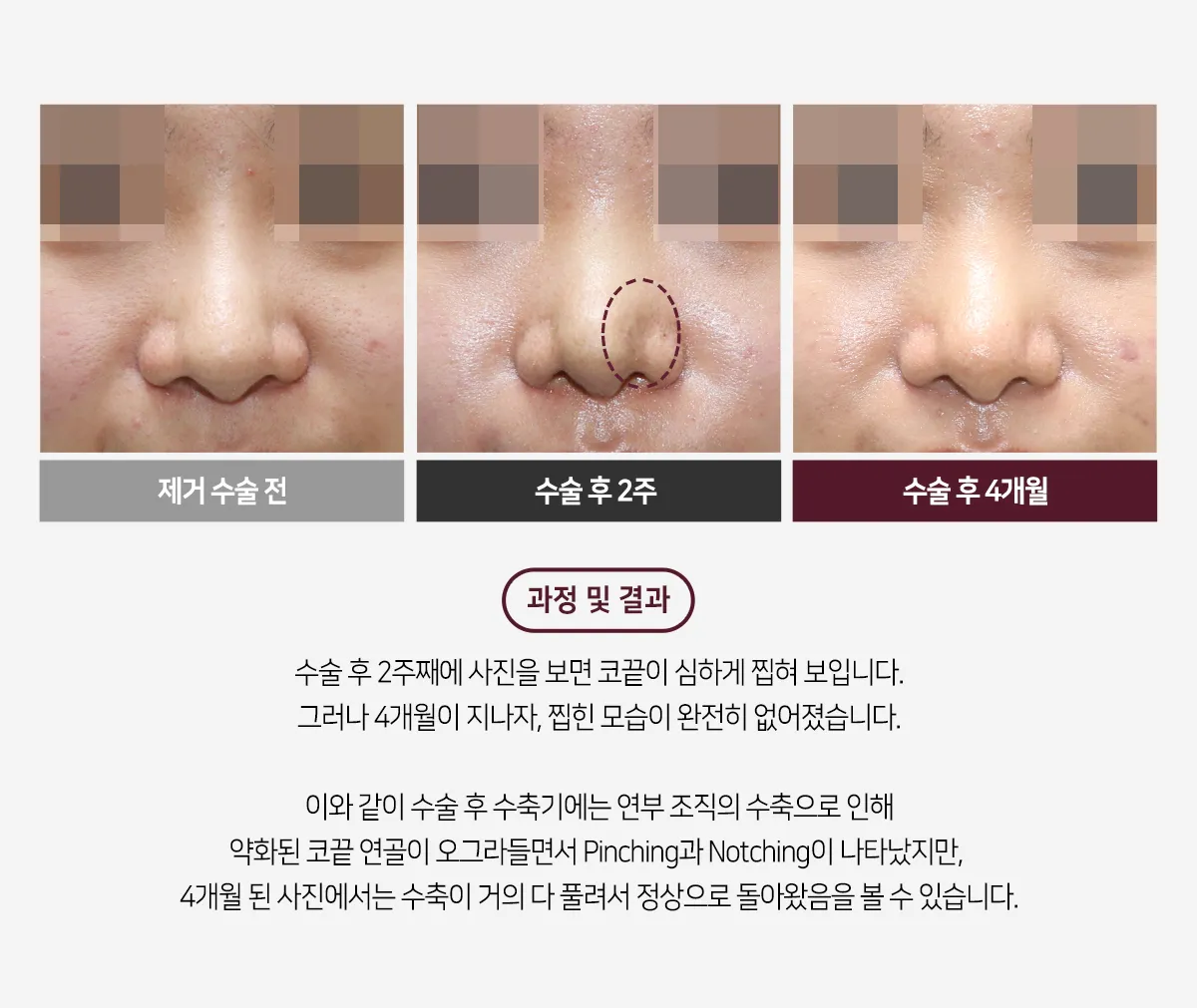
In the photo at 2 weeks after surgery, the tip looks severely pinched.
After 4 months, however, the pinched appearance had disappeared completely.
In this way, during the contraction phase after surgery, soft tissue contraction
caused the weakened tip cartilage to shrivel, producing pinching and notching,
but the photo at 4 months shows that the contraction has almost entirely released and the tip has returned to normal.
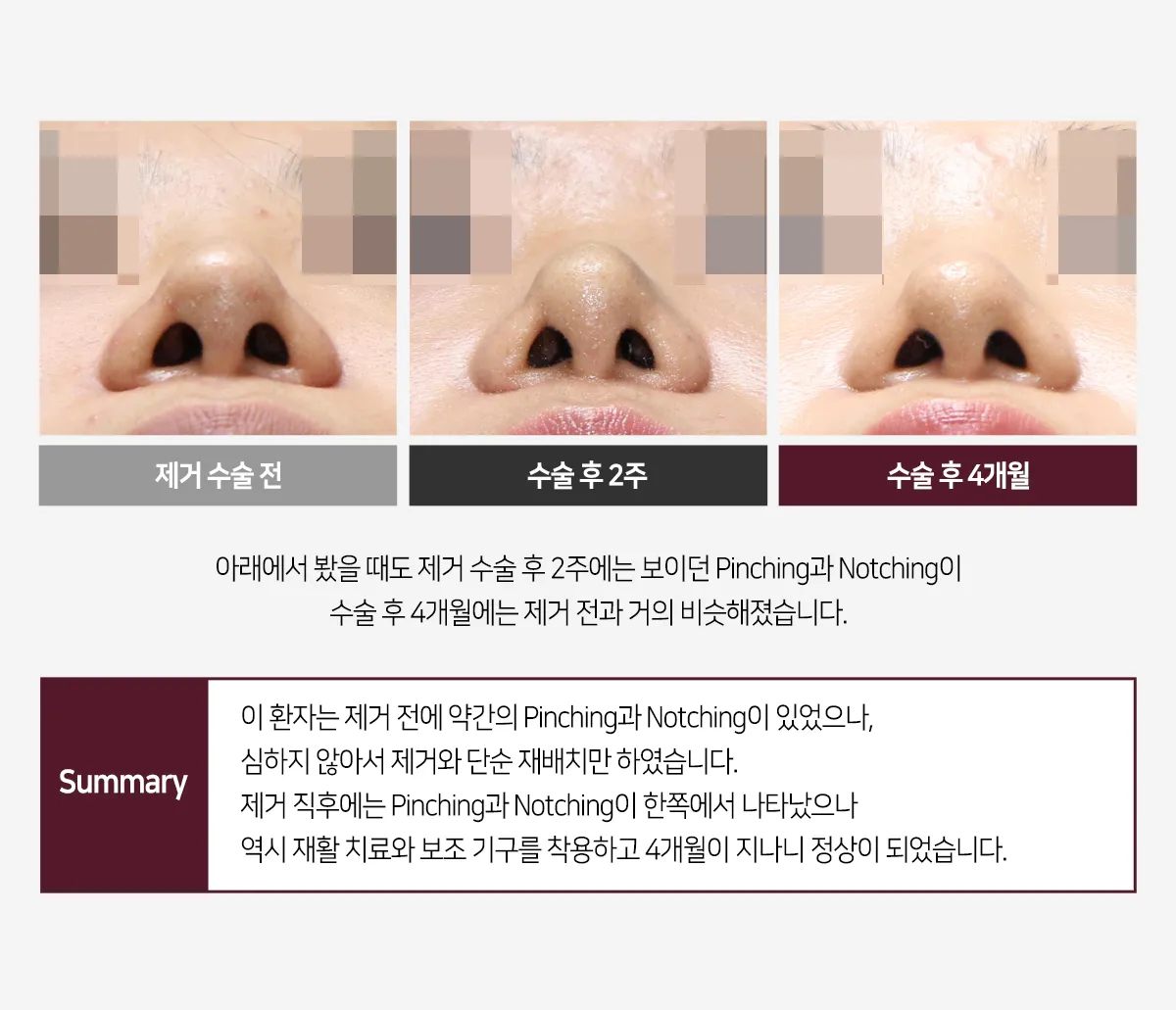
Viewed from below as well, the pinching and notching seen at 2 weeks after removal surgery
had, by 4 months after surgery, returned to nearly the pre-removal appearance.
Summary
This patient had slight pinching and notching before removal,
but because they were not severe, only removal and simple repositioning were performed.
Immediately after removal, pinching and notching appeared on one side,
but again, with rehabilitation therapy and a supportive device, the tip returned to normal after 4 months.
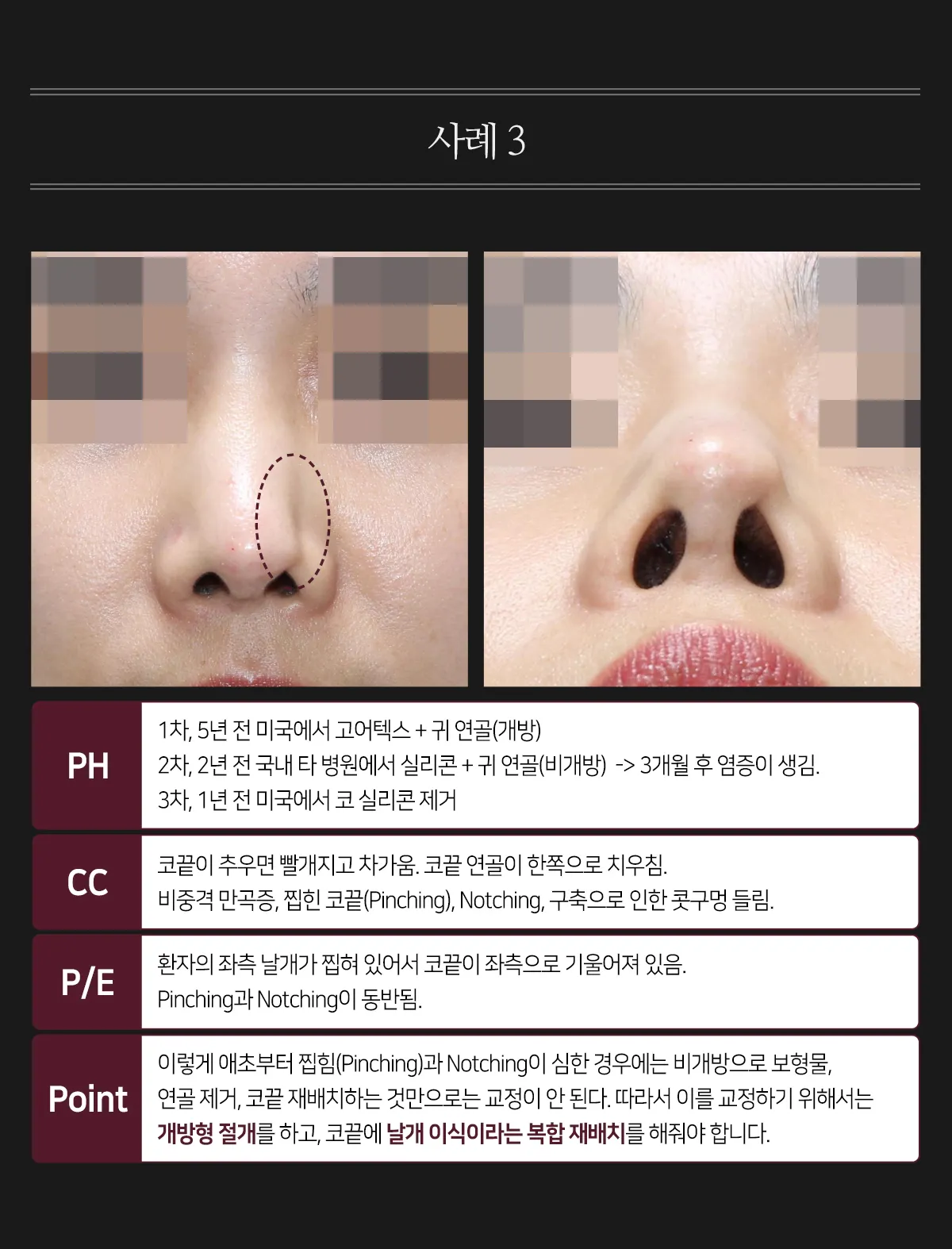
PH
1st surgery, 5 years ago in the United States: Gore-Tex + ear cartilage (open)
2nd surgery, 2 years ago at another clinic in Korea: silicone + ear cartilage (closed) -> inflammation developed 3 months later.
3rd surgery, 1 year ago in the United States: nasal silicone removed
cc
The tip turns red and feels cold in cold weather. The tip cartilage is displaced to one side.
Septal deviation, pinched tip, notching, and upward retraction of the nostrils due to contracture.
P/E

Although the patient was unaware of it, a septal extension graft had been placed using septal cartilage;
it was displaced to one side (the right) and the tip cartilage was loosely fixed,
narrowing the nostril, so the graft was removed.
The septal extension graft material was used to perform a lateral crural strut graft (LCSG) of the tip.
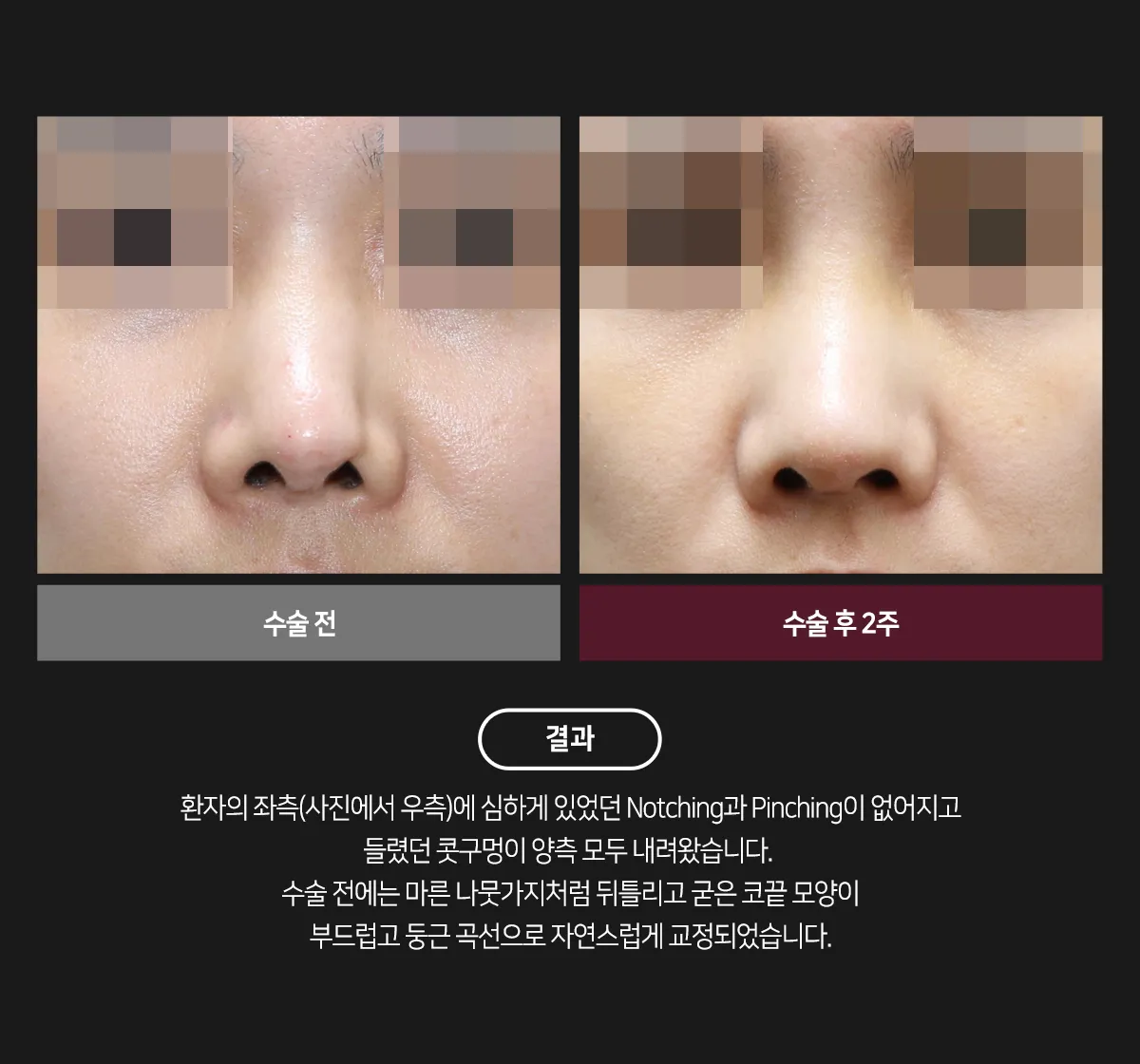
(Results)
The severe notching and pinching on the patient’s left (right in the photo) disappeared,
and the retracted nostrils came down on both sides.
The tip, which before surgery was twisted and stiff like a dry twig,
was corrected naturally into a soft, rounded curve.

The tilted columella and pinched appearance (pinching, notching) seen before surgery
were corrected after surgery: the columella stands straight, the tip has opened out, and the alae form a soft curve.
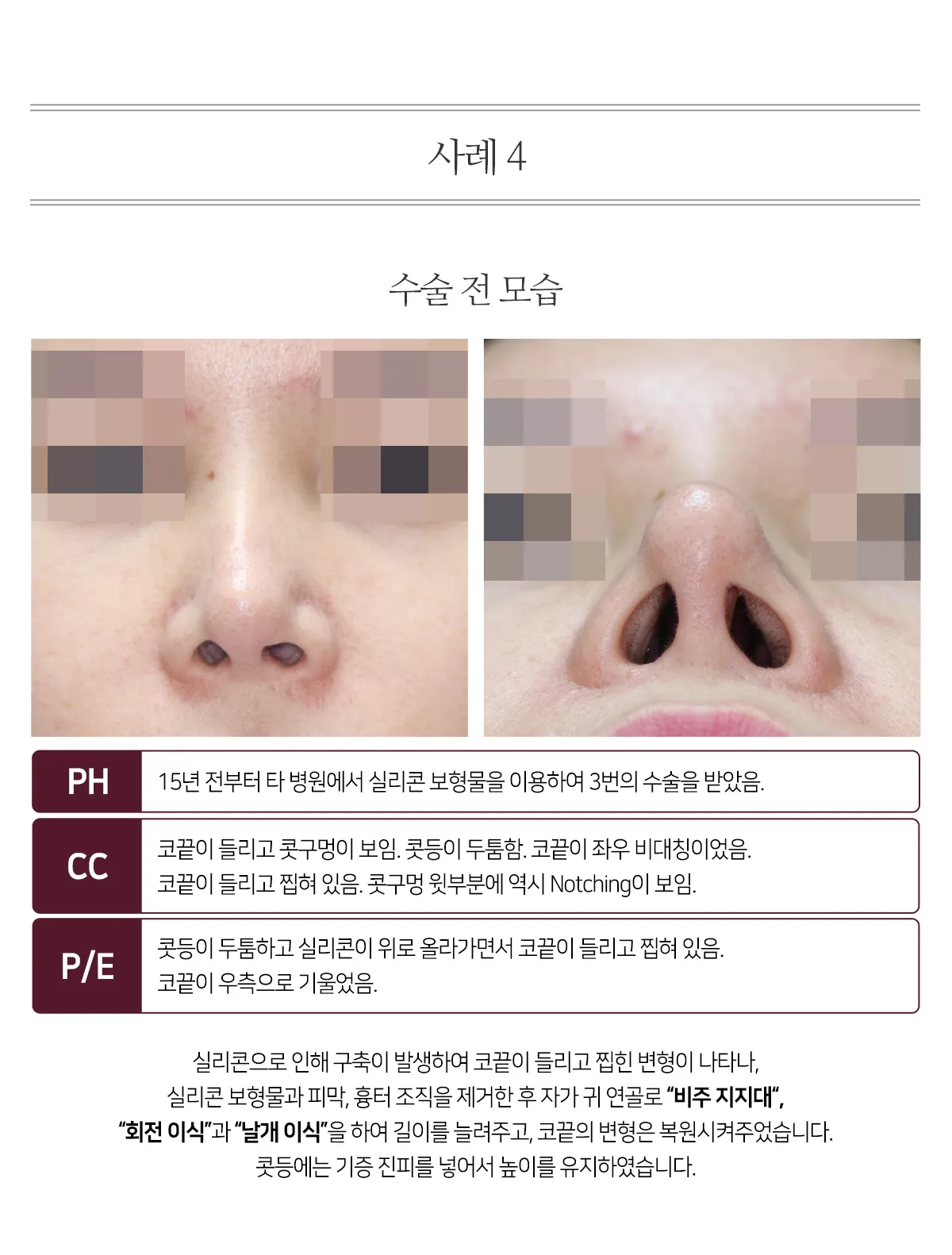
PH
Beginning 15 years ago, underwent 3 surgeries with silicone implants at another clinic.
cc
Upturned tip with nostril show. Thick dorsum. The tip was asymmetric.
The tip was upturned and pinched. Notching was also visible at the upper part of the nostril.
P/E
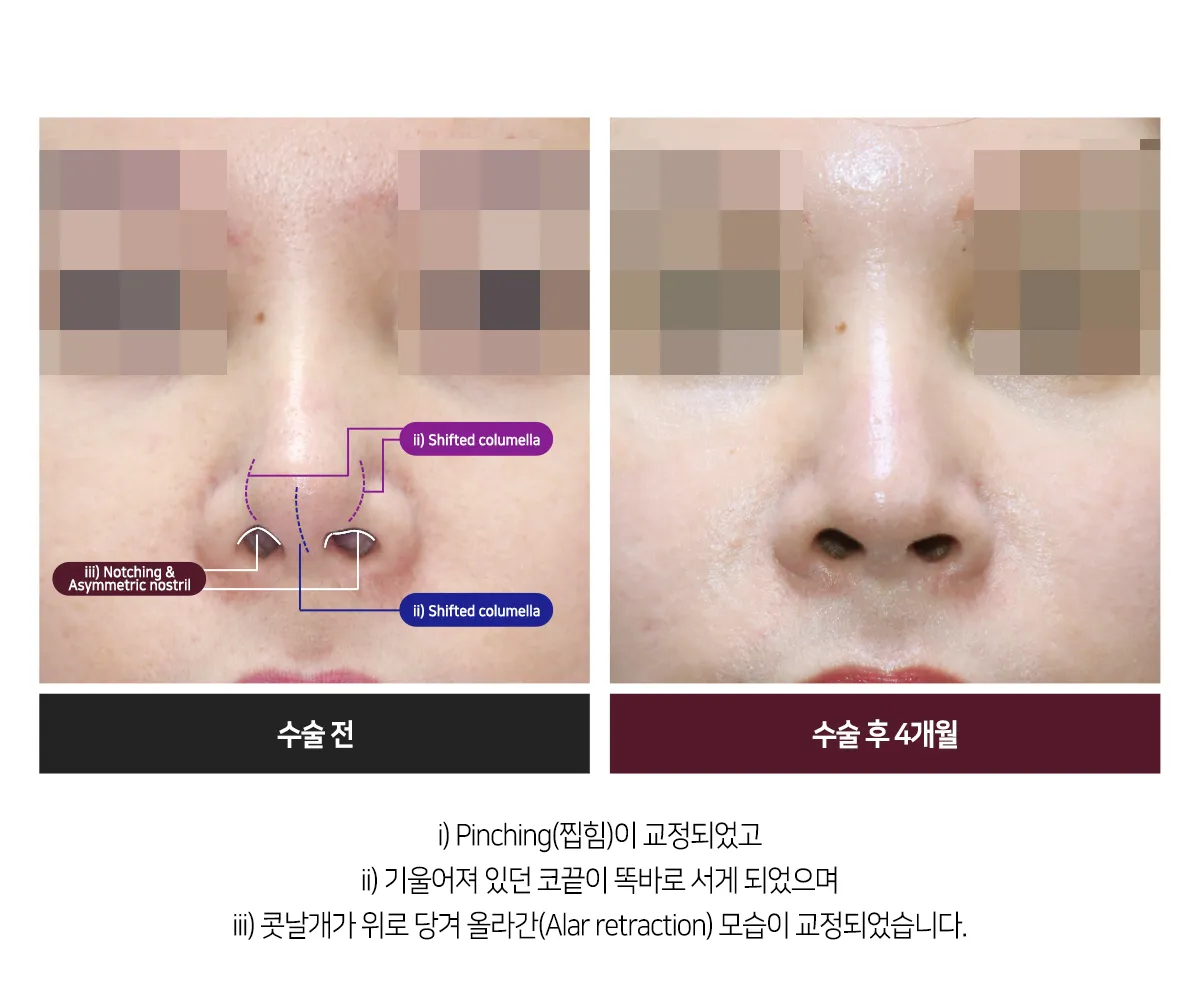
i) The pinching was corrected,
ii) the tilted tip now stands straight,
iii) and the upward-pulled alae (alar retraction) were corrected.

The tilted columella and tip became straight, the nostril notching disappeared,
and the tip, which had been as high as a Pinocchio nose, now looks natural.
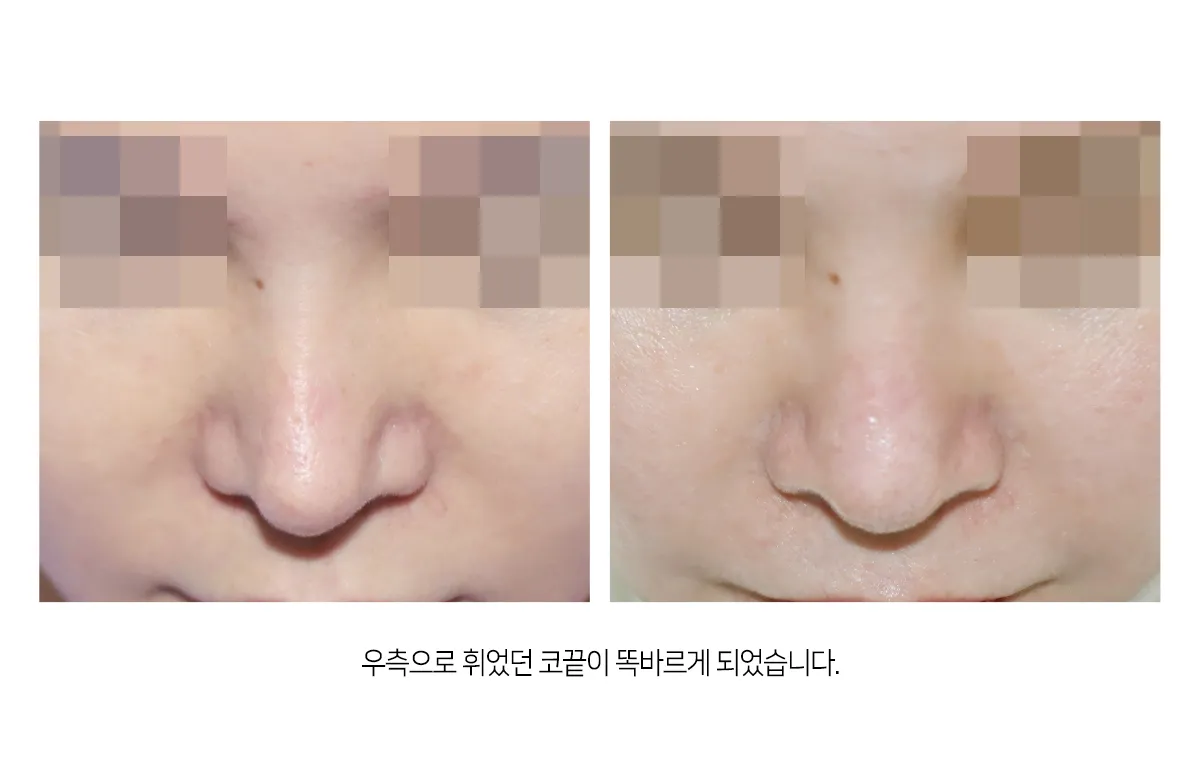
The tip, which had curved to the right, became straight.
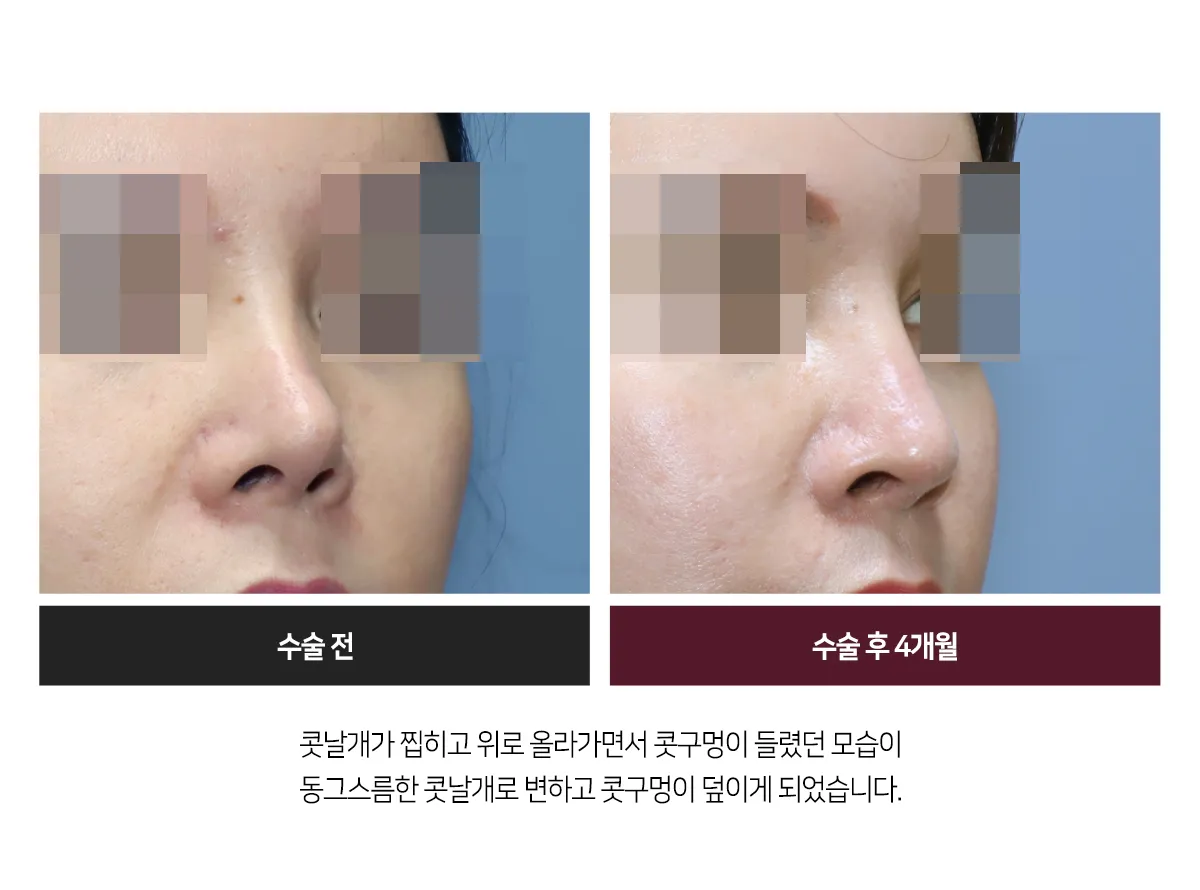
The alae, which had been pinched and pulled upward so that the nostrils were retracted,
have become gently rounded, and the nostrils are now covered.
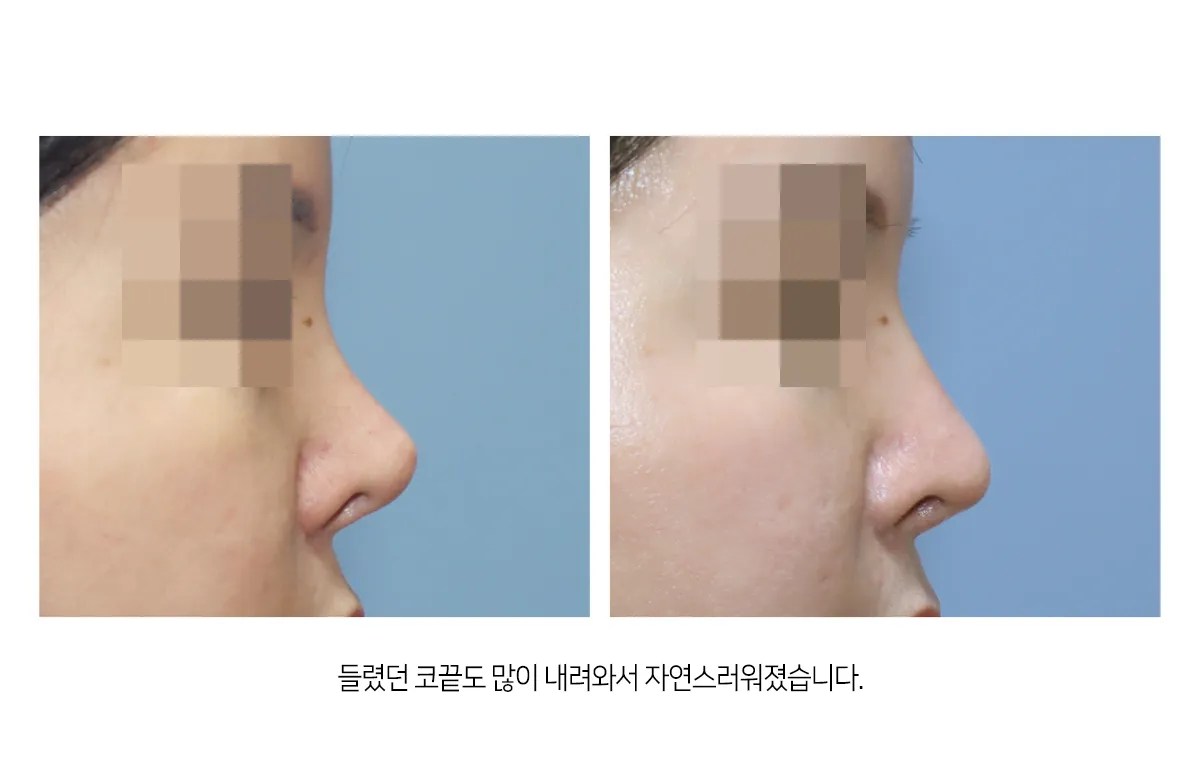
The upturned tip has also come down considerably and looks natural.