Contracted Nose Correction in Gangnam, Seoul | RESUM Plastic Surgery
Skip to main content

service / Nose

Contracted Nose

Contracted (Upturned) Nose Correction

CONTRACTED NOSE

We analyze a nose shortened and upturned by silicone-related contracture
and plan a contracted nose correction centered on autologous cartilage.

Method
1 hour
Anesthesia
Local anesthesia / IV sedation
Recovery
About 1 week · Same-day discharge · Suture removal after 5-7 days
Summary Contracted nose correction is a reconstructive procedure that uses autologous cartilage to restore the length and angle of a nose that has become short and upturned because of implant-related contracture. A staged approach is needed depending on the degree of contracture. It is performed at RESUM Plastic Surgery in Gangnam (Apgujeong), Seoul. Medical Review Medical Review: Won-Suk Kook,Jin-Young Kim
Last updated: 2026-06-30

Why Lisoom

Overview The key to correcting a contracted or upturned nose lies in accurately identifying the type and restoring length and alar shape with autologous cartilage.

Correction of a contracted or upturned nose is one of the more technically demanding rhinoplasty procedures.
The term "upturned nose" does not always refer to the same nasal shape, and the solutions differ as well.
Contracture is a phenomenon in which the capsule (membrane) that forms around the silicone gradually shrinks over time, pulling the surrounding tissue with it so that the nose as a whole contracts.
Not everyone who has augmentation rhinoplasty with a silicone implant develops contracture, but the likelihood of contracture gradually increases as time passes.

The key to correcting a contracted or upturned nose lies in accurately identifying the type and restoring length and alar shape with autologous cartilage.

Before & After

Contracted Nose Correction Before & After

Rhinoplasty Case Studies

DESIGN PRINCIPLE

Methods
Causes and Solutions

When the Nose Is Short and Upturned SUTURE guide image

caseWhen the Nose Is Short and Upturned

The nose may have become shorter because of contracture after rhinoplasty or because of injury from a burn, traffic accident, or the like, or it may be congenitally short. An upturned nose often results from contracture after augmentation rhinoplasty with a silicone implant. As for the surgical method, surgery is performed to lengthen the nose using autologous cartilage.

Shortened Nose Autologous Cartilage Lengthening Upturned Nose Correction
When the Ala Is Retracted and the Nostrils Show HYBRID guide image

caseWhen the Ala Is Retracted and the Nostrils Show

The cause may be an acquired deformity or congenital, with congenital cases being more common. To lower the ala and cover the nostril, there are various surgical methods, including Alar expansion graft (AEG), Alar crural strut graft (ACSG), Alar rim graft (ACG), and Composite graft (CG), and the technique is chosen according to how far the alar rim has retracted upward.

Nostril Show Correction Lowering the Ala Cartilage Graft Support

Column

Column
Doctor's Column

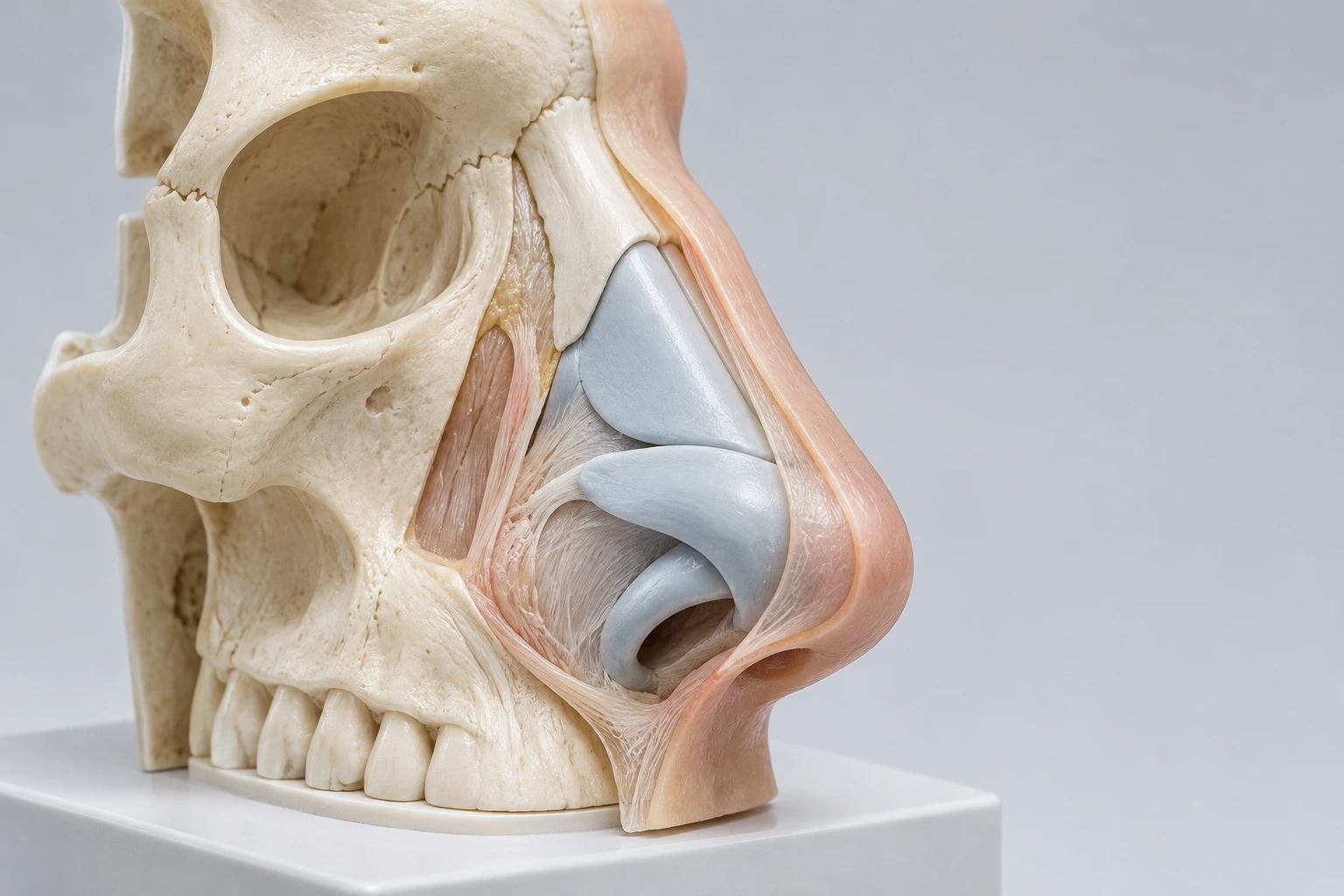
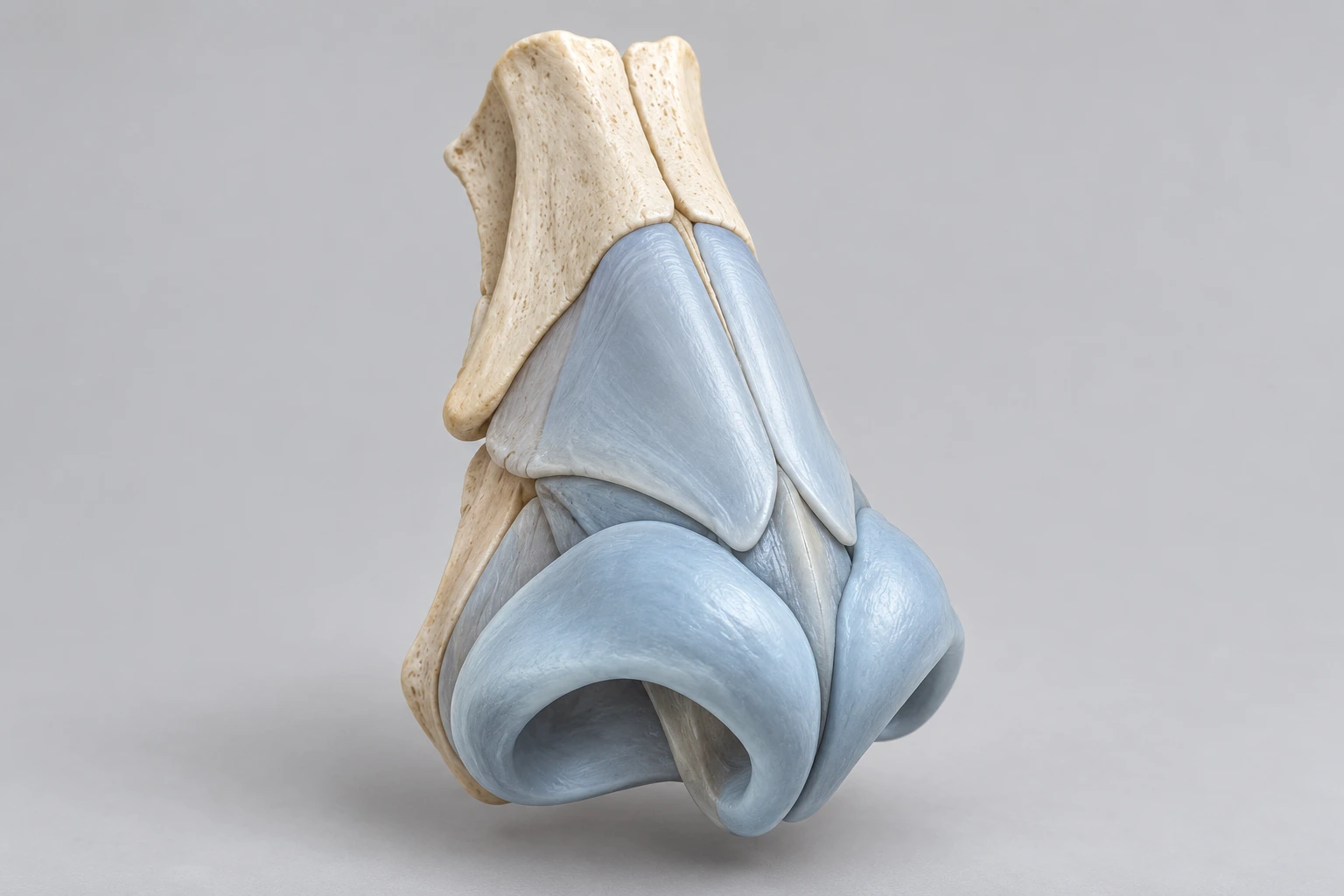
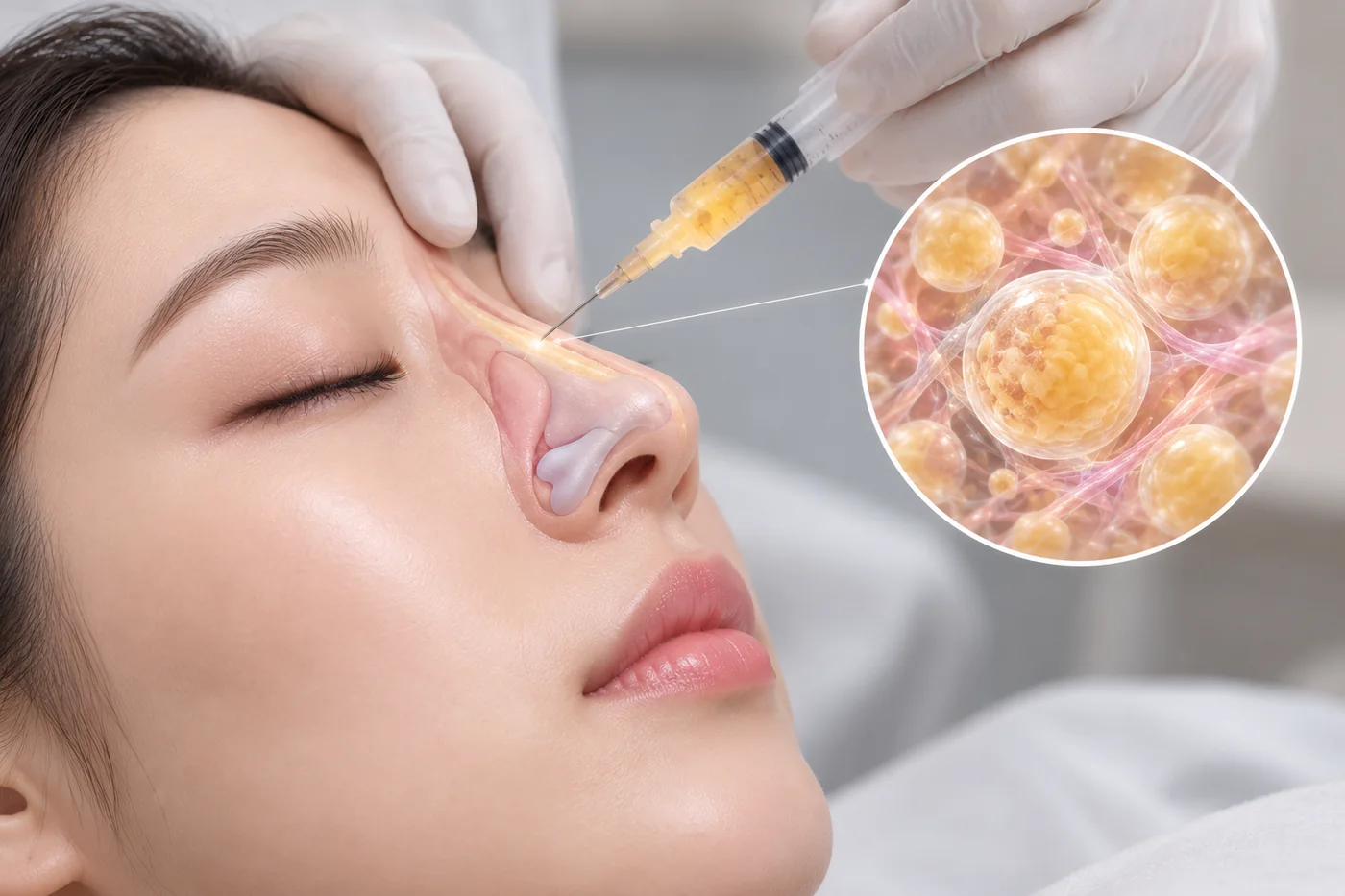
This is general medical information and does not replace an individual diagnosis or surgical plan. The tissue used, the extent of surgery, and the timing are decided after an examination, and there are possibilities of donor-site scarring, infection, asymmetry, contour irregularity, and revision surgery, as well as individual differences in recovery. The images are AI-generated illustrative artificial models and fictional people and do not represent actual human tissue, products, patients, or before-and-after surgical results. Sources checked: October 8, 2026.

Learn More
When Cartilage Contours Show After Rhinoplasty: The Role and Limits of Fascia Reinforcement

This is general medical information intended to help you understand spreader grafts and rhinoplasty. Whether to have surgery, the method, the extent, and the results depend on the structure of the nose, previous surgeries, and the condition of the skin and breathing, and this information does not replace an individual examination. Published papers and society guidance were consulted, and research findings do not guarantee an individual's surgical results. All images are AI-generated illustrative models and fictional people. Sources checked: September 30, 2026.

Learn More
Spreader Grafts in Dorsal Hump Surgery: Supporting with Cartilage After Lowering the Dorsum

This is general medical information and does not replace an individual diagnosis or surgical plan. Suitability for surgery, the extent of removal, whether reconstruction is needed, recovery, and results should be judged after an examination. The implant and capsule models and the people shown in this article are AI-generated illustrative images and do not represent actual products, tissue specimens, patients, or clinical results. Sources checked: September 21, 2026.

Learn More
Why the Capsule Is Also Examined in a Nasal Implant Removal Consultation

Sources checked: September 11, 2026. A [number] in the text refers to its order in the reference list.

Learn More
Correcting a Short, Upturned Nose: How to Choose Between Ear and Rib Cartilage?

This article explains why the skin and soft tissue are prepared first in revision surgery for a contracted nose. The reconstruction plan may vary depending on skin condition and blood flow.

Learn More
Why Does the Skin Need to Soften First in a Contracted Nose?

OUR PRINCIPLE

Core Values
Contracted Nose Correction: What Sets RESUM Plastic Surgery Apart

For the technically demanding contracted nose, precise correction by type is the key.

Point 01

Point 01

Precise Diagnosis by Type

We accurately identify the type: a shortened nose or a nose with a retracted ala.

Point 02

Point 02

Autologous Cartilage Lengthening

A shortened nose is restored by lengthening it with autologous cartilage.

Point 03

Point 03

Customized Alar Correction

We select the method of lowering the ala according to how far the alar rim has retracted upward.

Lisoom Channel

YouTube

View More Videos

NOTICE

Precautions
Post-Operative Treatment & Care

N · 01 Keep the surgical site clean, and take your prescribed medication after disinfecting the area as instructed.
N · 02 After surgery, take care not to bump or press on your nose, and avoid lifting heavy objects or straining.
N · 03 Apply cold or warm compresses as instructed, depending on how the swelling progresses.
N · 04 It is advisable to avoid alcohol, smoking, strenuous exercise, and saunas during the recovery period.
N · 05 Sutures are removed according to your progress, and your recovery is checked at scheduled follow-up visits.
N · 06 Swelling and recovery vary from person to person.
N · 07 Please ask during your visit when you may resume wearing glasses, blowing your nose, and similar activities, as this depends on your recovery.
N · 08 If you take aspirin, anticoagulants, or other medications that may increase bleeding, please let us know in advance during your visit.
N · 09 Please let us know in advance about any nasal conditions such as rhinitis or sinusitis, underlying medical conditions, or allergies.
N · 10 Avoiding alcohol, smoking, and strenuous exercise for a period after surgery helps recovery.
N · 11 Recovery varies from person to person, and it may take time for the results to settle.
N · 12 If you experience any abnormal symptoms (such as excessive swelling, bleeding, or pain), please visit the clinic immediately.
N · 13 Please be sure to consult a board-certified specialist before and after surgery.

PROCEDURE DATA

Summary
Surgery Overview

Procedure

Surgery Overview

Surgery time
About 1.5-2 hours
Anesthesia
Local anesthesia / IV sedation
Recovery
About 1 week
Hospital stay
Same-day discharge
Suture removal
After 5-7 days
Won-Suk Kook · M.D. - RESUM Plastic Surgery Clinic

Doctor's Note

The key to correcting a contracted or upturned nose lies in accurately identifying the type of upturned nose,
lengthening a shortened nose with autologous cartilage and lowering a retracted ala
with a suitable method to restore a natural-looking nose.

Won-Suk Kook · M.D.

Dr. Won-Suk Kook, Chief Director

PROCEDURE FLOW

Process
How Contracted Nose Correction Is Performed

01

PHASE I

Consultation & Diagnosis

We precisely diagnose the type of upturned nose and the degree of contracture.

CONSULT

02

PHASE II

Design

We plan the nasal length and alar shape to harmonize with the face.

DESIGN

03

PHASE III

Surgery

The nose is corrected by lengthening it with autologous cartilage or lowering the ala.

PROCEDURE

04

PHASE IV

Recovery & Care

Swelling and recovery are managed systematically according to your progress.

CARE

FREQUENTLY ASKED

FAQ
Frequently Asked Questions

We have compiled the questions patients ask most often before a consultation.

No. Even among upturned noses, the shape and cause differ, so the solution differs by type.
It is a phenomenon in which the capsule around the silicone shrinks and pulls on the surrounding tissue, causing the nose as a whole to contract.
Surgery is performed to lengthen the nose using autologous cartilage.
It is one of the more technically demanding rhinoplasty procedures, so it is important to have it done by an experienced surgeon.
The ala is lowered to cover the nostril, and the surgical technique is chosen according to how far it has retracted upward.
Surgery takes about 1 hour, recovery takes about 1 week, and same-day discharge is possible. There are individual differences.

RESUM Plastic Surgery Clinic Location

#601, 6F, 842 Nonhyeon-ro, Gangnam-gu, Seoul

6F #601, 599-4 Sinsa-dong, Gangnam-gu, Seoul

HOURS

Weekdays
10:00 ~ 20:00
Saturday
10:00 ~ 17:00
Lunch Break
1:00 PM - 2:00 PM

(No lunch break on weekends and public holidays) *Dr. Won-Suk Kook is not available on the 1st and 3rd Saturdays of each month.

Parking Information Parking is available in the building. 1 hour of free parking

Subway 5-minute walk from Exit 3 of Apgujeong Station on Line 3 (right next to the 14-story CGV building at Exit 3)

RESUM Plastic Surgery Clinic CEO Won-Suk Kook Business No. 733-11-02929 Phone 02-3445-7770