

What Is the Lateral Crural Strut Graft Published in PRS? Surgical Principles and Cases
Today I will explain my paper on the lateral crural strut graft of the nasal tip, published in May 2026 in the journal of the American Society of Plastic Surgeons. Looking at several cases, I will explain in detail when, how, and in which situations this surgery is applied.
Paper Overview
This section summarizes the nasal tip deformities that can develop after rhinoplasty in Asian patients and the role of the lateral crural strut graft in correcting them.
Paper Images

Cover of the Journal of the American Society of Plastic Surgeons
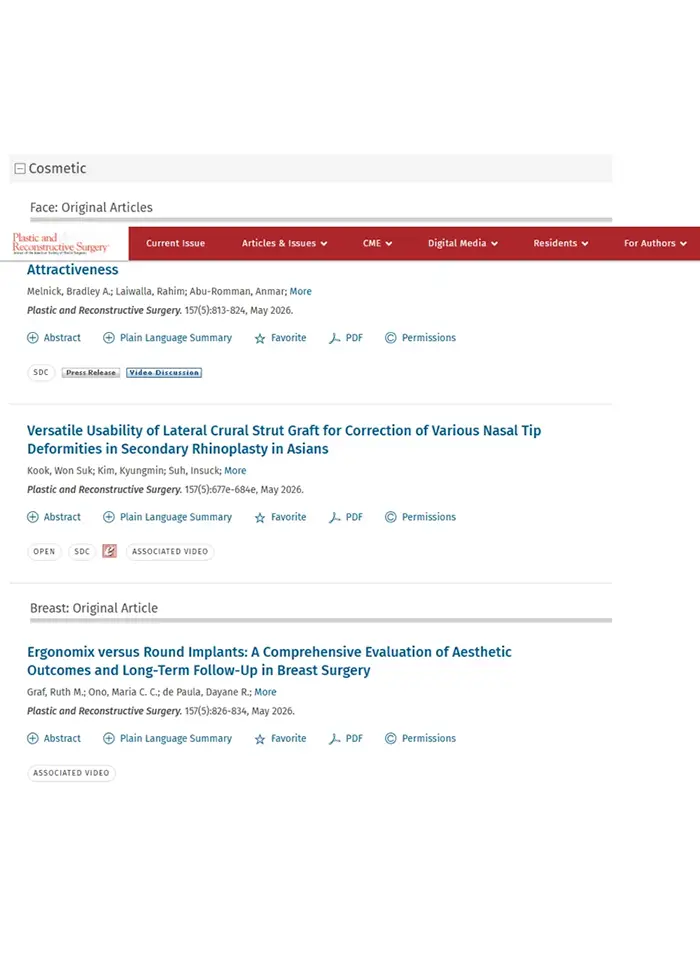
Online Publication Page

Paper Summary
Alar Cartilages of the Nasal Tip: Overview

Alar Cartilages of the Nasal Tip: Frontal View

Alar Cartilages of the Nasal Tip: Basal View
In most rhinoplasties in Asian patients, a silicone implant is placed on the dorsum and cartilage is grafted to the tip by various methods; the most common resulting side effects are silicone-related contracture and damage to the tip cartilages. Side effects from these two causes produce varied and extensive deformities of the tip, including pinching, twisting, asymmetry, external nasal valve collapse, and upturning, all of which are very difficult to correct. This paper reports the surgical method for correcting them and its results.
In short, it is a paper on revision rhinoplasty that corrects the varied and difficult tip deformities seen after nasal surgery in Asian patients, and I believe it will be helpful to those troubled by side effects of surgery.
Purpose and Surgical Principles of the Lateral Crural Strut Graft
This approach reinforces damaged or folded alar cartilages to improve tip pinching, upturning, nostril show, and asymmetry.
Purpose, surgical principles, and method of the lateral crural strut graft (LCSG): Rhinoplasty in Asian patients generally consists of raising the nasal bridge with silicone and shaping the tip with various cartilage grafts. After such typical rhinoplasty, damage to the tip cartilages and contracture often lead to various deformities of the tip cartilages, such as pinching, twisting, and upturning of the tip, nostril show (alar rim retraction), columellar retraction, a shifted columella, and nostril asymmetry.
The lateral crural strut graft is a surgery that straightens and reinforces the deformed tip cartilages and returns them to their normal position so that the nose regains a natural, normal appearance. In this method, autologous cartilage such as ear cartilage, septal cartilage, or costal cartilage is placed on the underside of the alar cartilages to reinforce them firmly, and the cartilages are then spread downward, improving the length of the nose, the shape of the alae, and the symmetry of the nostrils and alae. The photos below, taken from my paper, illustrate the surgical method.
Surgical Principles and Intraoperative Photos
These are the diagrams of the surgical principles published in the paper and actual intraoperative photos.

A. Principle of Pinching Correction

B. Principle of Notching Correction

C. Composite LCSG Grafting

Intraoperative Photos
Case 1. Tip Pinching and Alar Rim Retraction After Silicone-Related Contracture
At 1 year and a half after surgery, the tip pinching and nostril show (alar rim retraction) caused by silicone-related contracture can be seen to have improved following the lateral crural strut graft and derotation graft.
15 years ago: dorsum rasped down and augmentation rhinoplasty with silicone.
Bruising appeared frequently on the dorsum and lasted a long time. At some point, the patient noticed that the nose had become deformed by contracture.
The tip was pinched and upturned. The external nasal valve was narrowed. The external nasal valve was folded. The alae were curled upward.
The patient had consulted several clinics and reported that most had recommended surgery with costal cartilage.
At our clinic, however, considering the patient's history of 1 previous surgery, skin condition, and other factors, we judged that the length of the nose and the tip deformity could be corrected with ear cartilage. ** Removal of the silicone implant and capsule + columellar strut (ear cartilage) + derotation graft (ear cartilage) + bilateral lateral crural strut grafts (ear cartilage) + bridge augmentation with MegaDerm * When bruising occurs frequently after silicone augmentation rhinoplasty, it is because the capsule surrounding the silicone is injured by rubbing against the implant and bleeds slightly, and the blood collects inside the capsule, forming a hematoma.
Because the capsule has a weak capacity to absorb a hematoma, the bruising lasts a long time, and the capsule thickens as a result, leading to contracture. Removing the silicone and the capsule can therefore treat the contracture and also prevent recurrence.
Preoperative Assessment

Preoperative Frontal View

Preoperative Oblique View

Preoperative Lateral View
Intraoperative Correction Process

Dissection and Reconstruction of the Tip Cartilages

Lateral Crural Strut Graft and Derotation Graft
Frontal Comparison · 18 Months After Surgery

Before Surgery
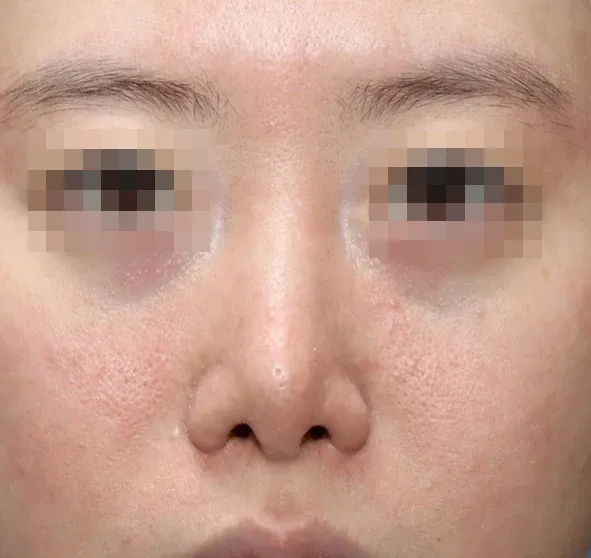
18 Months After Surgery
Basal View Comparison · 18 Months After Surgery

Before Surgery

18 Months After Surgery
Comparison From Below · 18 Months After Surgery

Before Surgery

18 Months After Surgery
Oblique View Comparison · 18 Months After Surgery

Before Surgery

18 Months After Surgery
Lateral View Comparison · 18 Months After Surgery

Before Surgery

18 Months After Surgery
Case 2. Tip Deformity With Twisting and Asymmetry
In this case, a septal extension graft and a lateral crural strut graft were used together to restore the symmetry of the tip and nostrils.
3 surgeries. (1st, 25 years ago: simple augmentation rhinoplasty with silicone. 2nd, 19 years ago: AlloDerm added to the tip. 3rd, 17 years ago: ear cartilage placed on the tip through an incision inside the nose.)
Twisted tip (the right ala is pulled up), asymmetry of the nostrils and alae, and an upturned tip.
The tip is red and discolored. Contracture has left the nose upturned and twisted, with asymmetry of the tip and nostrils and a columella retracted inward.
Removal of silicone, capsule, and scar tissue + septal extension graft + lateral crural strut graft (LCSG) with ear cartilage + augmentation rhinoplasty with MegaDerm
Preoperative Assessment

Preoperative View From Below

Preoperative Frontal View

Preoperative Basal View
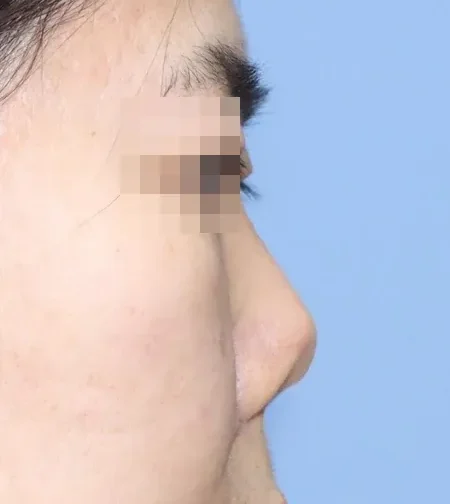
Preoperative Lateral View
Intraoperative Correction Process

A. Septal Extension Graft

B. Ear Cartilage Lateral Crural Strut Graft

C. Nostril Symmetry Immediately After Surgery
Frontal Comparison · 5 Months After Surgery

Before Surgery

5 Months After Surgery
Basal View Comparison · 5 Months After Surgery
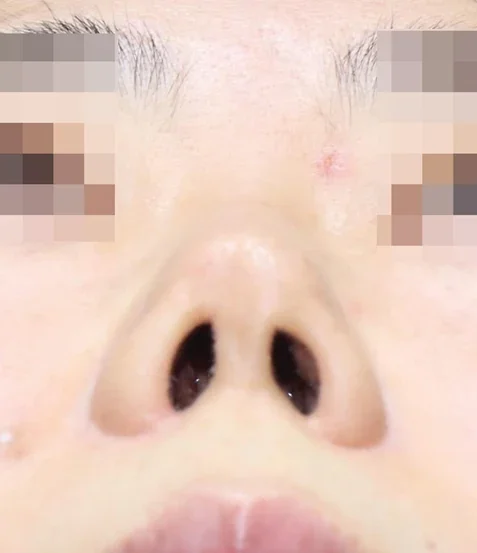
Before Surgery
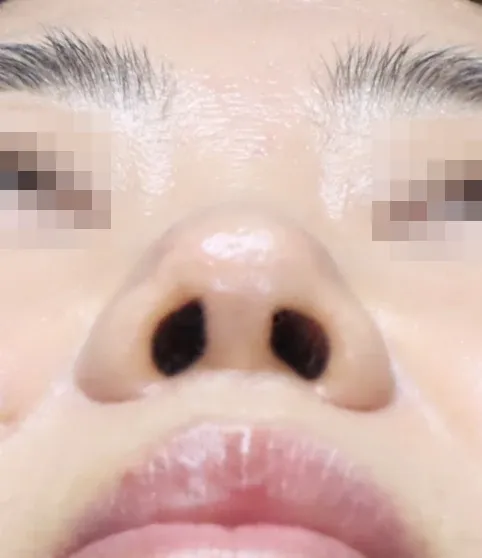
5 Months After Surgery
Comparison From Below · 5 Months After Surgery

Before Surgery
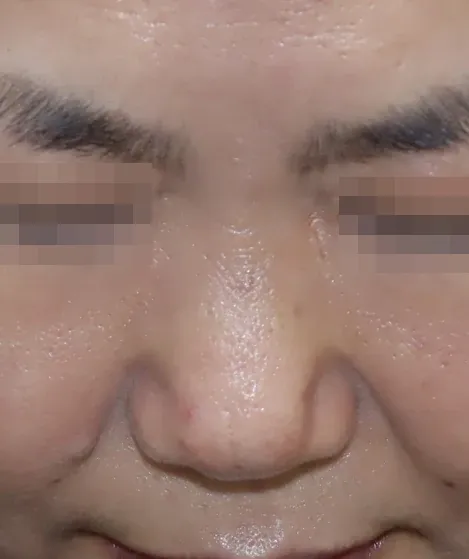
5 Months After Surgery
Lateral View Comparison · 5 Months After Surgery

Before Surgery

5 Months After Surgery
Case 3. Contracture and Upturning Worsened by Repeated Surgery After Trauma
In this case, costal cartilage-based reconstruction and a lateral crural strut graft were used to correct the upturned tip, notching, and pinching together.
Nasal bone fracture from trauma in 2012, followed by 4 rhinoplasty surgeries. 1st : 2012, silicone augmentation rhinoplasty + tip plasty with ear cartilage (open) => 4 months later, the silicone came out inside the nose => removed 2nd : 4 months later, silicone replaced => became crooked 3rd : 6 months later, silicone removed 4th : 2013, silicone inserted again
The nose is markedly upturned. It feels as if the nose is shrinking.
Severe contracture with a markedly upturned nose, alae pulled upward, nostril show, notching and pinching, and very stiff, thick soft tissue.
Preoperative Assessment

Preoperative Frontal View

Preoperative Oblique View

Preoperative Basal View

Preoperative Lateral View
Intraoperative Correction Process

A. Extended Spreader Graft
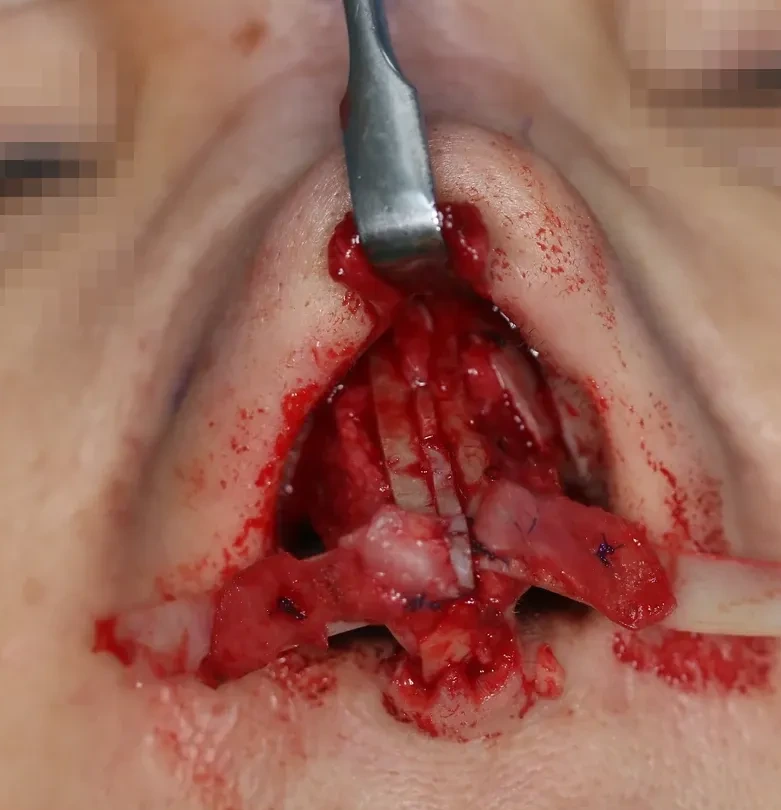
B. L-Strut Reconstruction

C. Lateral Crural Strut Graft
Frontal Comparison · 5 Months After Surgery

Before Surgery

5 Months After Surgery
Basal View Comparison · 5 Months After Surgery

Before Surgery

5 Months After Surgery
Oblique View Comparison · 5 Months After Surgery

Before Surgery
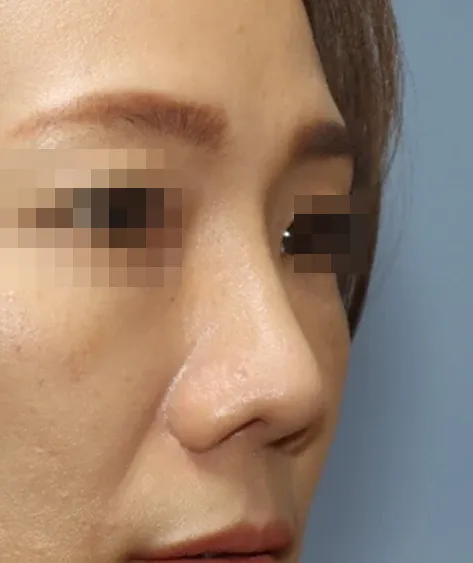
5 Months After Surgery
Lateral View Comparison · 5 Months After Surgery

Before Surgery

5 Months After Surgery
Case 4. External Nasal Valve Collapse and a Deep Alar Groove
In this case, a lateral crural strut graft was combined with an alar batten graft to resolve the narrowed tip and the external nasal valve problem.
Underwent 3 nasal surgeries at other clinics. 1st : 2011, silicone + SMR + tip plasty with septal cartilage + osteotomy (closed), ENT -> the glabella was high and the tip was pointed. 2nd : 2013, at another clinic, silicone + ear cartilage + septum left as it was (open) -> the silicone on the bridge was noticeable. 3rd : 2016, silicone only removed (closed)
The cartilage shows through at the tip. The tip is pinched, and breathing is uncomfortable.
Severe pinching has left the tip very narrow. The alar cartilages of the tip are folded and kinked, and the external nasal valve has collapsed. The alar groove is deeply indented.
Preoperative Assessment

A. Preoperative Frontal View

B. Kinked external nasal valve with the mucosa and cartilage displaced downward

C. Preoperative View From Below

D. Deeply indented alar groove
Lateral Crural Strut Graft and Alar Batten Graft

I
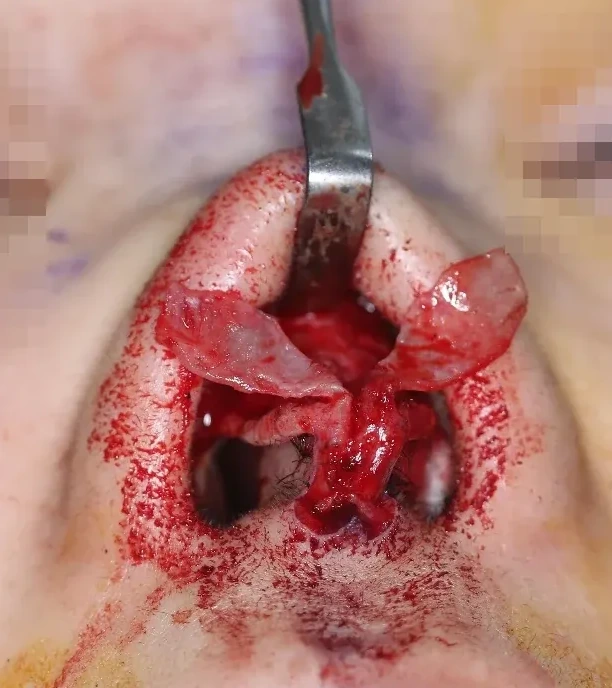
J

K. Alar batten graft

L. Lateral Crural Strut Graft (LCSG)
Detailed Intraoperative Photos

I

J

K. Alar batten graft

L
Frontal Comparison · 4 Months After Surgery

Before Surgery

4 Months After Surgery
Basal View Comparison · 4 Months After Surgery

Collapsed external valve

External nasal valve opened out
Comparison From Below · 4 Months After Surgery

Before Surgery

4 Months After Surgery
Lateral View Comparison · 4 Months After Surgery

Before Surgery

4 Months After Surgery
Case 5. Severe Pinching and Contracture Remaining After Four Surgeries
This case focused on correcting tip pinching, a tilted columella, and external nasal valve collapse.
Underwent a total of 4 surgeries at other clinics using silicone, septal cartilage, ear cartilage, and other materials. 1st - 6 years ago: silicone, septal cartilage (open) -> silicone mobile, dissatisfied with the shape 2nd - 5 years ago: silicone, donor costal cartilage, septal cartilage reused, AlloDerm at the tip (open) -> too high, nasal obstruction, pinching 3rd - 3 years ago: septoplasty, turbinectomy, nasal valve reconstruction, removal of the SEG and CS (open) -> columellar depression 4th - 1 year ago: columellar strut with ear cartilage (closed)
The tip is severely pinched and distorted. The columella is tilted, and breathing through the nose is difficult.
Severe pinching, twisted tip, external nasal valve collapse, upturned nose, and contracture.
Preoperative Assessment

Preoperative Frontal View

Preoperative Basal View
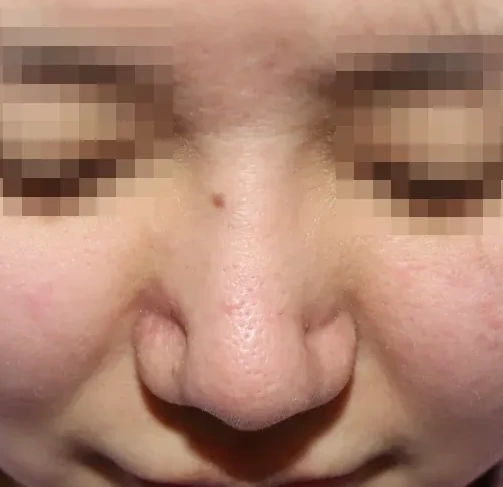
Preoperative View From Below

Preoperative Oblique View
Intraoperative Correction Process

A. Damage to the Columellar and Lateral Tip Cartilages

B. Remaining Septal Cartilage

C. L-Strut Reconstruction With Costal Cartilage
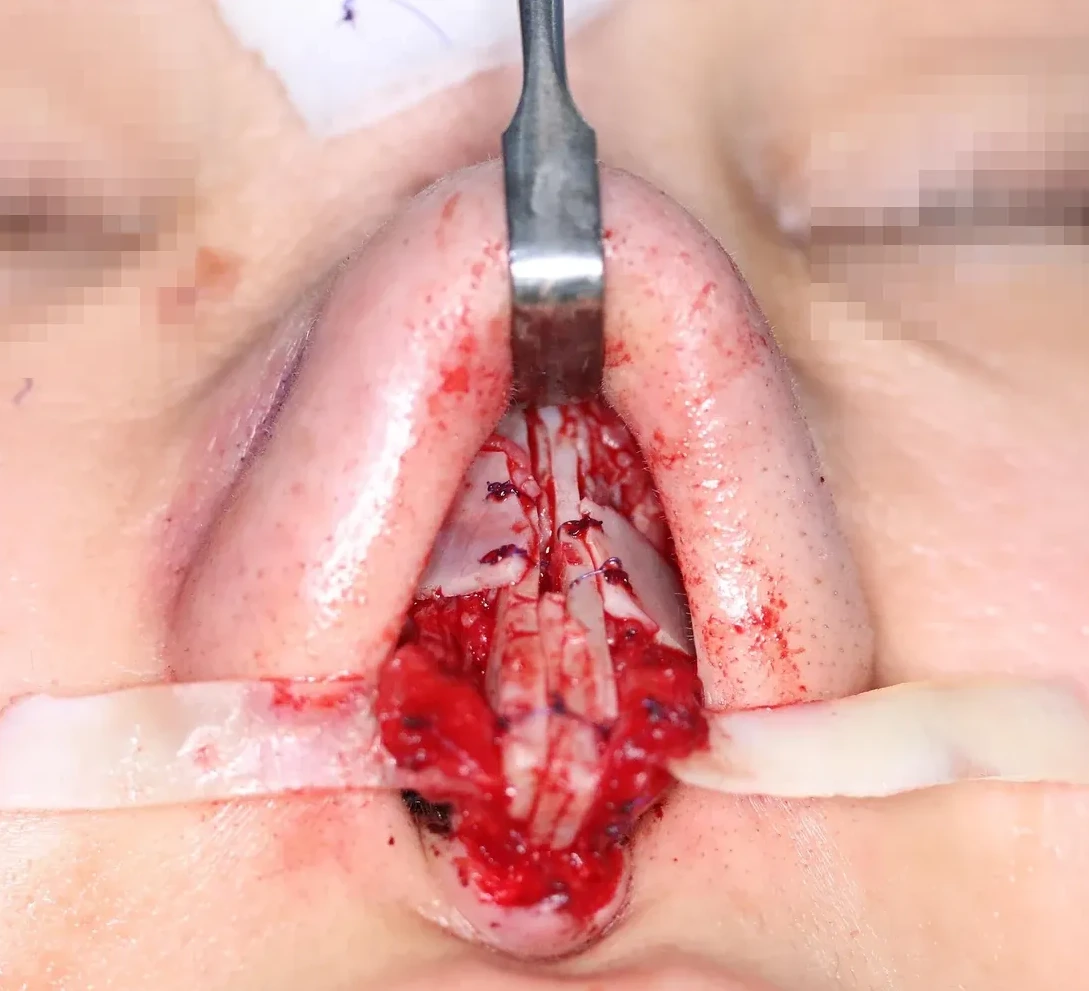
D. Lateral Crural Strut Graft and Upper Lateral Cartilage Reconstruction
Frontal Comparison · 2 Months After Surgery

Before Surgery

2 Months After Surgery
Basal View Comparison · 2 Months After Surgery

Before Surgery · Notching

2 Months After Surgery
Comparison From Below · 2 Months After Surgery

Before Surgery
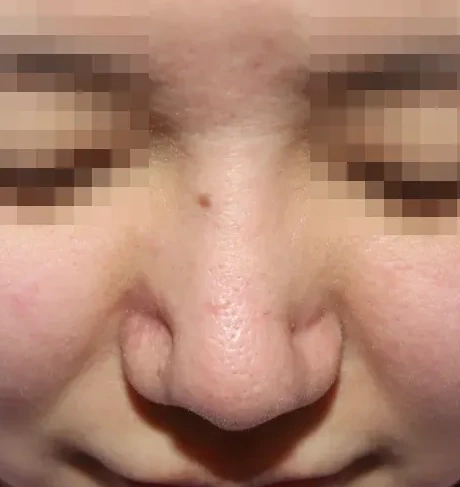
2 Months After Surgery
Oblique View Comparison · 2 Months After Surgery

Before Surgery

2 Months After Surgery
Lateral View Comparison · 2 Months After Surgery

Before Surgery

2 Months After Surgery
This content is an explanation based on academic materials and clinical cases, and the method of application and the results may vary depending on each person's nasal structure and tissue condition. A suitable surgical approach is recommended after diagnosis.