Revision Double Eyelid Surgery in Gangnam, Seoul | RESUM Plastic Surgery
Skip to main content

service / Eye

Double Eyelid Revision

Revision Double Eyelid Surgery

DOUBLE EYELID REVISION

We analyze why the first surgery failed
and plan revision double eyelid surgery that accounts for crease loss, scarring, and asymmetry.

Method
1½-2 hours
Anesthesia
Local anesthesia / IV sedation
Recovery
About 1 week · Same-day discharge · Suture removal after 5-7 days
Summary Revision double eyelid surgery analyzes the causes of adhesion, crease loss, and asymmetry from the previous surgery and redesigns the crease; its difficulty depends on the condition of the scars and adhesions. At RESUM Plastic Surgery in Gangnam (Apgujeong), Seoul, it is tailored to each cause. Medical Review Medical Review: Won-Suk Kook,Jin-Young Kim
Last updated: 2026-07-03

Why Lisoom

Overview Reading the Cause of the First Surgery Accurately,
Redesigning to Fit the Situation

In revision double eyelid surgery, what matters most is properly identifying the causes of the various side effects that appeared after double eyelid surgery, along with the anatomical condition. The most common problems include a crease that is too wide, a crease that is too deep and heavy, a sausage-like crease with fullness beneath it, and scars that are highly visible when the eyes are closed.

The key to revision double eyelid surgery lies in accurately identifying the cause of the first surgery's failure and the anatomical condition, then planning a crease 1:1 to suit the situation.

Before & After

Revision Double Eyelid Surgery Before & After

Subcategory
Time Since Procedure

Complications such as bleeding, infection and inflammation may occur depending on the individual, so caution is needed.
Results may vary by individual. Please confirm the method and expected results that suit you through a consultation.

Column

Column
Doctor's Column

This article is general medical information. Whether surgery is needed and which method is appropriate for each person are determined after an in-person examination.

Learn More
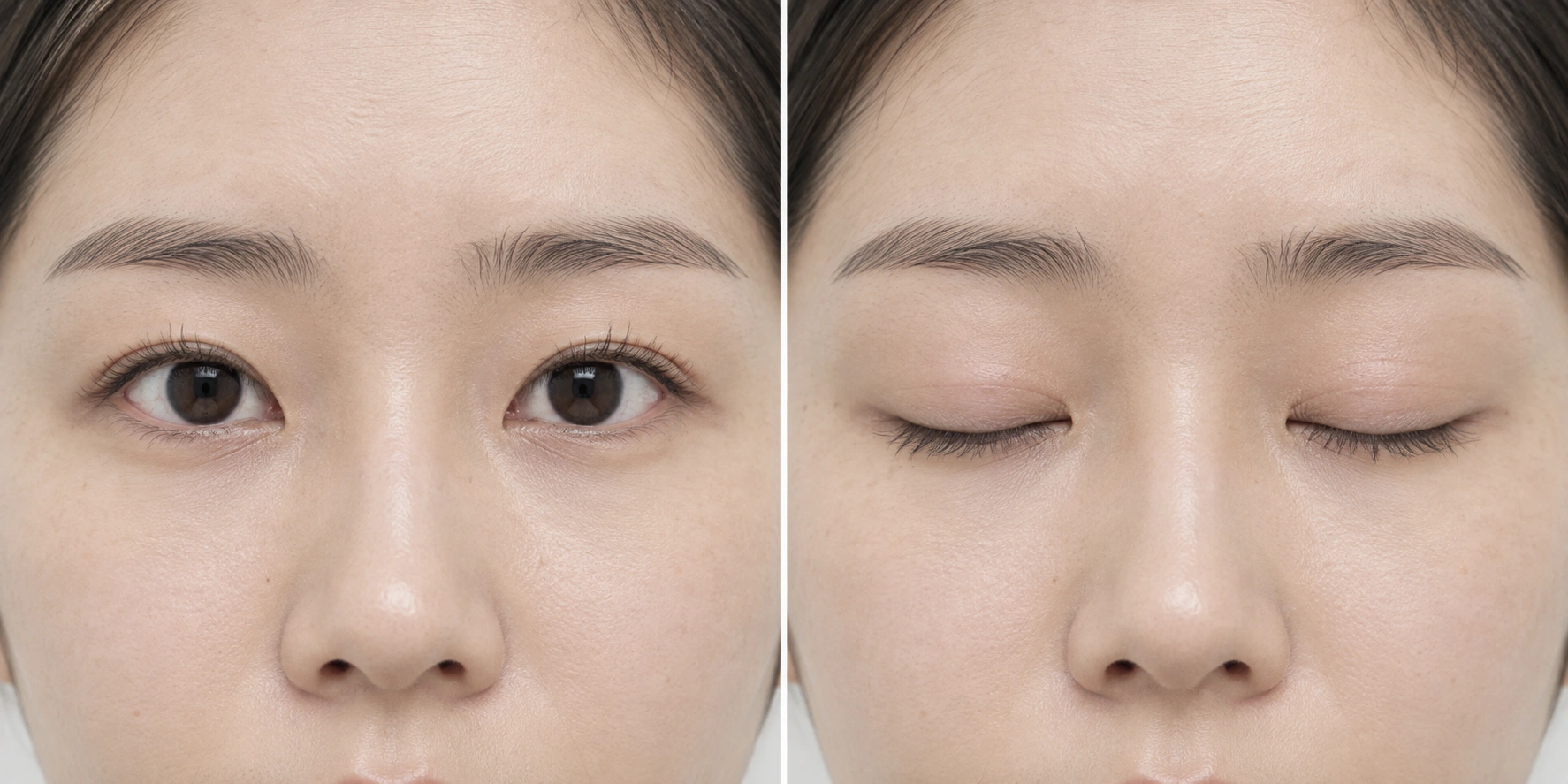

Double Eyelid Scars Visible When the Eyes Are Closed: Before Excising Again

OUR PRINCIPLE

Core Values
Revision Double Eyelid Surgery: What Sets RESUM Plastic Surgery Apart

Analyzing the cause of failure and 1:1 customization are the key.

Point 01

Point 01

Meticulous Technique

Backed by extensive clinical experience, we continue our ongoing research and apply meticulous technical skill.

Point 02

Point 02

Cause-of-Failure Analysis

We accurately analyze what caused the first surgery to fail, address the problems, and create a beautiful crease.

Point 03

Point 03

Extensive Clinical Experience

Drawing on long-accumulated know-how and our specialists' extensive experience, we aim for highly satisfying results.

POINT 03 Reasons

Why Revision Double Eyelid Surgery Is Demanding

Among revision surgeries, the most common is double eyelid surgery. It is, of course, also the most frequently performed surgery, but part of the reason is that double eyelid surgery is sometimes taken too lightly when it is performed.

A Common Yet Demanding Surgery

A Common Yet Demanding Surgery

In fact, most experienced plastic surgeons say that double eyelid surgery is one of the most demanding procedures. Creating a natural, attractive double eyelid for each individual is not that easy.

Revision Is Even Harder

Revision Is Even Harder

Revision double eyelid surgery is far more difficult than a first-time surgery, so it is possible only with extensive experience and highly advanced surgical know-how.

1:1 Customized Revision

1:1 Customized Revision

At RESUM Plastic Surgery, we do not perform revisions with a single fixed method; instead, we perform 1:1 customized surgery with advanced technique and know-how so that the most natural crease can be created for each situation.

POINT 04 Timing

Timing of Revision Eyelid Surgery

Revision surgery is considered when the result of the 1st surgery is unsatisfactory because of the shape of the double eyelid or inflammation. Having revision surgery after about 3-6 months, once the swelling has fully subsided, is a way to help prevent a 2nd or 3rd revision. It takes roughly 6 months for the surgical site to heal completely and for the redness to fade. Early surgery is possible in some cases, but the most important point is that revision surgery should be performed after the eye tissue has stabilized. We recommend having surgery only after a thorough consultation with a board-certified plastic surgeon to accurately identify the cause of the failure.

After 3-6 Months

About 3-6 months after the first surgery

After Swelling Subsides

After the swelling of the double eyelid has fully subsided

After the Scar Settles

When the scar is no longer firm but soft, and the redness has faded

POINT 05 Side Effects

Common Complications and Revision Methods

When the Double Eyelid Is Set Too High

When the double eyelid is too large, opening the eyes can feel uncomfortable, and the eyes may look only partly open, as with ptosis. In most cases skin was excised during the first surgery, so there is little spare skin. In the surgery, a new incision is made below the current crease; through it the tissue is dissected to release the high crease and fix it at a lower position, and then fat or orbital septum is laid in place to prevent re-adhesion.

“Sausage” Double Eyelid

The so-called sausage double eyelid occurs when scar tissue pulls the crease in deeply and the continuity of the orbicularis oculi muscle is lost. It can be resolved by restoring the continuity of the orbicularis oculi muscle and allowing the levator muscle and the skin tissue to adhere naturally.

Asymmetric Double Eyelids

In general, the size and shape of the two eyes differ in more than 80% of people. If the size of the double eyelids differs markedly between the two sides, correction is needed, and revision surgery is generally best performed after 6 months. The crease on the side that is too high is released and fixed lower, and fat or a thin membrane is laid under the skin at the released site to prevent re-adhesion.

When Surgical Scars Are Too Noticeable

The surgical scar is removed, and at this point it is essential to check carefully whether there is spare skin. Excising part of the scarred skin while releasing the adhered areas makes the scar far less visible than before.

When the Crease Forms 2-3 Folds

This happens when the surgical crease has come undone or when too much tissue around the crease was excised. If it has come undone, a single clear crease can be created with either the non-incisional or the incisional method. If the excision and adhesion are severe, the adhered tissues are released, a crease is created at an appropriate position, and fat or orbital septum is laid in place to prevent adhesion from recurring.

When a Prominent Epicanthal Fold Makes the Eyes Look Far Apart

When the epicanthal fold appears more prominent and the eyes look even farther apart: the cause is that the surgery created a hidden (inner) double eyelid while leaving the epicanthal fold as it was. The epicanthal fold is removed with Magic Epicanthoplasty, and the double eyelid is then corrected again to match.

When the Eyes Look Only Partly Open

The cause is either a double eyelid that is too large or pre-existing ptosis. The cause must be identified, and then either the size of the double eyelid is adjusted or the ptosis is corrected.

When the Eyes Do Not Close Fully

The cause is that too much skin was removed, or that the crease was anchored too high when it was attached to the levator muscle. After the adhesions are released first, it must be checked carefully whether there is spare skin, and a cautious decision made on whether a skin graft is needed.

When the Crease Is Wide Inside and Narrow Outside

When the crease is wide toward the inner eye and narrow toward the outer eye, making the eyes look small and closed-in: an incision is made below the original incision site to release the adhered area above, the levator muscle is returned as closely as possible to its original state, and the orbital septum and fat above are then used to lower the crease on the inner side and widen it on the outer side, re-creating a natural double eyelid.

Lisoom Channel

YouTube

View More Videos

NOTICE

Precautions
Post-Operative Treatment & Care

N · 01 It is important to keep the surgical site clean. Do not rub it with unclean hands; disinfect it about once a day and then apply antibiotic ointment. It is best not to wear makeup for 1 week after surgery.
N · 02 After surgery, it is best to avoid lowering your head or lying face down as much as possible, and to avoid lifting heavy objects or straining. Keep your head elevated on a higher pillow when sleeping.
N · 03 Apply cold compresses with the cool pack provided by the clinic, for 2 hours a day for 3 days.
N · 04 Reading or watching TV is best resumed after 1-2 days, and antibiotics, anti-inflammatory medication, and pain relievers are taken for about 3-5 days.
N · 05 With the incisional method, sutures are removed after 3-5 days. With the non-incisional (buried suture) method, no sutures are removed, and you can wash your face and wear makeup from the 3rd day after surgery.
N · 06 You can wear makeup and wash your face once the sutures have been removed. Until then, cleanse your face with a damp towel.
N · 07 Swelling after surgery varies from person to person. In most cases about 60% of the swelling subsides within about 7 days, but it takes 1-3 months for the results to settle completely. Contact lenses are best worn from 2 weeks after surgery, and exercise and alcohol are best resumed after at least 3 weeks.
N · 08 From 2 weeks before surgery, stop smoking and stop taking aspirin, vitamin E, oral contraceptives, and similar medications, and check that your surgery date does not coincide with the start of your menstrual period.
N · 09 It is helpful to bring glasses, a scarf, a hat, or similar items to wear on your way home on the day of surgery.
N · 10 Please let us know in advance about any underlying conditions such as high blood pressure, diabetes, or thyroid disease, as well as any allergies.
N · 11 Recovery varies from person to person, and it may take time for the results to settle.
N · 12 If you experience any abnormal symptoms (such as excessive swelling, bleeding, or pain), please visit the clinic immediately.
N · 13 Please be sure to consult a board-certified specialist before and after surgery.

PROCEDURE DATA

Summary
Surgery Overview

Procedure

Surgery Overview

Surgery time
1-2 hours
Anesthesia
Local anesthesia / IV sedation
Recovery
About 1 week
Hospital stay
Same-day discharge
Suture removal
After 5-7 days

Recommended For

Candidates

Consider a Consultation If

03 Recommended Cases

01 When the crease has faded or come completely undone after surgery
02 When the crease height or shape differs noticeably between the two eyes
03 When the crease gradually becomes shallower and loosens, or unwanted fine folds (multiple creases) have formed
Won-Suk Kook · M.D. - RESUM Plastic Surgery Clinic

Doctor's Note

The key to revision double eyelid surgery is not a single fixed method, but accurately identifying the cause of the complications that appeared after the first surgery and the anatomical condition, then planning a crease 1:1 to suit the situation.

Won-Suk Kook · M.D.

Dr. Won-Suk Kook, Chief Director

PROCEDURE FLOW

Process
How Revision Double Eyelid Surgery Is Performed

01

PHASE I

Consultation & Analysis

We precisely analyze the cause of the first surgery's failure and the anatomical condition.

CONSULT

02

PHASE II

Design

We plan a natural crease that suits your eyes, tailored 1:1 to your condition.

DESIGN

03

PHASE III

Revision Surgery

We release the adhesions and reconstruct the crease while taking steps to prevent re-adhesion.

PROCEDURE

04

PHASE IV

Recovery & Care

Swelling and recovery are managed systematically through 1:1 customized aftercare.

CARE

FREQUENTLY ASKED

FAQ
Frequently Asked Questions

We have compiled the questions patients ask most often before a consultation.

It is advisable to wait about 3-6 months after the first surgery, until the swelling has fully subsided and the scar has softened. This varies from person to person.
Yes. Because adhesions, scarring, and anatomical changes must all be addressed together, it is more demanding than the first surgery and requires extensive experience and skill.
Having the surgery at the right time, after the tissue has stabilized, helps reduce the need for a 2nd or 3rd revision.
The approach is to restore the continuity of the orbicularis oculi muscle and encourage natural adhesion, reducing the fullness below the crease.
If the difference between the two sides is pronounced, correction is generally performed after 6 months, with the timing adjusted to the situation.
After checking how much spare skin there is, we excise part of the scarred skin and release the adhesions, with the aim of reducing the scar.

RESUM Plastic Surgery Clinic Location

#601, 6F, 842 Nonhyeon-ro, Gangnam-gu, Seoul

6F #601, 599-4 Sinsa-dong, Gangnam-gu, Seoul

HOURS

Weekdays
10:00 ~ 20:00
Saturday
10:00 ~ 17:00
Lunch Break
1:00 PM - 2:00 PM

(No lunch break on weekends and public holidays) *Dr. Won-Suk Kook is not available on the 1st and 3rd Saturdays of each month.

Parking Information Parking is available in the building. 1 hour of free parking

Subway 5-minute walk from Exit 3 of Apgujeong Station on Line 3 (right next to the 14-story CGV building at Exit 3)


RESUM Plastic Surgery Clinic CEO Won-Suk Kook Business No. 733-11-02929 Phone 02-3445-7770