Thread Lift in Gangnam, Seoul | RESUM Plastic Surgery
Skip to main content

service / Thread-lifting

Thread Lifting

Thread Lift

THREAD LIFTING

A non-surgical lift that uses absorbable threads to pull sagging facial contours and reinforce support within the skin.

Method
30-60 minutes
Anesthesia
Recovery
Local anesthesia · Daily life, swelling settles in 3-5 days
Summary A thread lift is a treatment in which absorbable threads such as PDO, PLLA, and PCL are inserted to pull sagging tissue and induce collagen production, addressing early- to mid-stage sagging without incisions. The plan is matched to the thread type and layer, and the treatment is performed at RESUM Plastic Surgery in Gangnam, Seoul (Apgujeong). Medical Review Medical Review: Won-Suk Kook,Jin-Young Kim
Last updated: 2026-08-10

Why Lisoom

Overview A Non-Surgical Lift That Refines
Sagging Contours with Absorbable Threads

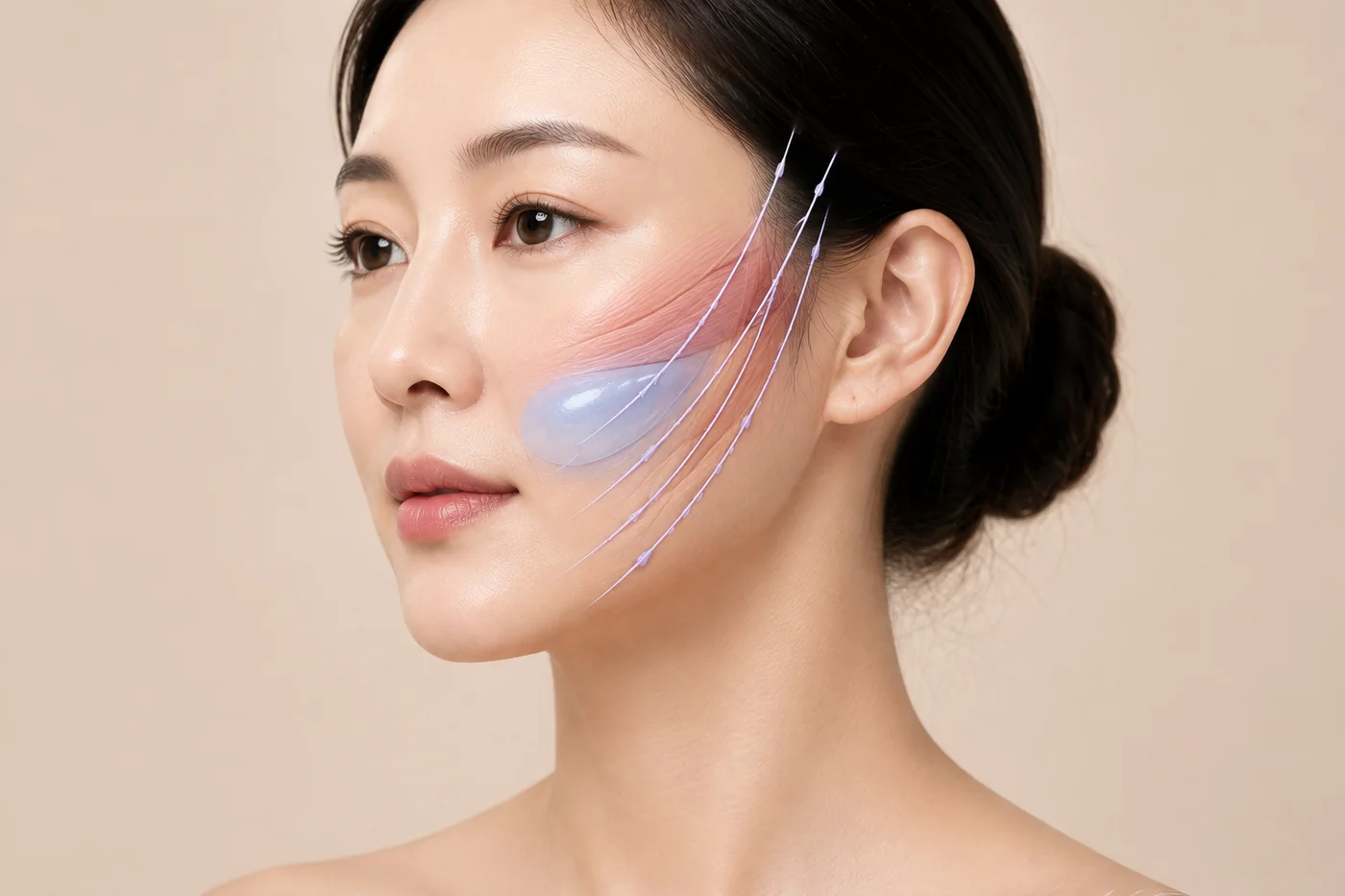
A thread lift is a non-surgical lift in which medical absorbable threads (absorbable sutures) that are absorbed by the body over time are precisely inserted into the dermis, the subcutaneous layer, or the layer above the SMAS to pull sagging contours toward the temple.
Three types are mainly used, PDO (Polydioxanone), PLLA (Poly-L-Lactic Acid), and PCL (Polycaprolactone), and in addition to the physical pull of the thread, collagen production induced as the thread breaks down is added over time.

Because the rate of breakdown and the degree of collagen stimulation differ by type, the thread is chosen to match the stage of sagging, and a vector design matched to the direction of sagging matters more to the result than the number of threads.

Before & After

Thread Lift Before & After

DESIGN PRINCIPLE

Methods
How a Thread Lift Works

PDO Threads SUTURE guide image

SuturePDO Threads

Polydioxanone type. It breaks down in the body in 6-8 months, and results have been reported to last about 9-12 months. It comes in mono (smooth threads, mainly for collagen stimulation), screw (twisted), and cog (barbs that provide traction) forms, chosen according to the area and the degree of sagging. It is the most widely used type.

Breaks Down in 6-8 Months Lasts 9-12 Months mono/cog
PLA Threads HYBRID guide image

HybridPLA Threads

Poly-L-lactic acid type. It breaks down in the body in 12-18 months, and results have been reported to last up to 12-24 months. Its collagen stimulation is stronger than that of PDO, so an improvement in skin texture comes with it. It is suited to mid-stage sagging.

Breaks Down in 12-18 Months Collagen Stimulation Mid-Stage Sagging
PCL Threads PARTIAL guide image

PartialPCL Threads

Polycaprolactone type. It breaks down in the body in 18-24 months, and results have been reported to last up to 24-36 months. Of the three types, it breaks down the most slowly and its collagen stimulation also tends to be the strongest. It is chosen in cases where how long the result lasts is the priority.

Breaks Down in 18-24 Months Lasts 24-36 Months Longevity First
Treatment Areas INCISION guide image

IncisionTreatment Areas

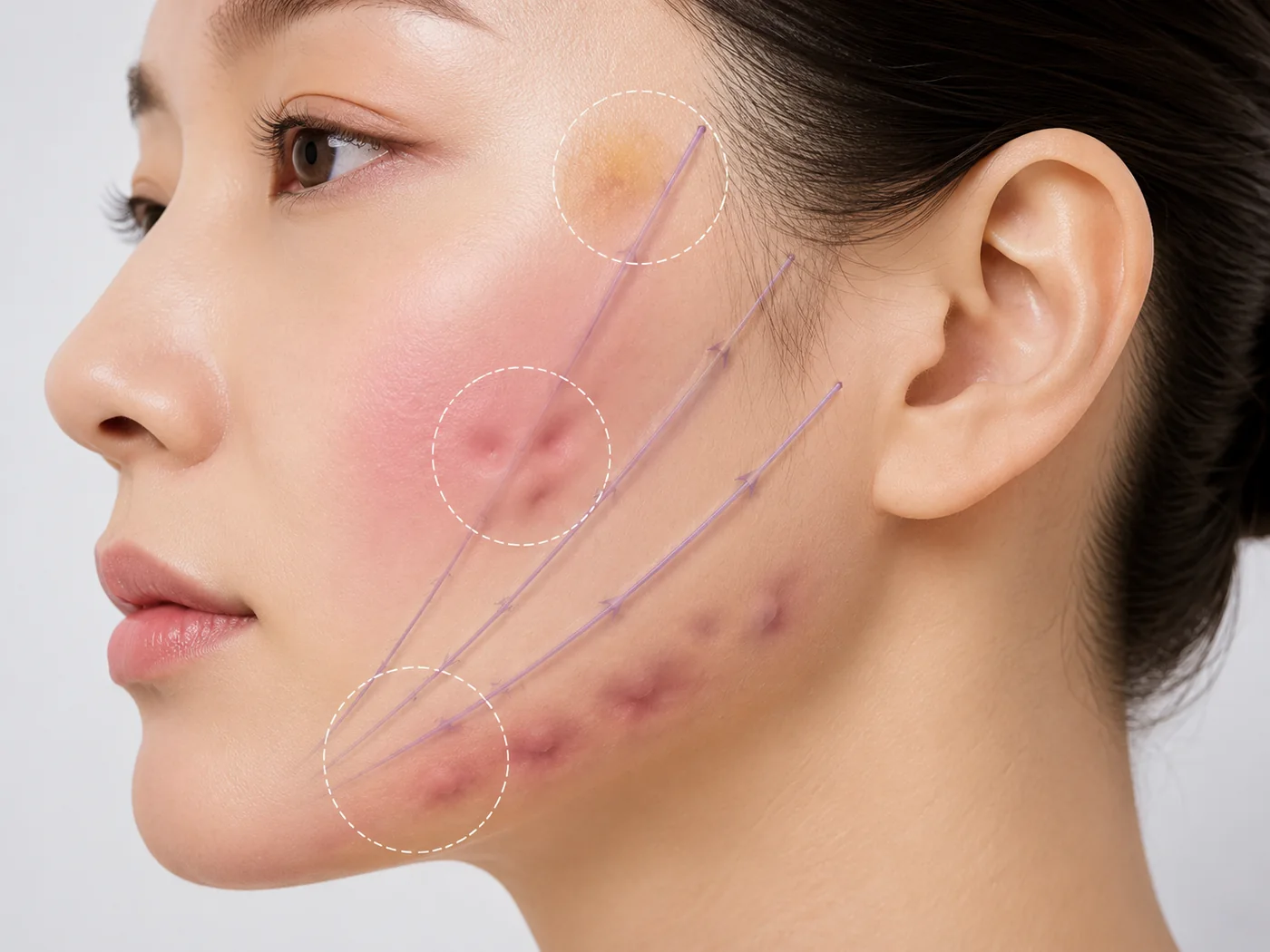
It can be applied to the cheeks, jawline, double chin, nasolabial folds, deep cheeks, the sides of the cheekbones, and the neck contour. The entry point (scalp, temple, or near the tragus), the insertion depth (dermis, subcutaneous layer, or above the SMAS), and the number of threads used vary by area. Even for the same sagging, the plan is redrawn according to the patient's skin thickness and bone structure.

Area-Specific Planning Vector Direction Entry Point

OUR PRINCIPLE

Core Values
The Principles RESUM Keeps

The result of a thread lift depends on the thread type, the line, the direction, and the number of threads. At RESUM, even for the same patient, the plan needed is drawn up anew for each area.

Right Thread

Right Thread

Thread Selection

RESUM selects from PDO, PLA, and PCL according to the stage of sagging and how long you wish the result to last. We do not push PCL for mild sagging, and we explain honestly that for mid-stage or more advanced sagging, results with PDO alone do not last long. We do not insist on a single product.

Right Vector

Right Vector

Vector Design

Direction, more than the number of threads, determines the result. After setting a traction line that matches the direction of sagging, we decide the entry point, the insertion angle, and the stable line to lift toward. Even with the same number of threads, a natural refinement is possible only when the vector is right.

Honest Limit

Honest Limit

Honest Limitations

If sagging is at an advanced stage, we tell you honestly at the consultation that a thread lift alone is not enough. If you are at a stage where lift surgery is more reasonable than inserting many threads, we consider that option together as well. An excessive number of threads increases the risk of dimpling, knot irritation, and asymmetry.

POINT 03 Features

Features of a Thread Lift

Thread Types and How They Work

Thread Types and How They Work

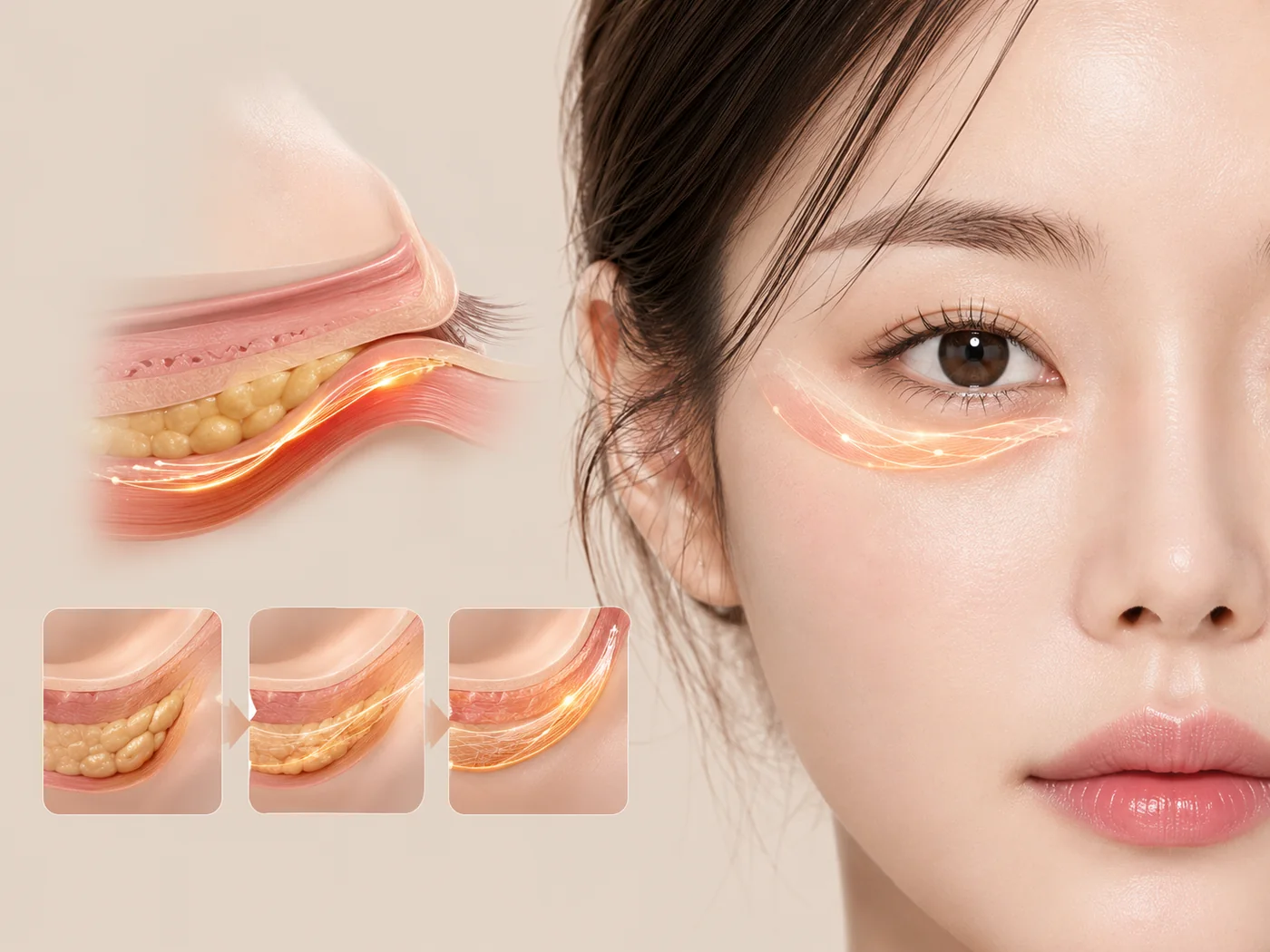
Three types of absorbable thread, differing in breakdown rate and strength of collagen stimulation, are mainly used in thread lifts. Immediately after insertion the thread physically pulls the tissue to lift the contour, and as it breaks down a secondary effect is added: it stimulates fibroblasts and induces collagen production. Even within the same type, whether the thread works mainly by traction or mainly by collagen stimulation depends on its form, such as mono or cog. PDO (Polydioxanone): breaks down in 6-8 months, lasts 9-12 months, the most widely used · PLLA (Poly-L-Lactic Acid): breaks down in 12-18 months, relatively strong collagen stimulation · PCL (Polycaprolactone): breaks down in 18-24 months, relatively long-lasting · Physical pull + induced collagen production act at different times

Vector Design and the Right Thread Count

Vector Design and the Right Thread Count

The result of a thread lift is determined not by the number of threads but by along which line, at which depth, and in which direction the tissue is pulled. After setting a traction line that matches the direction of sagging, we design the entry point, the insertion angle, and the anchoring line. Even with the same number of threads, the vector must be right to aim for a natural refinement. Traction vector matched to the direction of sagging is designed first · Entry point, insertion depth, and anchoring line decided for each area · Direction matters more to the result than the number of threads · Too many threads can raise the risk of dimpling, knot irritation, and asymmetry


NOTICE

Precautions
Aftercare & Precautions

N · 01 With a thread lift, the result does not increase in proportion to the number of threads, and too many threads can increase dimpling or knot irritation.
N · 02 When sagging is at an advanced stage, absorbable threads alone are limited in how much they can lift, so we assess together at the consultation whether lift surgery would be more reasonable.
N · 03 PDO, PLA, and PCL differ in breakdown rate and strength of collagen stimulation, so we do not force a slowly degrading type onto mild sagging.
N · 04 The treatment is not performed during pregnancy or where there is an active skin infection or severe inflammation in the area.
N · 05 If you are taking anticoagulants, aspirin, or similar medication, please let us know in advance at the consultation stage so that the likelihood of bruising and bleeding can be reduced.
N · 06 For 1-2 weeks after treatment, avoid opening your mouth wide, exaggerated facial expressions, and strong massage so that no stress is placed on the threads while they settle.
N · 07 Results differ according to individual skin thickness and the distribution of sagging, so a consultation with a board-certified specialist is needed before treatment.

PROCEDURE DATA

Summary
Treatment Overview

Procedure

Treatment Overview

Treatment time
30-60 minutes
Anesthesia
Local anesthesia
Daily activities
Swelling settles in 3-5 days
Duration
About 12 months

FOR WHOM

Candidates

Consider a Consultation If

05 Recommended Cases

01 Those in their 30s-40s at an early to mid stage of sagging, whose cheek, jawline, nasolabial fold, and double chin contours are beginning to lose definition.
02 Those who want to refine their contours without the burden of surgery and whose schedule calls for a short return to daily life.
03 Those who wish to manage results in stages by combining a thread lift step by step with other non-surgical lifts such as Ultherapy, Thermage, or Botox.
04 Cases where you would rather address sagging in stages and reinforce how long the result lasts than have a lift all at once.
05 Those whose previous thread lift result faded quickly and who want the thread type and plan reassessed.
Jin-Young Kim · M.D. - RESUM Plastic Surgery Clinic

Doctor's Note

With a thread lift, inserting more threads does not bring a proportionally greater result. What matters is along which line, in which direction, and how many threads are placed. In our anti-aging skin practice, we use only thread types that have been academically validated, and we recommend treating in stages with an appropriate number of threads rather than placing many at once. In a 1:1 consultation with the director, the distribution of sagging, skin thickness, and past treatment history are assessed in person before a decision is made.

Jin-Young Kim · M.D.

Dr. Jin-Young Kim, Director

PROCEDURE FLOW

Process
Treatment Process

01

PHASE I

Sagging Type Diagnosis

We assess the lines where sagging has begun, such as the cheeks, jawline, and nasolabial folds, along with skin thickness and past treatment history, to first determine whether it is at a stage that absorbable threads can address.

CONSULT

02

PHASE II

Thread Type & Vector Design

We choose the thread type from PDO, PLA, and PCL according to the stage of sagging and how long you wish the result to last, and design the vector giving priority to the traction direction and the stable line over the number of threads.

DESIGN

03

PHASE III

Precise Insertion

After local anesthesia, a fine needle is advanced from the entry point at the planned depth and angle to pull the sagging line toward the temple.

STEP

04

PHASE IV

Recovery & Touch-Up Guidance

We explain how to care for swelling and plan with you the timing of the next touch-up according to when the thread type used breaks down.

CARE

FREQUENTLY ASKED

FAQ
Frequently Asked Questions

We have compiled the questions patients ask most often before a consultation.

A thread lift is a non-surgical lift in which medical absorbable threads (PDO, PLA, PCL) that break down in the body over time are precisely inserted into the dermis, the subcutaneous layer, or the layer above the SMAS to pull sagging tissue toward the temple and stimulate collagen synthesis. Because access is made with a fine needle, no incision is involved and the recovery burden is light. The result comes from two effects working together: traction and collagen stimulation.
The main types used are PDO (polydioxanone; breaks down in 6-8 months, lasts 9-12 months), PLA/PLLA (poly-L-lactic acid; breaks down in 12-18 months, lasts 12-24 months), and PCL (polycaprolactone; breaks down in 18-24 months, lasts 24-36 months). Within each type there are also various forms, such as mono (smooth threads), cog (barbed threads), and screw (twisted threads), which are selected at your consultation according to the area and the degree of sagging.
Depending on the thread type used, results last about 9-12 months with PDO, 12-24 months with PLA, and 24-36 months with PCL. This varies between individuals depending on the rate of skin aging, changes in weight, and patterns of facial expression. The expected duration is explained according to the thread type selected at your consultation.
Most of the swelling lasts about 3-5 days and largely settles within 1-2 weeks. A return to daily activities is generally possible from the day after treatment, and office work is usually possible after 1-2 days. Recovery time varies between individuals depending on the number of threads and the treatment area.
Besides the usual swelling, bruising, and tightness, temporary asymmetry, dimpling, or knot irritation may occur, and most of these settle with time. In rare cases, infection, thread exposure, knot enlargement, or nerve irritation have been reported, and these are explained in advance at your consultation. A conservative plan that does not use an excessive number of threads lowers the risk of side effects.
The cost depends on the thread type used (PDO/PLA/PCL), the number of threads, the treatment area, and whether other treatments are combined. The exact cost is explained after a consultation, based on the distribution of sagging and the suitable thread type. We explain the cost within an appropriate plan rather than by increasing the number of threads.

RESUM Plastic Surgery Clinic Location

#601, 6F, 842 Nonhyeon-ro, Gangnam-gu, Seoul

6F #601, 599-4 Sinsa-dong, Gangnam-gu, Seoul

HOURS

Weekdays
10:00 ~ 20:00
Saturday
10:00 ~ 17:00
Lunch Break
1:00 PM - 2:00 PM

(No lunch break on weekends and public holidays) *Dr. Won-Suk Kook is not available on the 1st and 3rd Saturdays of each month.

Parking Information Parking is available in the building. 1 hour of free parking

Subway 5-minute walk from Exit 3 of Apgujeong Station on Line 3 (right next to the 14-story CGV building at Exit 3)

RESUM Plastic Surgery Clinic CEO Won-Suk Kook Business No. 733-11-02929 Phone 02-3445-7770