Lower Blepharoplasty in Gangnam, Seoul | RESUM Plastic Surgery
Skip to main content

service / Eye

Lower Eyelid

Under-Eye Surgery

LOWER EYELID

We distinguish the causes of under-eye fat, hollowing, and shadowing
and plan lower blepharoplasty for a bright, relaxed impression.

Method
30 minutes to 1 hour
Anesthesia
IV sedation / Local anesthesia
Recovery
About 2-7 days (varies by procedure) · No hospital stay · Suture removal not required or after 5-7 days (by procedure)
Summary Lower blepharoplasty refers to procedures that diagnose under-eye concerns such as dark circles, tear troughs, and lower eyelid sagging by cause and address them through fat repositioning, removal, or reinforcement. At RESUM Plastic Surgery in Gangnam (Apgujeong), Seoul, the method is decided after evaluating the cause of the shadowing, and patients also visit from nearby areas such as Banpo. Medical Review Medical Review: Won-Suk Kook,Jin-Young Kim
Last updated: 2026-06-27

Why Lisoom

Overview The key to lower blepharoplasty: accurately diagnosing the cause of dark circles and the condition of the under-eye fat, sagging, and tear trough, and choosing the method that suits them

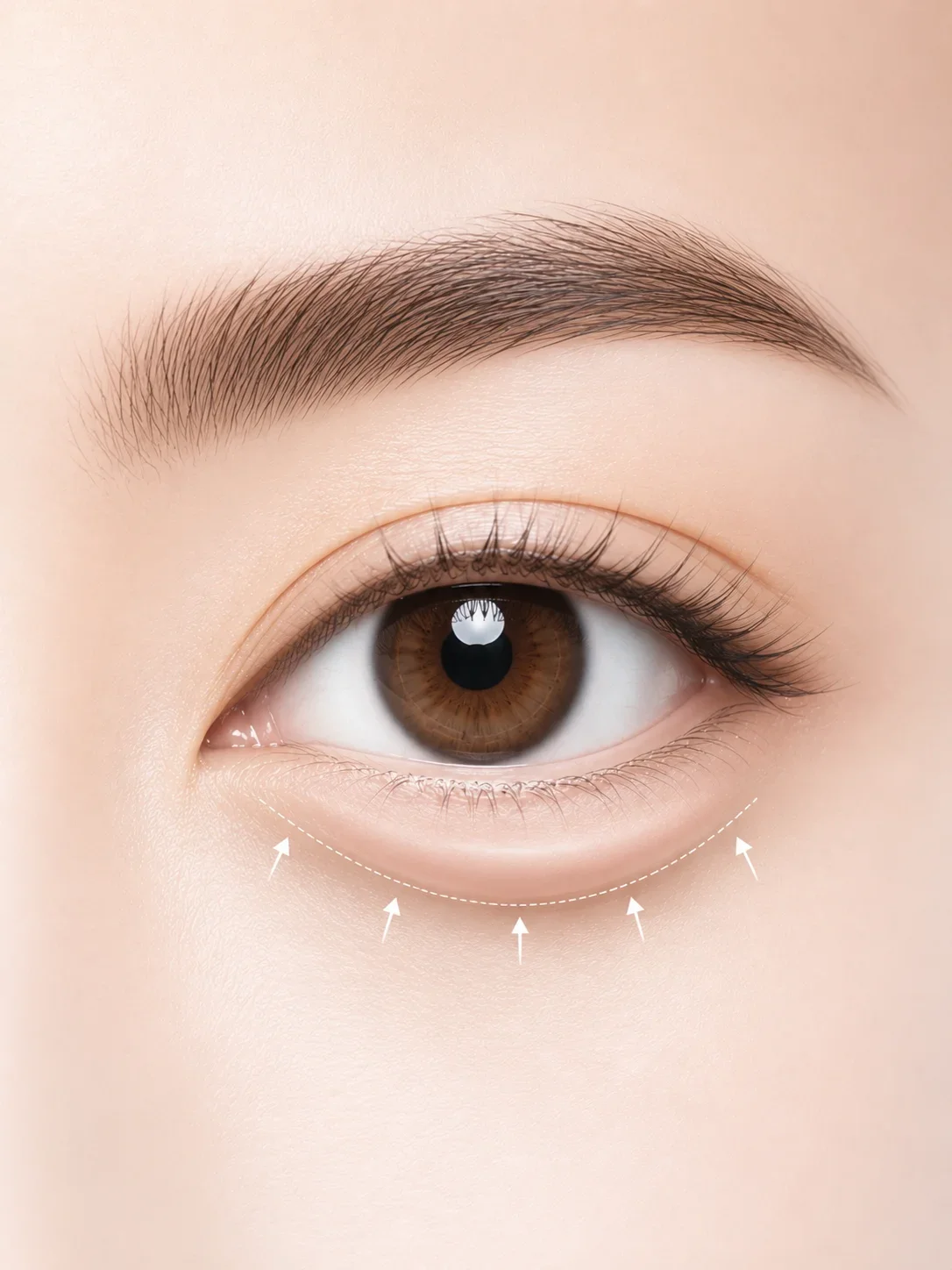
Lower blepharoplasty is a collective term for procedures that improve a range of under-eye concerns, including dark circles, bulging under-eye fat, under-eye hollowing (tear trough), sagging skin, and aegyo-sal volume, to create a bright, well-defined eye area. The under-eye area largely determines whether the face looks tired and older, so the appropriate method must be chosen according to the cause.

The key to lower blepharoplasty is to accurately diagnose the cause of dark circles and the condition of the under-eye fat, sagging, and tear trough, and to choose the method that suits them.

Before & After

Under-Eye Surgery Before & After

Subcategory
Time Since Procedure

Complications such as bleeding, infection and inflammation may occur depending on the individual, so caution is needed.
Results may vary by individual. Please confirm the method and expected results that suit you through a consultation.

DESIGN PRINCIPLE

Methods
Under-Eye Aegyo-sal

Dark Circles SUTURE guide image

Dark Circles

"Dark circles" is a general term for the roundish,
dark shadowing that appears under the eyes.

Medically, the fat around the lower eyelid protrudes so that the area below it is relatively sunken and looks like a groove,
or the skin under the eyes darkens and a roundish shadow appears.

Dark circles are the leading reason the eye area looks aged and tired, and they are a common everyday concern. Dark circles have several causes, so no single treatment alone can resolve them.


Treatment must be tailored to the cause.

Lower Eyelid Fat Repositioning Lower Blepharoplasty High-Concentration Micro Fat Grafting
Tear Trough HYBRID guide image

Tear Trough

A tear trough is a groove-like depression running from the inner 1/3 of the under-eye area to its middle.
It usually appears along the border of the orbital bone (the bone around the eye) and is commonly seen in young and older people alike. The problem is that it makes a person look older and worn out.


The tear trough appears at the boundary between the thin skin of the lower eyelid and the thick skin of the cheek and nose, and the skin color of the tear trough also differs from its surroundings.
Its location is along the border of the orbital bone.


Because the tear trough arises from an anatomical boundary regardless of age, it needs to be managed as it appears. Treatment with fat grafting or filler is generally effective.

Lower Blepharoplasty Lower Eyelid Fat Repositioning Fat Grafting,Filler
Under-Eye Aegyo-sal PARTIAL guide image

Eye SmileUnder-Eye Aegyo-sal

Aegyo-sal surgery is a procedure that makes the under-eye area fuller through various methods, such as gathering the under-eye muscle or using filler or fat grafting, thereby also removing wrinkles and creating a cute, youthful-looking face.

This surgical technique gathers the orbicularis oculi muscle under the eye with absorbable sutures and lets it adhere, giving volume to the under-eye area.

Because it uses your own under-eye muscle, there is no external incision mark and no foreign-body sensation, so the result looks natural. Because no skin incision is made, no surgical mark is left.

Aegyo-sal Muscle Suturing Petit Aegyo-sal Aegyo-sal Filler

OUR PRINCIPLE

Core Values
Lower Blepharoplasty: What Sets RESUM Plastic Surgery Apart

The key is to pinpoint the cause and tailor the treatment to it.

Point 01

Point 01

Diagnosing the Cause

We precisely diagnose the cause and the condition of the under-eye fat, sagging, and tear trough.

Point 02

Point 02

Repositioning, Not Removal

Rather than simply removing bulging fat, we reposition it into the hollow area to fill it in evenly.

Point 03

Point 03

Custom Combination Treatment

Aegyo-sal, dark circles, the lower eyelid, and the tear trough are planned in combination according to the cause.

POINT 05 Dark Circles

Diagnosis by Dark Circle Type

Structural Dark Circles (SD)

Proportion: 5-8%. The under-eye fat is abundant and appears to sag downward, or is scant so the area looks deeply sunken and shadowed. Recommended treatments are lower eyelid fat repositioning, under-eye fat removal, and high-concentration micro fat grafting.

Pigmented Dark Circles (PD)

Proportion: 5%. Excessive pigmentation in the area under the eyes. Recommended treatments are laser (such as IPL) and high-concentration micro fat grafting.

Vascular Dark Circles (VD)

Proportion: 14%. The skin is thin and blood vessels show through, or the under-eye area is dark because muscle and blood vessels show through. Recommended treatments are laser, filler, lower eyelid fat repositioning, and under-eye fat removal.

Aging Wrinkle Type (AD)

Proportion: 12%. Many fine lines under the eyes, or wrinkles that form as the area sags. Recommended treatments are lower eyelid fat repositioning, lower blepharoplasty, and under-eye fat removal.

Combined Dark Circles (CD)

Proportion: 60-65%. A combination of the four types above appearing together; the causes are analyzed carefully to choose the appropriate treatment.

POINT 04 Tear Trough

Lower Eyelid Fat Repositioning: Surgical Method

Lower eyelid fat repositioning releases the tear trough attached to the bone between the under-eye area and the anterior cheek and spreads the under-eye fat flat into the hollow areas of the under-eye and tear trough
to fill them in.

01

01

An incision is made
in the lower part of the eye.

02

02

The tear trough ligament area
is incised.

03

03

The fat is drawn down to the lower part of the eye
and secured. Lower eyelid fat repositioning
removes the under-eye fat bulge and groove
to create clear, clean-looking eyes.

POINT 03 Repositioning

Anatomical Structure of the Under-Eye Area

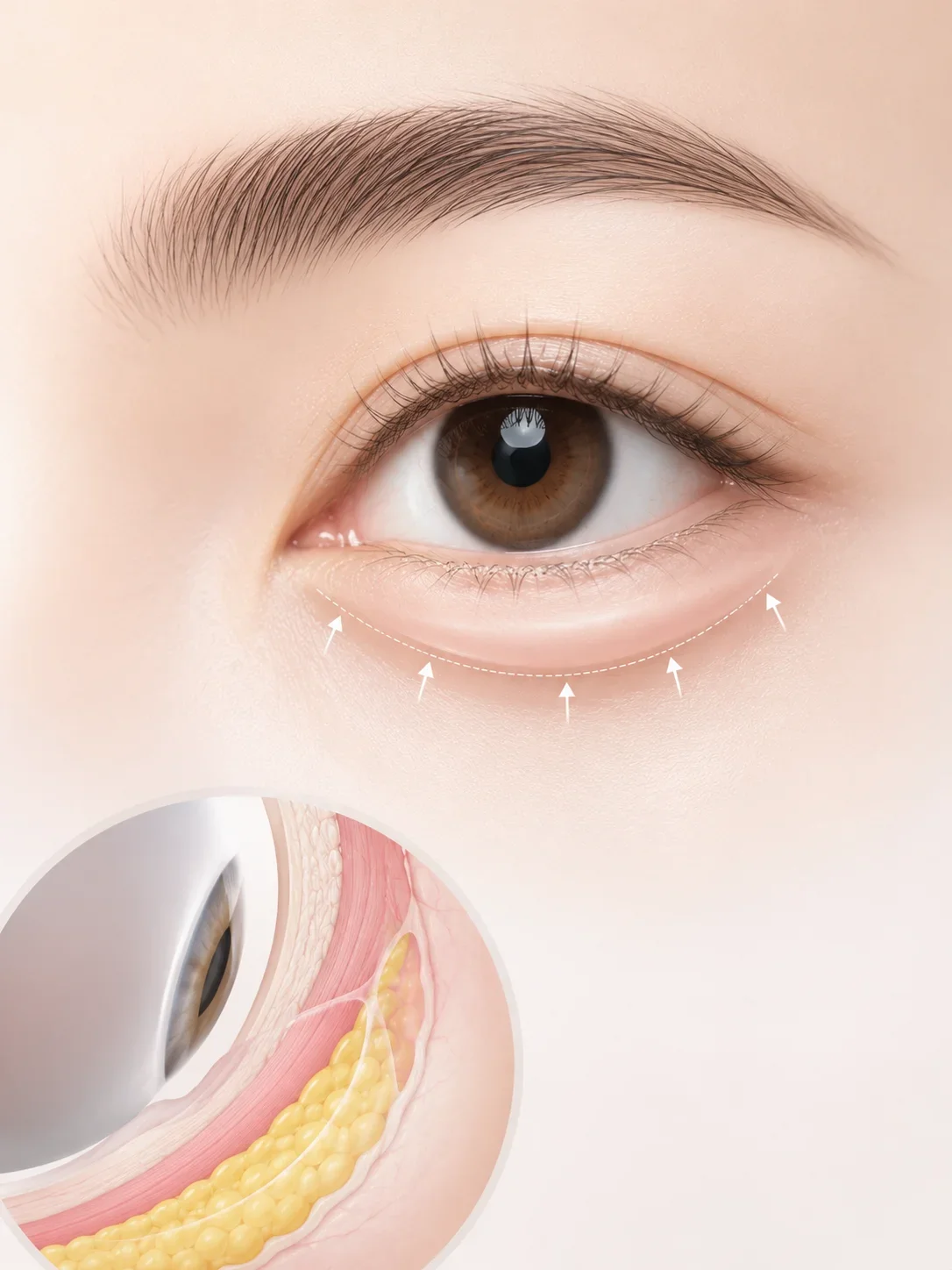
When a bulging under-eye area is the concern, there is a tear trough beneath the bulging under-eye fat. This area is firmly attached to the bone between the under-eye area and the anterior cheek, so removing the under-eye fat does not improve the tear trough; the under-eye hollow beneath the bulging fat must be filled in as well.

Tear Trough

Tear Trough

• TT: tear trough
• Black dotted line: border of the orbital bone
• Yellow dotted line: protruding fat

Dark Circles

Dark Circles

Dark circles refer to changes that appear inside the orbital bone (the bone around the eye), but the tear trough that appears outside it must also be addressed together.

POINT 06 Lower Eyelid

Lower Blepharoplasty

For lower blepharoplasty, the appropriate surgical method is applied according to the degree of under-eye sagging and the individual situation. When the skin is not lax, a transconjunctival incision is used; when a skin incision is needed, the skin, muscle, orbital septum, and other layers are separated and the tissue is removed by the amount it has stretched. Unnecessary fat is removed and fat is repositioned where needed to complete an ideal eye shape.

Before Surgery

Before Surgery

Deciding on the surgical method that suits you through a thorough consultation with a board-certified plastic surgeon

Design

Design

Detailed design of the most ideal line based on under-eye sagging, fat bulging, and skin characteristics

Surgery & Closure

Surgery & Closure

Removal and repositioning of unnecessary fat; skin is tightened and sutured

Lisoom Channel

YouTube

NOTICE

Precautions
Post-Operative Treatment & Care

N · 01 It is important to keep the surgical site clean. Do not rub it with unclean hands, and apply antibiotic ointment after disinfecting as instructed.
N · 02 After surgery, it is best to avoid lowering your head or lying face down, and to avoid lifting heavy objects or straining. Keep your head elevated on a higher pillow when sleeping.
N · 03 Apply cold compresses with the cool pack provided by the clinic, following the instructed duration and frequency according to how the swelling progresses.
N · 04 Reading or watching TV is best resumed after 1-2 days, and prescribed antibiotics, anti-inflammatory medication, and pain relievers should be taken as instructed.
N · 05 Sutures are removed according to your progress, and your progress is checked at the scheduled follow-up visits after surgery.
N · 06 Swelling after surgery varies from person to person, and the time it takes to settle completely also varies.
N · 07 Please ask during your visit when you may resume wearing contact lenses, exercising, and drinking alcohol, as this depends on your recovery.
N · 08 If you take aspirin, anticoagulants, or other medications that may increase bleeding, please let us know in advance during your visit.
N · 09 Please let us know in advance about any underlying conditions such as high blood pressure, diabetes, or thyroid disease, as well as any allergies.
N · 10 Avoiding alcohol, smoking, and strenuous exercise for a period after surgery helps recovery.
N · 11 Recovery varies from person to person, and it may take time for the results to settle.
N · 12 If you experience any abnormal symptoms (such as excessive swelling, bleeding, or pain), please visit the clinic immediately.
N · 13 Please be sure to consult a board-certified specialist before and after surgery.

PROCEDURE DATA

Summary
Surgery Overview

Procedure

Dark Circles

Surgery time
About 30 minutes
Recovery Period
2-3 days
Suture removal
Not required
Anesthesia
Short IV sedation

Procedure

Lower Eyelid Fat Repositioning

Surgery time
About 30 minutes to 1 hour
Recovery Period
2-7 days
Suture removal
None
Anesthesia
Local anesthesia / IV sedation

Procedure

Under-Eye Fat & Aegyo-sal

Surgery time
About 30 minutes
Recovery Period
Right away
Suture removal
None
Anesthesia
IV sedation

Procedure

Aegyo-sal Filler

Treatment time
10 minutes
Recovery Period
None
Suture removal
Not required
Anesthesia
Anesthetic ointment

Procedure

Lower Blepharoplasty

Surgery time
Around 1 hour
Recovery Period
5-7 days
Suture removal
5-7 days
Anesthesia
Local anesthesia / IV sedation

Recommended For

Candidates

Consider a Consultation If

05 Recommended Cases

01 When the under-eye area is always dark and shadowed, making you look tired and older
02 When the under-eye fat stands out and the area below it is sunken, looking like a groove
03 When you are bothered by a groove-like tear trough at the inner part of the under-eye area
04 When mixed causes of dark circles meant a single treatment did not bring improvement
05 When you want a soft, youthful impression with full aegyo-sal when you smile
Won-Suk Kook · M.D. - RESUM Plastic Surgery Clinic

Doctor's Note

The key to lower blepharoplasty is not to solve everything with a single treatment,
but to accurately diagnose the cause of dark circles and the condition of the under-eye fat, sagging, and tear trough,
and choose the method that suits them.

Won-Suk Kook · M.D.

Dr. Won-Suk Kook, Chief Director

PROCEDURE FLOW

Process
How Lower Blepharoplasty Is Performed

01

PHASE I

Consultation & Diagnosis

We precisely diagnose the cause of dark circles and the condition of the under-eye fat and sagging.

CONSULT

02

PHASE II

Design

We plan a treatment method that suits the cause, your eye shape, and your condition.

DESIGN

03

PHASE III

Treatment

The procedure is carried out with the method that suits the cause, such as fat repositioning, aegyo-sal, lower blepharoplasty, or filler.

PROCEDURE

04

PHASE IV

Recovery & Care

Swelling and recovery are managed systematically according to your progress.

CARE

FREQUENTLY ASKED

FAQ
Frequently Asked Questions

We have compiled the questions patients ask most often before a consultation.

It is a collective term for procedures that address under-eye concerns according to their cause, including dark circles, bulging under-eye fat, under-eye hollowing (tear trough), sagging skin, and aegyo-sal volume.
Dark circles have several causes, so they are difficult to resolve with a single treatment; we diagnose the type and apply the treatment that matches the cause.
Because a tear trough often lies beneath the bulging fat, rather than simply removing the fat we reposition it into the hollow area to fill it in evenly.
Aegyo-sal muscle suturing gathers your own muscle to create volume, while petit aegyo-sal creates volume simply with autologous fat grafting or filler.
It is considered when there is sagging skin, bulging fat, or dark circles, or when you want to look naturally younger without changing your overall impression.
Mild cases, Class 1 and 2, can also be improved with non-surgical methods such as filler injections; when sagging is also present, lower blepharoplasty and fat repositioning are considered together.

RESUM Plastic Surgery Clinic Location

#601, 6F, 842 Nonhyeon-ro, Gangnam-gu, Seoul

6F #601, 599-4 Sinsa-dong, Gangnam-gu, Seoul

HOURS

Weekdays
10:00 ~ 20:00
Saturday
10:00 ~ 17:00
Lunch Break
1:00 PM - 2:00 PM

(No lunch break on weekends and public holidays) *Dr. Won-Suk Kook is not available on the 1st and 3rd Saturdays of each month.

Parking Information Parking is available in the building. 1 hour of free parking

Subway 5-minute walk from Exit 3 of Apgujeong Station on Line 3 (right next to the 14-story CGV building at Exit 3)

RESUM Plastic Surgery Clinic CEO Won-Suk Kook Business No. 733-11-02929 Phone 02-3445-7770