Double Eyelid Surgery in Gangnam, Seoul | RESUM Plastic Surgery
Skip to main content

service / Eye

Double Eyelid

Double Eyelid Surgery

DOUBLE EYELID

We analyze each person’s eye shape and skin thickness
to plan a natural, harmonious double eyelid crease.

Method
20-60 min
Anesthesia
Local anesthesia / IV sedation
Recovery
3-7 days · Same-day discharge · Suture removal after 3-7 days
Summary Double eyelid surgery is divided into the non-incisional (buried suture), partial-incision, and incisional methods, and the crease is planned around the eyelid skin, fat, and eye-opening strength. Recovery usually takes 3-5 days for the non-incisional method and 1-2 weeks for the incisional method. The surgery is performed at RESUM Plastic Surgery in Gangnam (Apgujeong), Seoul. Medical Review Medical Review: Won-Suk Kook,Jin-Young Kim
Last updated: 2026-07-21

Why Lisoom

Overview Accurately Finding the Crease
That Is Naturally Yours

Just as each person has a distinctive fingerprint of their own, the eyes also have a double eyelid crease that is uniquely theirs.
Even if there is currently no crease, it is the line that readily appears when something is gently pressed against the eyelid.

The key to double eyelid surgery is not creating a large, distinct crease,
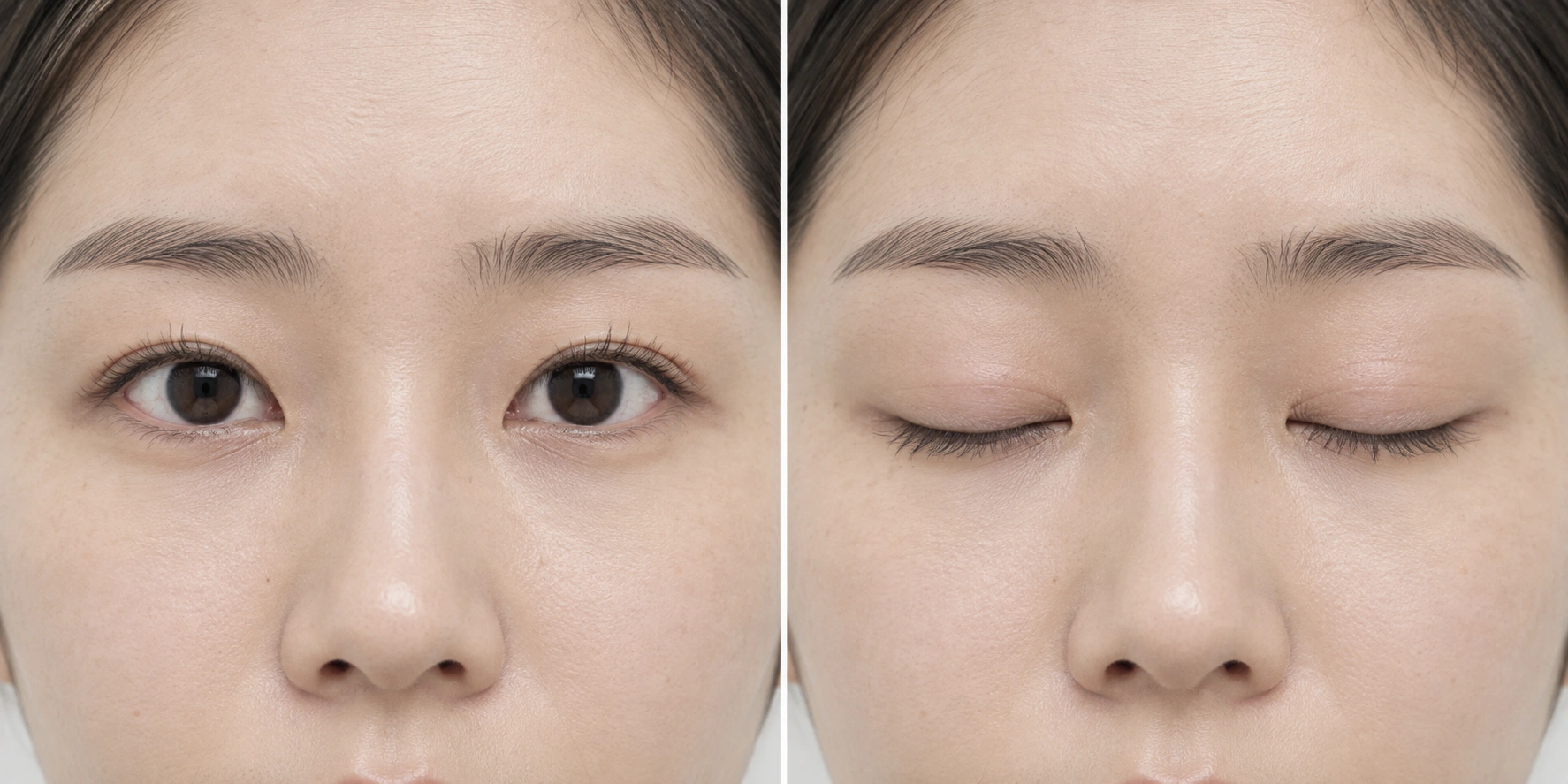
but accurately finding the crease that naturally suits each person’s eyes. We aim for eyes that look natural when open and show no obvious signs of surgery when closed.

Before & After

Double Eyelid Surgery Before & After

Subcategory
Time Since Procedure

Complications such as bleeding, infection and inflammation may occur depending on the individual, so caution is needed.
Results may vary by individual. Please confirm the method and expected results that suit you through a consultation.

Eye Surgery Case Studies

DESIGN PRINCIPLE

Methods
Types of Double Eyelid Surgery

Magic Double Eyelid SUTURE guide image

MethodMagic Double Eyelid

The concept of double eyelid surgery keeps evolving, becoming more refined and multifaceted. Within it, eye-shape correction and the dynamic crease are two very important concepts that have emerged in recent years. Dr. Won-Suk Kook calls the technique that combines these two concepts the Magic Double Eyelid. It is a surgical method that makes the eyes look larger with a softer, more open shape, while the double eyelid crease shows only when the eyes are open and is not readily visible when they are closed.

Looking at the anatomy after conventional double eyelid surgery, the levator aponeurosis, which lifts the eyelid, is connected by scar tissue to the skin along the crease. Seen from the outside, the eyelid skin is therefore indented like the numeral “3,” leaving a deep, distinct crease in which scars and surgical marks show easily. In the Magic Double Eyelid, there is almost no loss of skin or orbicularis oculi muscle, and the crease is connected to a dynamic flap arising from the levator muscle. As a result, surgical marks are not readily visible and the surface stays flat even when the eyes are closed, creating a so-called “dynamic double eyelid” that folds only when the eyes are open.

With Eye-Shape Correction Dynamic Crease Minimal Visible Marks
Natural Adhesion Method HYBRID guide image

Natural Adhesion Method

The conventional buried suture method connects the skin to the underlying muscle or tarsal plate by forcibly tying them together with the tension of a thread. A drawback of this tying approach is that the tied spots become indented, so the crease line is noticeable when the eyes are closed; the crease tends to last a long time before loosening.

No-Tie Technique Natural Adhesion Minimal Visible Marks
Non-Incisional (Buried Suture) Method PARTIAL guide image

Buried Suture MethodNon-Incisional (Buried Suture) Method

The non-incisional (buried suture) method fixes the double eyelid crease through tiny punctures without cutting the skin. RESUM Plastic Surgery’s No-Knot (NO) buried suture method combines the advantages of the single-stitch and continuous buried suture methods.

Non-Incisional Micro-Puncture Fixation NO Knot
Partial-Incision (Minimal-Incision) Method INCISION guide image

Partial Incision Method
(Minimal Incision Method)
Partial-Incision (Minimal-Incision) Method

The partial-incision (minimal-incision) method was developed to combine the advantages of the non-incisional and incisional methods. Like the non-incisional method, it allows for a quick recovery with minimal scarring, and like the incisional method, it allows unnecessary fat and muscle to be removed, so the crease forms and is relatively unlikely to loosen. The surgery is performed through an incision of only 2-3 mm.

Minimal Incision 2-3 mm Quick Recovery Crease Loss ↓
Incisional Method SUTURE guide image

Incisional Method

The incisional method suits eyelids with generally thick skin, abundant fat, or sagging. Through the incision, lax skin, sagging muscle, and the fat layer can all be removed; the crease is relatively unlikely to loosen, and the eye shape can be adjusted in a variety of ways.

RESUM Plastic Surgery’s Natural Adhesion Dynamic Double Eyelid is an incisional method that nevertheless minimizes surgical marks and lets the crease show when the eyes are open. Drawing on the surgical skill of the RESUM Plastic Surgery medical team, we minimize scarring and aim for a natural-looking double eyelid.

Skin & Fat Removal Crease Loss ↓ Flexible Shape Control

PROCEDURE DATA

Summary
Treatment Overview

Procedure

Non-Incisional (Buried Suture) Method

Surgery time
About 20 minutes
Anesthesia
Local anesthesia / IV sedation
Recovery
3-4 days
Hospital stay
Same-day discharge
Suture removal
After 3 days

Procedure

Partial-Incision Method

Surgery time
About 30 minutes
Anesthesia
Local anesthesia / IV sedation
Recovery
3-5 days
Hospital stay
Same-day discharge
Suture removal
After 3-5 days

Procedure

Incisional Method

Surgery time
40-60 minutes
Anesthesia
Local anesthesia / IV sedation
Recovery
About 1 week
Hospital stay
Same-day discharge
Suture removal
After 5-7 days

Surgery time and recovery vary by surgical method and may differ from person to person.

POINT 05 Why It Looks Better

Why Double Eyelid Surgery Makes the Eyes More Attractive

First, it makes the eyes look larger.
As the eyelid folds, more of the iris shows, so the vertical width of the eye increases.

As the eyelid folds, more of the iris shows, so the vertical width of the eye increases.

For small eyes, Magic Epicanthoplasty can also be performed along with double eyelid surgery to lengthen the eyes, and ptosis correction, which tightens the muscle that lifts the eyelid, can be added so that the eyes open wider; as a result, both the length and the vertical width of the eyes can increase.

The crease should extend all the way to the inner corner.

The crease should extend all the way to the inner corner.

Many East Asian eyes have an epicanthal fold; if double eyelid surgery is performed without addressing it, the inner part of the crease is covered and a hidden (inner) double eyelid forms, which can make the eyes look closed-in to others.

Surgical marks should not be visible.

Surgical marks should not be visible.

Visible marks occur more often in people with thick eyelid skin and muscle, and can also vary with suturing technique. When the orbicularis oculi muscle is deeply resected and the skin is fixed to the tarsal plate, the crease may look wide, like the numeral “3,” when the eyes are closed. At our clinic, we aim to improve this with the “Natural Adhesion Dynamic Double Eyelid,” in which scars are not readily noticeable even when the eyes are closed. When scarring is severe, we aim to improve it through revision surgery.

The double eyelid should look slim.

The double eyelid should look slim.

A double eyelid can be called natural when the areas above and below the crease are slim.

The epicanthal fold should be addressed.

The epicanthal fold should be addressed.

The epicanthal fold, often the main obstacle to attractive eyes among East Asians, is “skin at the inner corner that covers the eyeball and creates a closed-in look.” It needs to be released for a natural, attractive double eyelid crease to form.

If ptosis is present, it should be corrected at the same time.

If ptosis is present, it should be corrected at the same time.

If ptosis is present, it should be corrected at the same time. Ptosis refers to eyes that look sleepy because the muscle that lifts the eyelid is weak, so the eyelid does not open fully and covers part of the iris. If double eyelid surgery is performed without recognizing it, the ptosis may worsen, so it is advisable to examine carefully for ptosis and correct it together with double eyelid surgery.

POINT 04 Eyelid Line Types

Types of Double Eyelid Creases

In-fold
TYPE 01

In-fold

The crease is hidden at the inner part of the eye and becomes visible toward the outer part, giving a natural, East Asian look.
It can make the eyes appear shorter.

Out-fold
TYPE 02

Out-fold

The crease is visible from the inner part of the eye, giving a large-eyed, open, Western look. If the crease is too large, it may look unnatural.

In-out fold
TYPE 03

In-out fold

A form midway between in-fold and out-fold, and a frequently chosen crease. It is not overly Western, yet the crease is long, creating an open eye shape.

Crescent Type

Crescent Type

A semicircular crease that is widest around the middle of the eye and narrows again toward the outer corner, giving an East Asian look.

Parallel Type

Parallel Type

The crease runs parallel at a similar width from the middle to the outer corner, giving an open look.

Column

Column
Doctor's Column

This is general medical information and does not replace an individual diagnosis or surgical plan. The surgical method, timing, and expected changes are determined through an in-person examination, and there are risks such as scarring, asymmetry, recurrence, and changes in eyelid position, as well as individual differences in recovery. The images in this article are AI-generated educational models, equipment, and fictional people; they do not represent actual patients, before-and-after treatment results, or equipment actually owned by RESUM. Sources checked: October 7, 2026.

Learn More
A Rounded Outer Corner After Lateral Canthoplasty: Looking at Scarring and Support Structures Separately

This is general medical information and does not replace an individual diagnosis or surgical plan. Suitability for surgery, methods, recovery, and results vary from person to person. The images in this article are AI-generated illustrative models, fictional people, and examination scenes; they are not actual patients, surgical results, or RESUM's actual equipment or clinical scenes. Sources checked: September 28, 2026.

Learn More
Why We Check for Dryness and Eyelid Support Before Under-Eye Surgery

This article is general medical information. Whether surgery is needed and which method is appropriate for each person are determined after an in-person examination.

Learn More
Double Eyelid Scars Visible When the Eyes Are Closed: Before Excising Again

OUR PRINCIPLE

Core Values
What Sets RESUM Plastic Surgery Apart

Safe Beauty

Safe Beauty

RESUM Plastic Surgery designs balanced eye lines that suit each patient’s facial features, using eye surgery techniques that our medical team has steadily researched and refined. We put safe outcomes first, using medically validated methods.

Specialist

Specialist

A board-certified plastic surgeon finds the most suitable surgical method and designs the crease based on a thorough consultation. We aim for a natural eye shape that does not look artificial.

Custom Design

Custom Design

Rather than following a fixed template, we find the style you want and that suits you most, and create a customized design. We plan the crease by looking at face shape, eye shape, and overall impression.

Lisoom Channel

YouTube

View More Videos

NOTICE

Precautions
Post-Operative Treatment & Care

N · 01 It is important to keep the surgical site clean. Do not rub it with unclean hands; disinfect it about once a day and then apply antibiotic ointment. It is best not to wear makeup for 1 week after surgery.
N · 02 After surgery, try not to bend your head down or lie face down, and avoid lifting heavy objects or straining. Sleep with your head raised on a higher pillow.
N · 03 Apply cold compresses with the cold pack provided by the clinic, for 2 hours a day for 3 days. The 2 hours may be done in one session or split into 20-30 minute sessions.
N · 04 Reading or watching TV is best resumed after 1-2 days, and antibiotics, anti-inflammatory medication, and pain relievers are taken for about 3-5 days.
N · 05 With the incisional method, sutures are removed after 3-5 days, and follow-up visits are on day 3 and day 5 after surgery, then at 1 month and 3 months. With the non-incisional method, no sutures are removed, and you can wash your face and wear makeup from day 3 after surgery.
N · 06 Swelling after surgery varies from person to person; usually about 60% subsides within around 7 days, but it takes 1-3 months to settle completely.
N · 07 Contact lenses are best worn from 2 weeks after surgery, and exercise and alcohol are best avoided for at least 3 weeks.
Won-Suk Kook · M.D. - RESUM Plastic Surgery Clinic

Doctor's Note

The key to double eyelid surgery is not creating a large, distinct crease,
but accurately finding the crease that naturally suits each person’s eyes.
We aim for eyes that look natural when open and show no obvious signs of surgery when closed.

Won-Suk Kook · M.D.

Dr. Won-Suk Kook, Chief Director

PROCEDURE FLOW

Process
Surgical Process

01

PHASE I

Consultation & Diagnosis

We comprehensively analyze eyelid skin thickness, the amount of fat, the degree of sagging, and whether ptosis or an epicanthal fold is present, and a board-certified specialist provides a 1:1 consultation.

CONSULT

02

PHASE II

Crease Design

Together we plan the double eyelid crease that is uniquely suited to your eye size and overall impression.

DESIGN

03

PHASE III

Surgical Process

The surgery is performed precisely using the method suited to each individual, such as the non-incisional, partial-incision, or incisional method.

PROCEDURE

04

PHASE IV

Recovery & Aftercare

Sutures are removed according to your progress, and swelling and recovery are monitored systematically.

CARE

FREQUENTLY ASKED

FAQ
Frequently Asked Questions

We have compiled the questions patients ask most often before a consultation.

As the eyelid folds, more of the iris shows, so the eye becomes taller vertically, and puffy upper eyelids look noticeably slimmer once excess fat and muscle are trimmed. Lashes that pointed downward lift slightly for a more defined look, and a sharp-looking eye shape can be refined into a softer, more open one.
Every person has a crease that naturally suits their eyes. A natural-looking double eyelid shows only slightly, about 1-2 mm, when the eyes are open, runs smoothly all the way to the inner corner, and leaves surgical marks that are not readily noticeable when the eyes are closed.
They fall broadly into the non-incisional (buried suture) method, the partial-incision (minimal-incision) method, and the incisional method. The suitable method depends on eyelid skin thickness, the amount of fat, the degree of sagging, and whether ptosis is present, so it is decided through consultation.
The non-incisional (buried suture) method fixes the crease through tiny punctures without cutting the skin, so recovery is quick; it suits eyes with thin skin and little sagging. The incisional method can remove lax skin, muscle, and fat, so it suits thick or sagging eyelids, and the crease is less likely to loosen.
The “Natural Adhesion Dynamic Double Eyelid” is a method designed so that the crease shows only when the eyes are open and marks are not readily noticeable when they are closed. Results may vary, however, depending on each person’s skin and muscle condition.
Yes. If ptosis is present, ptosis correction can be performed together with double eyelid surgery, and if there is an epicanthal fold, canthoplasty can be combined. Assessing these together is how we aim for a natural, open eye shape.
POINT 03 Why Lisoom

What Sets RESUM Plastic Surgery Apart

Consultation & Surgery by Your Attending Surgeon

Consultation & Surgery by Your Attending Surgeon

Consultation and surgery are not handled by different people; the doctor who consults with you personally performs the surgery and provides the follow-up care. Through ongoing communication with each patient, we work together toward a satisfying result.

Structured Aftercare Program

Structured Aftercare Program

We directly run a structured aftercare program after surgery. We check your progress at each stage and offer a range of programs to support recovery.

Smartlux Laser

Smartlux Laser

A laser for post-operative care that helps relieve pain and swelling and supports a faster recovery. LED light acts on the skin to help promote collagen and elastin production and supports the natural recovery of damaged skin.

RESUM Plastic Surgery Clinic Location

#601, 6F, 842 Nonhyeon-ro, Gangnam-gu, Seoul

6F #601, 599-4 Sinsa-dong, Gangnam-gu, Seoul

HOURS

Weekdays
10:00 ~ 20:00
Saturday
10:00 ~ 17:00
Lunch Break
1:00 PM - 2:00 PM

(No lunch break on weekends and public holidays) *Dr. Won-Suk Kook is not available on the 1st and 3rd Saturdays of each month.

Parking Information Parking is available in the building. 1 hour of free parking

Subway 5-minute walk from Exit 3 of Apgujeong Station on Line 3 (right next to the 14-story CGV building at Exit 3)

RESUM Plastic Surgery Clinic CEO Won-Suk Kook Business No. 733-11-02929 Phone 02-3445-7770