

Correction of Various Nasal Tip Deformities #2. Twisted Tip #TipSurgery #RevisionTipSurgery

A distinctive feature of our clinic is that many patients, after a first surgery at another clinic went wrong,
come to us for revision surgery.
Patients therefore come with a wide range of problems, and among them “nasal tip deformity” is, within rhinoplasty,
the most demanding area, and one in which good results are not easy to achieve.
The reason is that “nasal tip deformity”
i) takes many different forms and is complex because the deformity appears in 3 dimensions.
ii) also has a complex course of development and causes, including “contracture,” “damage to and deformation of the tip cartilage from repeated surgery,” and “inflammation,”
among others, which makes the surgery very demanding and difficult.

01 Upturned Tip (Upturned Nose)
02 Twisted Tip
03 Pinched Tip
04 Triangular Nostril (Nostril Notching, Alar Retraction)
05 Asymmetric Nostrils, Deviated Columella
06 External Valve Insufficiency
From here, we turn to a demanding and highly difficult area of rhinoplasty,
“nasal tip deformity,” and examine it in detail.
This case study continues as a series of 6 parts in total; we hope you will follow along.

Twisted Tip
As with other tip deformities, after augmentation rhinoplasty with a silicone implant, capsule formation, an inflammatory response,
tissue damage from repeated surgery, and similar factors lead to “contracture,” which causes this deformity.
Apart from contracture, it can also arise when various manipulations of the tip cartilage during a previous surgery
have left it damaged or displaced.
It can be corrected with tip cartilage repositioning (lateral crural repositioning) or a lateral crural strut graft (LCSG).
In particular, the lateral crural strut graft is an effective way to correct almost every deformity, including the twisted, pinched, and upturned tip,
so a surgeon who has mastered the technique can obtain good results in most
tip deformities caused by contracture.
Septal cartilage | Costal cartilage | Ear cartilage
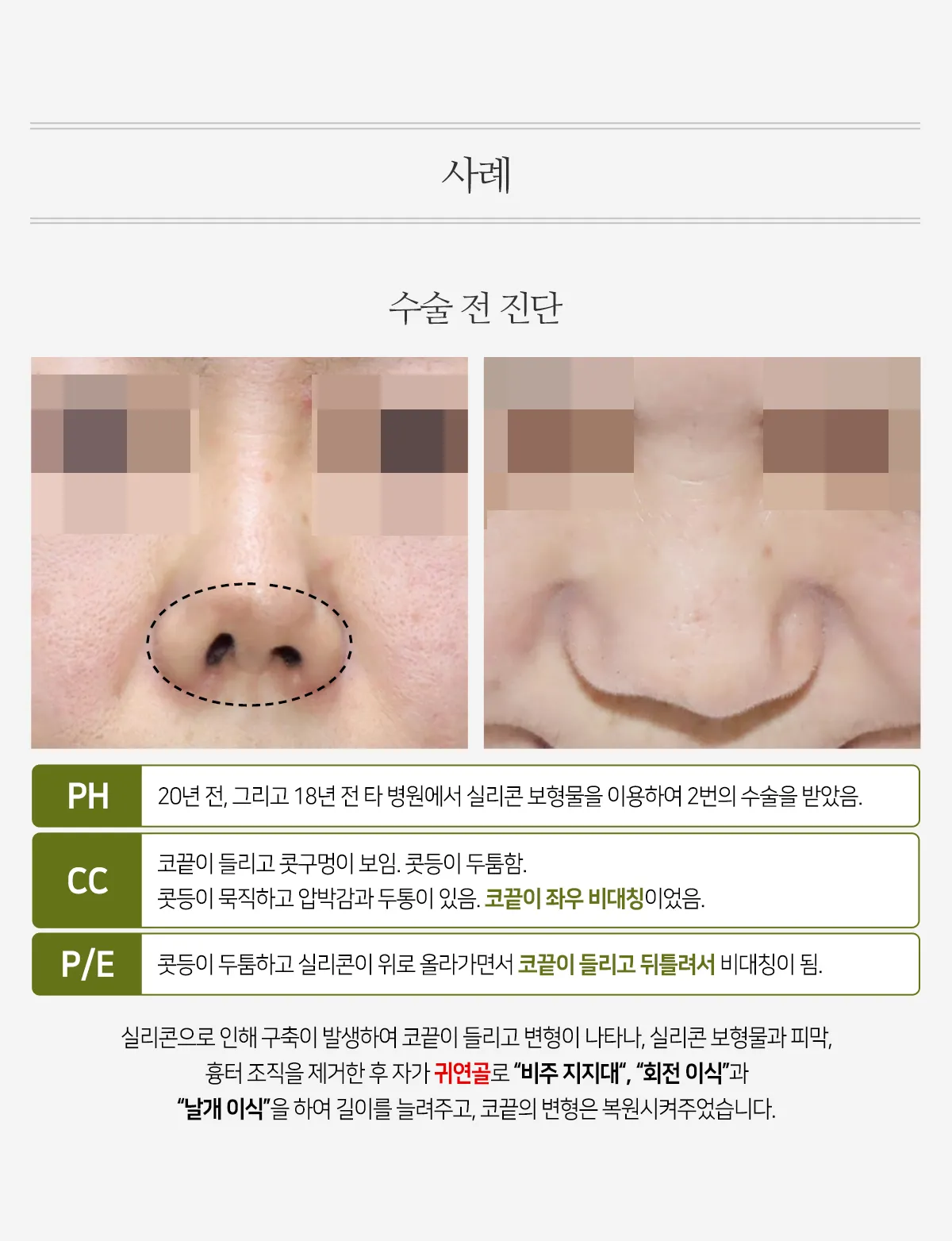
PH
Underwent 2 surgeries with silicone implants at another clinic, 20 years ago and 18 years ago.
CC
Upturned tip with nostril show. Thick dorsum.
Heaviness of the dorsum with a sense of pressure and headaches. The tip was asymmetric.
P/E
The dorsum was thick, and as the silicone migrated upward the tip became upturned and twisted, resulting in asymmetry.
Because contracture caused by the silicone had left the tip upturned and deformed, the silicone implant, capsule,
and scar tissue were removed, and with autologous ear cartilage a “columellar strut,” a “derotation graft,” and a “lateral crural strut graft” were performed to lengthen the nose and restore the deformed tip.

The twisted tip became symmetric, and the upturned tip came down to cover the nostrils.
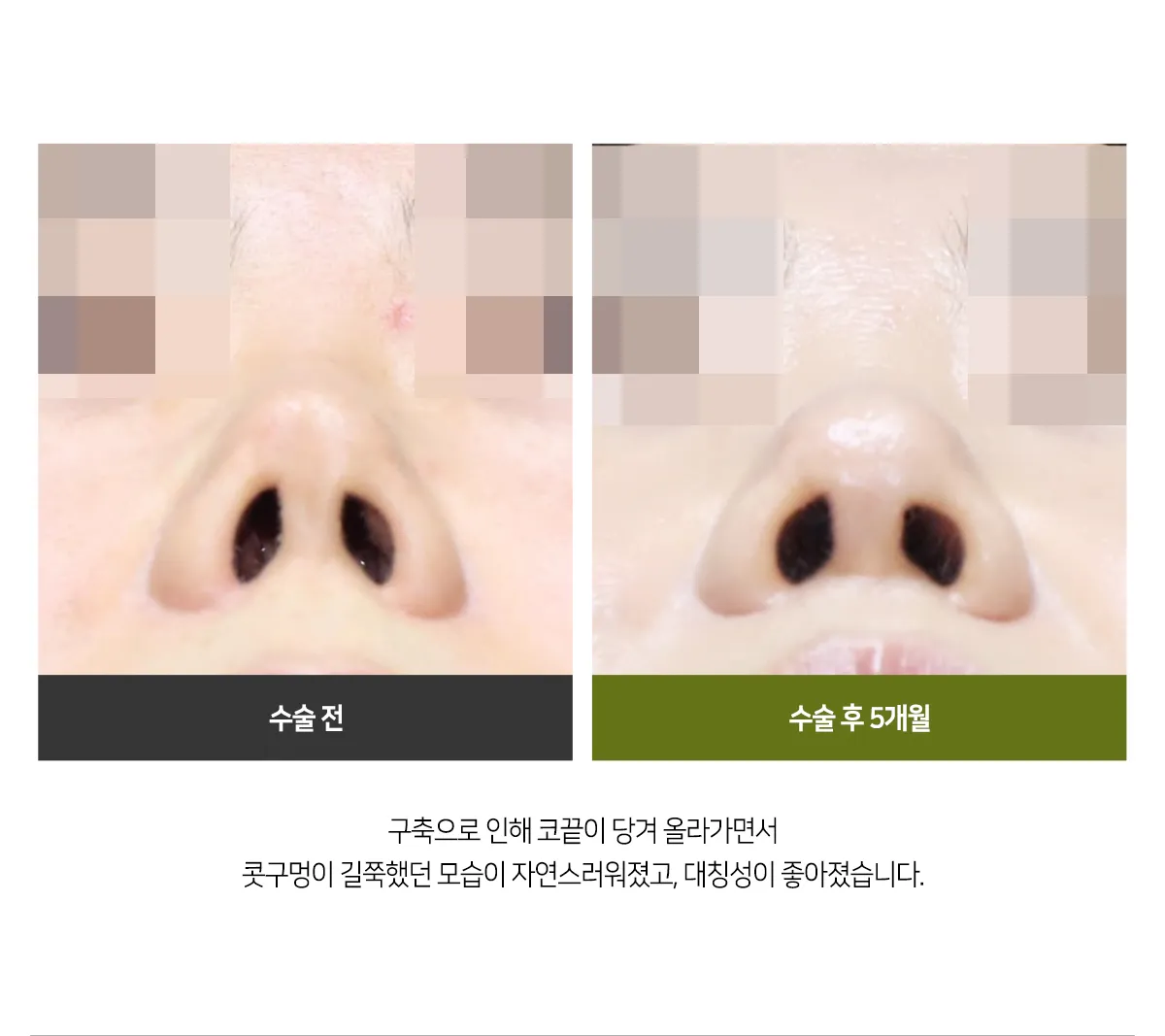
The nostrils, which had been elongated as contracture pulled the tip upward,
now look natural, and symmetry has improved.

The length increased sufficiently, the tip took on a natural, balanced shape,
and the left-right asymmetry was well corrected.
