

Crooked Tip and Columella & Nostril Asymmetry Case Study 3

After rhinoplasty, it is surprisingly common for the tip and columella to become crooked and the nostrils asymmetric, accompanied by nasal obstruction.
Unhappy with how it looks and stressed every time they see it, patients go back to the clinic that performed the surgery,
"The swelling has not fully gone down and things have not settled yet, so let's wait a little longer," they are told.
Quite a few of them wait 2-3 months, see no improvement, and then come to my clinic.
A crooked columella and tip and asymmetric nostrils after rhinoplasty are stressful enough,
and patients are anxious and worried, unsure whether it will improve on its own with time or needs to be corrected.
However, this never improves on its own simply by waiting.
Corrective surgery must be performed to regain the original appearance.

To correct this, the cause must first be identified with an endoscope and careful examination,
and then the twisted tip cartilages and septum must be returned to the exact midline.
Technically, there are two methods.


Because the patient did not want any further cartilage grafting, an open approach was used, but the procedure itself was close to simple repositioning.
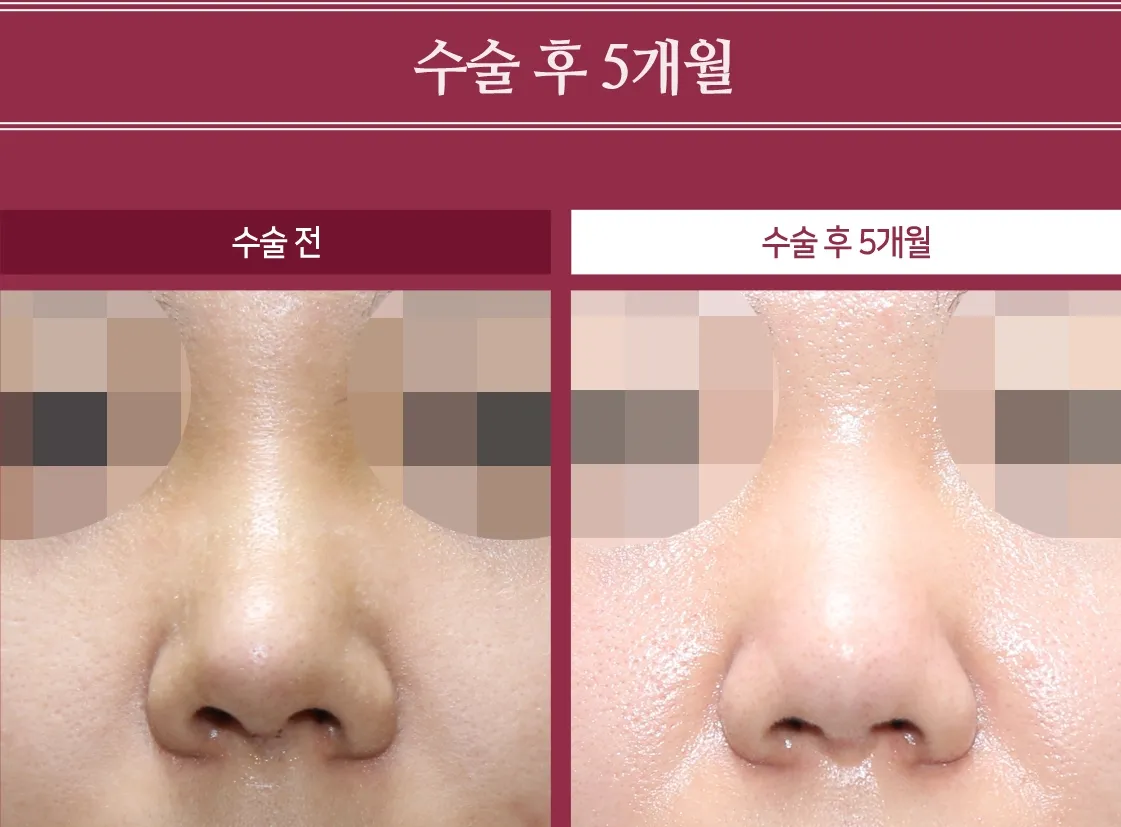
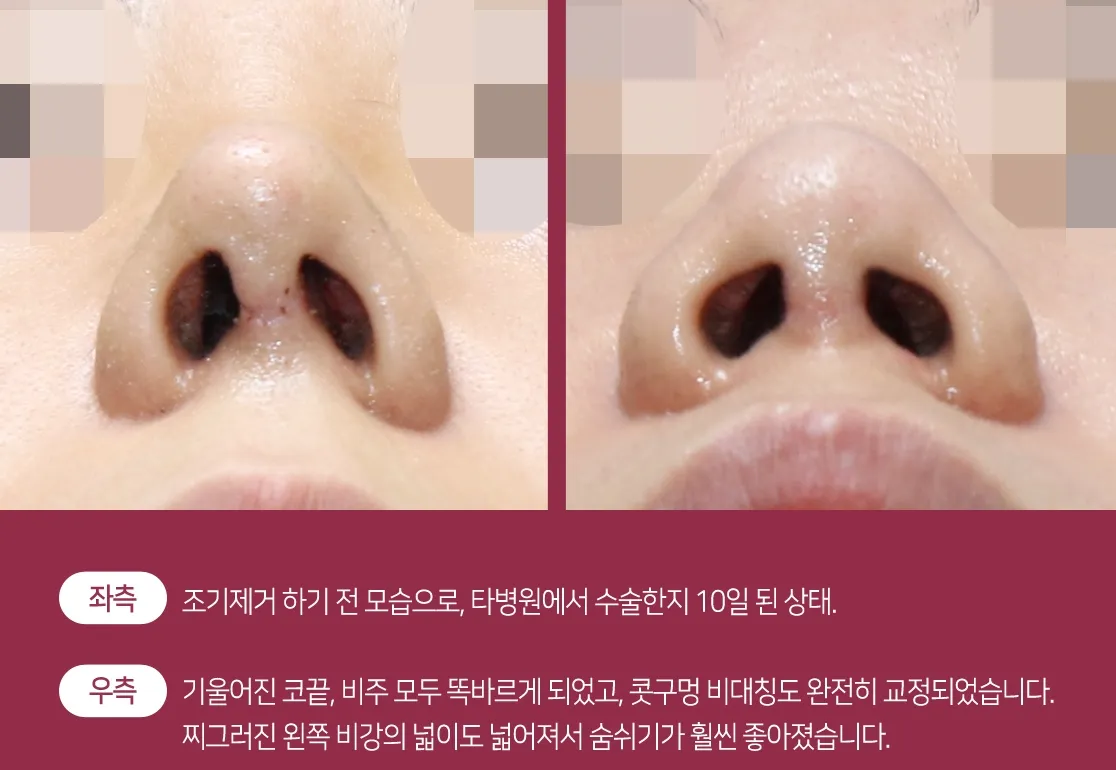
The left photo shows the state before correction, with the tip cartilages in the columella markedly bent and curved.
The right photo shows the state after simple suturing; had a more complex surgery with cartilage grafting been performed,
further correction could have been achieved, which is a regret.

In the preoperative photo, the left and right alae differ considerably in size, which shows that asymmetry was present to begin with.
After surgery, the tip sits in the midline, and the deviation has improved considerably.

After surgery, the axis of the columella is upright. However, some asymmetry of the nostrils and alar rims
caused by facial asymmetry remains; correcting it would require additional procedures such as a columellar strut, lateral crural strut grafting, and left alar reduction,
but the patient did not want them.

Before surgery, the dorsum and tip looked separated; after surgery they are well connected.

The side view clearly shows the columella at the tip pressed by the silicone implant and bent downward.
After surgery, the bent columella straightened, and the length of the nose settled into a straight line.


Donor costal cartilage had been used for both the septal extension graft and the tip onlay graft.
On the left, the onlay graft and the septal extension graft can be seen.
Because the donor costal cartilage was thick, the columella had become too thick.
The septal extension graft was fixed to the left side of the septum, and it had been fixed in a tilted position.
Because the tip cartilages are fixed to a tilted extension graft, the tip inevitably tilts.
Such a large, bulky septal extension graft would have narrowed the left nasal cavity and made breathing difficult.

Removal of the septal extension graft.

After the septal extension graft was removed, the septum can be seen to be deviated.
There is much debate about early removal performed within 3 weeks after surgery,
but at our clinic, when an overly exaggerated nasal shape, functional problems, inflammation, or the like occur after surgery as in this case,
we do not hesitate to perform early removal.
That said, although early removal poses no problem in theory, technically it is a surgery that requires extensive experience and meticulous skill.
The patient in this case achieved good overall balance and recovered well without tissue damage or scarring.

The unnatural "Pinocchio" tip has been reduced, and the nose looks far more natural.