

Severe Deviation After a Blow to a Nose With Silicone Augmentation (Deviated Nose / Deviated Nose Correction)

This patient had undergone augmentation rhinoplasty with silicone 10 years earlier
and presented with severe deviation after the nose collided with a head.
In such cases, it must be determined whether only the silicone has shifted out of place or whether the nasal framework has fractured
and deviated, and the surgical plan made accordingly.
Also, for a deviated nose caused by post-traumatic fracture, careful judgment is needed as to whether, depending on its severity, emergency surgery is required
or whether surgery can wait until the swelling has subsided.

PH
The patient reported having had augmentation rhinoplasty using silicone and ear cartilage 13 years earlier.
P/E
The nose was deviated overall,
and the tip in particular was bent so far that it leaned over to the right, resulting in nostril asymmetry, columellar deviation, and nasal obstruction.
Plan
The plan was to remove the silicone implant through a closed approach and perform manual reduction.
Not only the silicone implant but the nasal framework itself was severely deviated to the right,
with symptoms including nostril asymmetry, columellar deviation, and nasal obstruction.
When the nose is this severely deviated, fracture and deviation of the septal cartilage is a more serious problem than the nasal bone fracture alone,
and if fracture and severe deviation of the septal cartilage are not corrected immediately by manual reduction, correction becomes difficult after 1 week.

The nasal bone fracture, the silicone implant, and a metal plate embedded at the anterior nasal spine (below the columella), as seen on CT.
The patient was unaware of the metal plate at the anterior nasal spine;
it is presumed to have been used as a columellar strut to raise the tip at the time of surgery 13 years earlier,
and it can be seen that this plate bent with the impact, making the deviation of the tip worse.

Before the open approach, the fractured bones and septal cartilage were straightened by manual reduction.
An incision was then made, the silicone, capsule, septal extension graft, and other material were removed, and combined repositioning was performed.
A, B: Removing the septal extension graft after removal of the silicone implant.
C: The metal plate that had been lying between the septal cartilage and the extension graft comes into view.
The metal plate had been serving to support the extension graft.
After the metal plate was removed, the septal extension graft was trimmed smaller and used as a columellar strut.

These are the removed silicone, capsule, scar tissue, grafted tip cartilage, metal plate, and other material.
The metal plate was "L"-shaped, with its short limb on the maxilla and its long limb directed toward the columella (anterior),
and it was fixed with 2 screws.
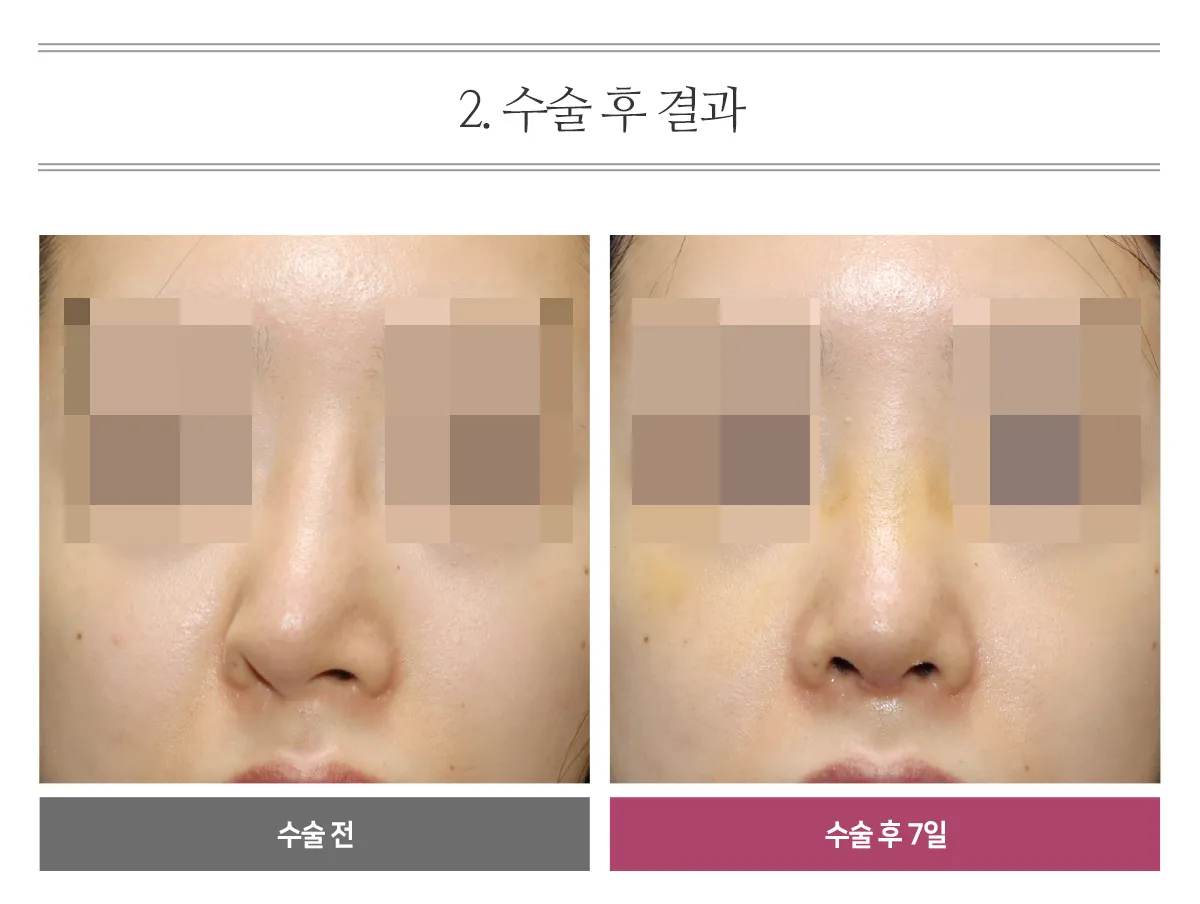
The right photo shows the appearance 7 days after surgery.
The axis of the dorsum is well aligned to the midline,
and the tip that had rotated to the right has returned to the center, so the nostrils are fully symmetric.
Although removal and manual reduction were performed through an open approach, by 7 days only slight bruising remained and the swelling had almost entirely subsided.

The axis of the columella has returned fully to the center, and nostril symmetry has been completely restored.
The surgical scar is likewise in good condition at 1 week.

The change in the nose as seen from above.
The severely deviated nose can be seen to have been restored to its original shape.

Before surgery, the dorsal lines seen from the left and right oblique views differed markedly,
but after the restorative surgery they were restored to the same appearance.
The dorsal line is also natural, and the tip is more projected and longer.

Before surgery the tip was upturned and bulbous, but after removal it is actually more projected and longer.
A clear improvement in left-right symmetry can be seen.
