

Side Effect of Silicone Rhinoplasty: A Case of Correcting "Contracted Nose" Deformity

Side Effect of Silicone Rhinoplasty: A Case of Correcting "Contracted Nose" Deformity
Rhinoplasty with a silicone implant
becomes, over time, a cause of various side effects.
Representative side effects include
skin damage
inflammatory reaction
show-through
contracture
and others.
Of these, "contracture" develops slowly over a long time,
so it goes unnoticed at first
and is recognized only at some point;
the further contracture has progressed,
the more distinct and extensive the nasal deformity becomes.
In early contracture, removing the silicone alone
can restore the nose almost to its original appearance,
but when it has progressed considerably,
several deformities have to be corrected,
so cartilage grafting is essential,
and the more severe the contracture, the greater the need for costal cartilage.

Past History: 15 years ago, the dorsum was rasped down
and augmentation rhinoplasty was performed with silicone.
Chief Complaint: Bruising appeared frequently on the dorsum
and lasted a long time,
and at some point the patient realized the nose had become deformed.
Physical Examination: The tip was pinched and upturned,
and the external valve was narrowed.
When bruising occurs frequently after silicone augmentation rhinoplasty,
the capsule surrounding the silicone
is injured by rubbing against the silicone,
a small amount of bleeding occurs from the capsule,
and this collects inside the capsule to form a hematoma.
The capsule has little ability to absorb a hematoma,
so the bruising lasts a long time,
and as the capsule thickens as a result,
contracture follows.
Removing the silicone and capsule therefore
treats the contracture and also
serves to prevent recurrence.
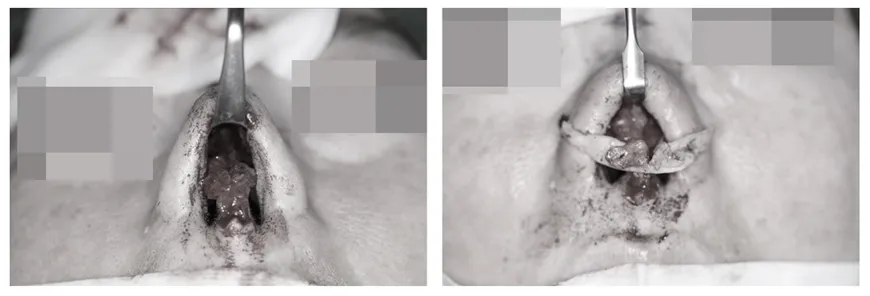
OP: After the silicone and capsule were thoroughly removed,
the tip cartilages were dissected.
At surgery, the tip was drawn together toward the center,
so it was dissected free;
the tip cartilages were badly damaged
and little of them remained.
The bent, damaged alar cartilages of the tip
were reinforced with ear cartilage in a lateral crural strut graft,
the upturned tip was brought down with a derotation graft,
and the dorsum was augmented with acellular dermal matrix.
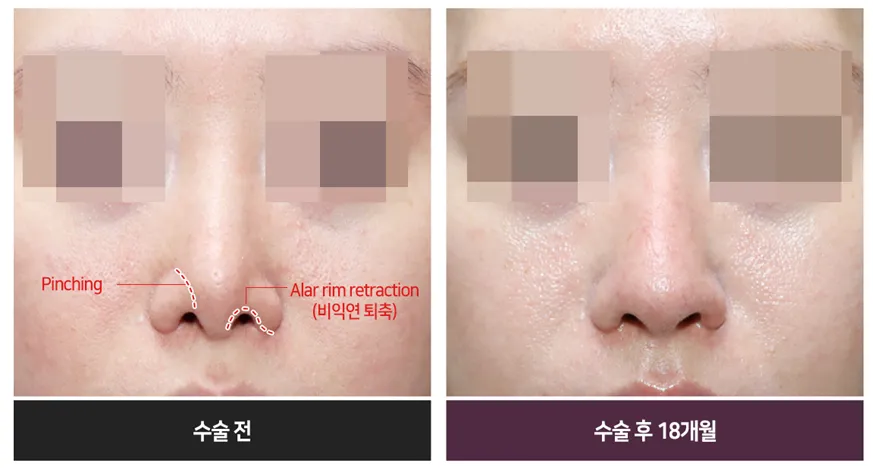
At 1.5 years after surgery, the tip pinching and nostril show (alar rim retraction)
caused by silicone contracture
have been completely corrected with the lateral crural strut graft and derotation graft.

The pointed, pinched tip has also been corrected
to a round, natural shape.
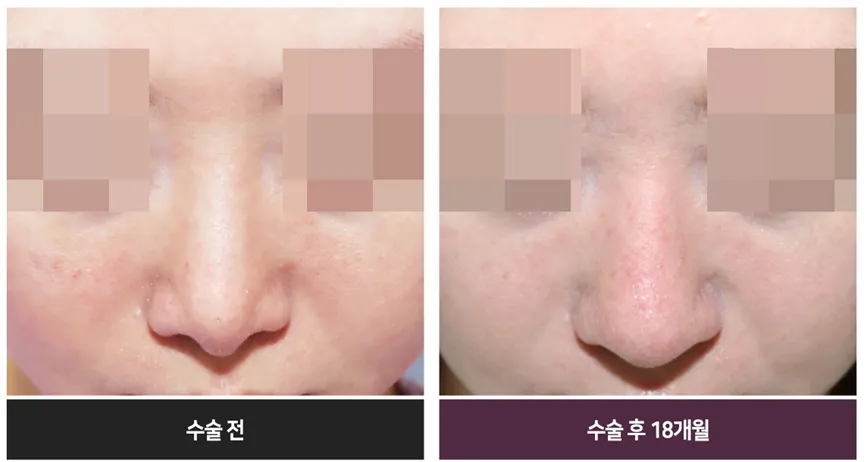
The tip that had jutted out to a point and
the deeply notched alar rim (the margin of the ala)
have become gentle and natural.
Pinching of the tip had narrowed the external valve
and made breathing difficult,
but with the nasal valve opened after surgery,
breathing has improved remarkably.

The severely upturned tip has come down completely,
and the dorsal line reinforced with acellular dermal matrix
is well defined yet natural.
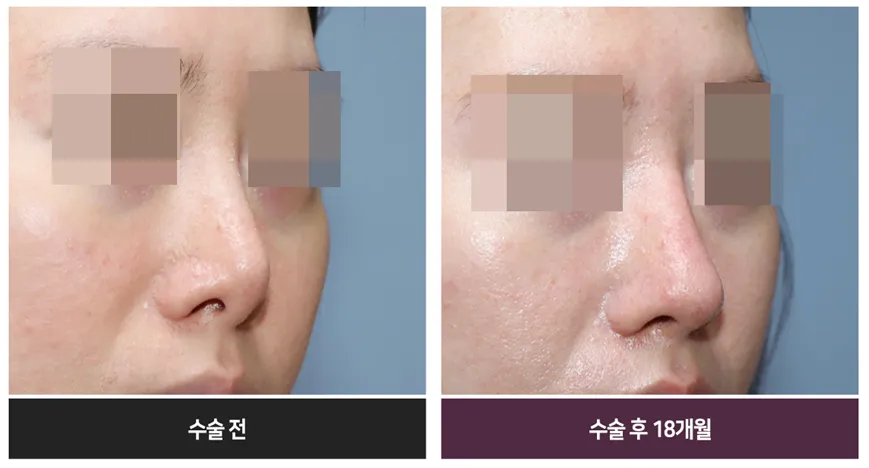
The severely upturned tip has come down completely,
and the line running from the dorsum to the tip
can be seen to have a natural shape.