

Deviated Nose and Dorsal Hump Correction, and Silicone Removal After Hump Surgery
Among patients who have had dorsal hump surgery, we often see cases in which silicone was used.
Whatever the reason, this is clearly bound to lead to a poor result.
Silicone is fundamentally an implant used to raise the height of the dorsum,
so there is no reason to use it in dorsal hump surgery, which reshapes a bulging dorsum to make it straight.
Looking at cases in which silicone was used in dorsal hump surgery,
the bulging hump could not be made straight, and silicone was used to cover it.
When a hump is covered with silicone in this way, the dorsum becomes higher,
so the tip has to be raised even more, which places excessive tension on the tip skin; the skin of the tip becomes thin
and firm, and the pulling of the skin causes discomfort.
In addition, the dorsum and tip become too high, giving the nose an unnatural overall shape.
For this reason, surgery for a dorsal hump or a deviated nose must always be performed with autologous tissue alone.
Dorsal hump surgery with silicone? No!
When a silicone implant is placed in a nose with a dorsal hump, the dorsum becomes too high, and the tip must be
raised high to match it, so the tip ends up excessively high and pointed and looks unnatural.
In addition, when tension in the tip skin increases, the nose and mouth feel tight and stiff, which is uncomfortable.

PH
A 31-year-old man. Several years earlier, during dorsal hump surgery at another clinic, he received silicone on the dorsum
and a septal extension graft and an ear cartilage cap graft at the tip.
CC
Ever since the surgery, the tip had been too high, tight, pointed, and unnatural,
so he wished to return to his original appearance.
P/E
To connect smoothly with the height of the bulging dorsum, the tip already has to be raised considerably,
and with silicone added on top, the tip had to be raised about twice as much.
As a result, not only had a septal extension graft been used, but ear cartilage had also been placed on top of the tip.
Silicone was palpable on the dorsum, and the tip was fixed and firm because of the septal extension graft.
The tip was too pointed.
OP
The silicone, the septal extension graft, and the tip cap graft were all removed,
and combined repositioning of the tip cartilages was performed.
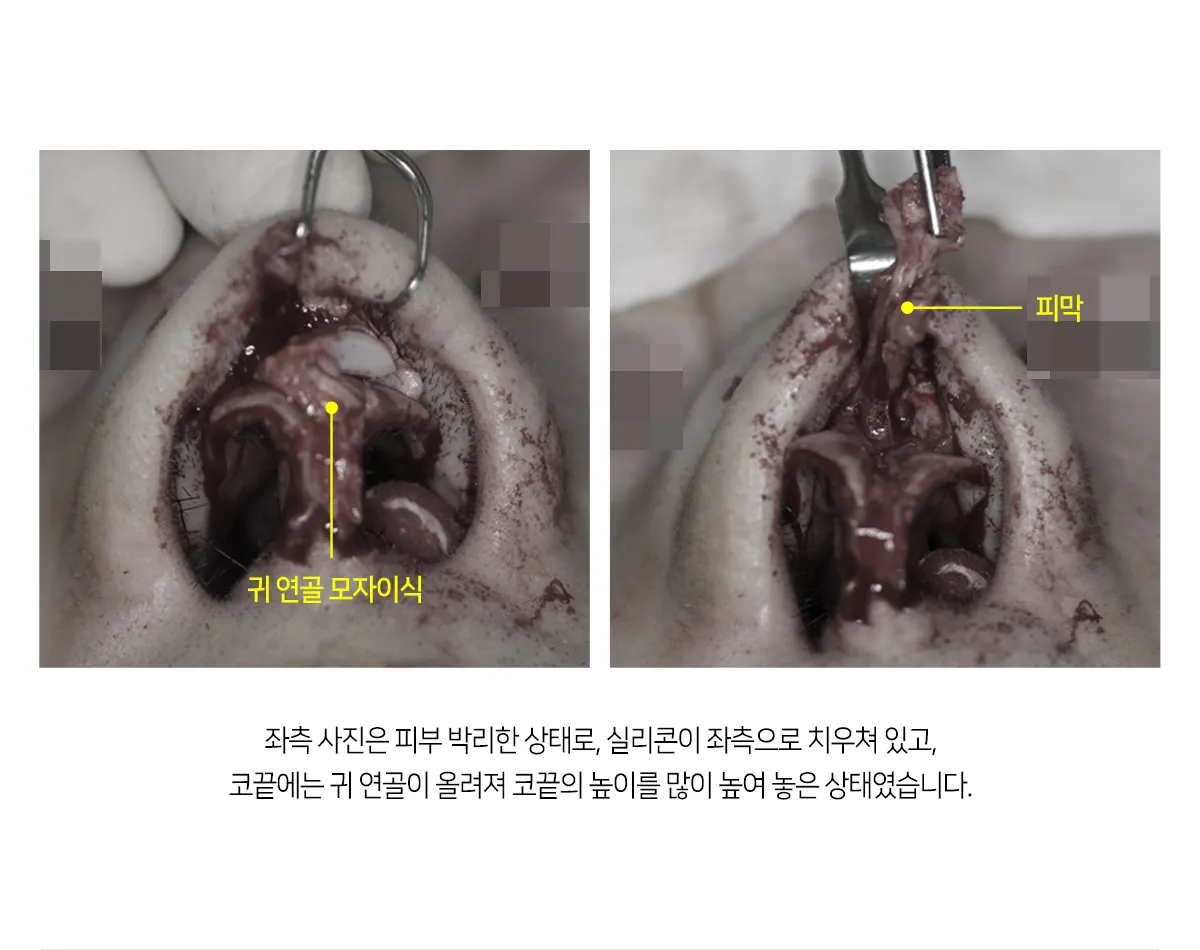
The photo on the left shows the nose after skin dissection: the silicone was displaced to the left,
and ear cartilage had been placed on the tip, raising the tip height considerably.
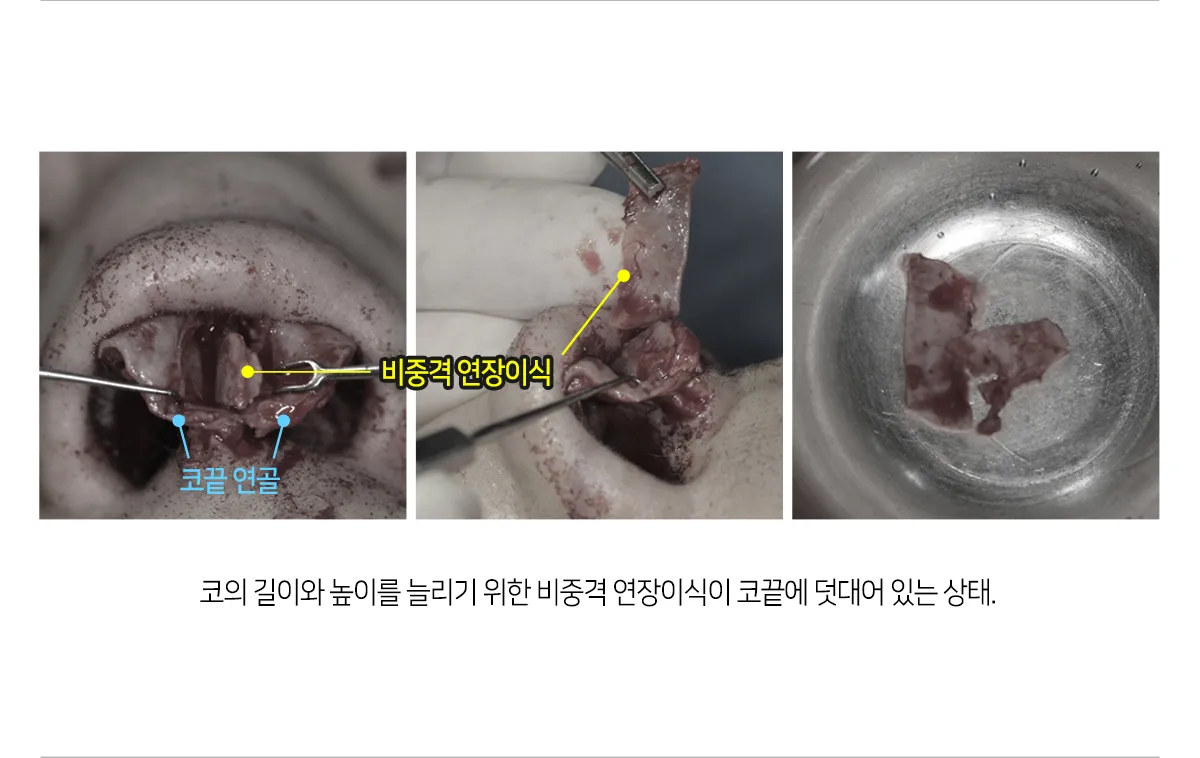
A septal extension graft, intended to increase the length and height of the nose, had been attached at the tip.

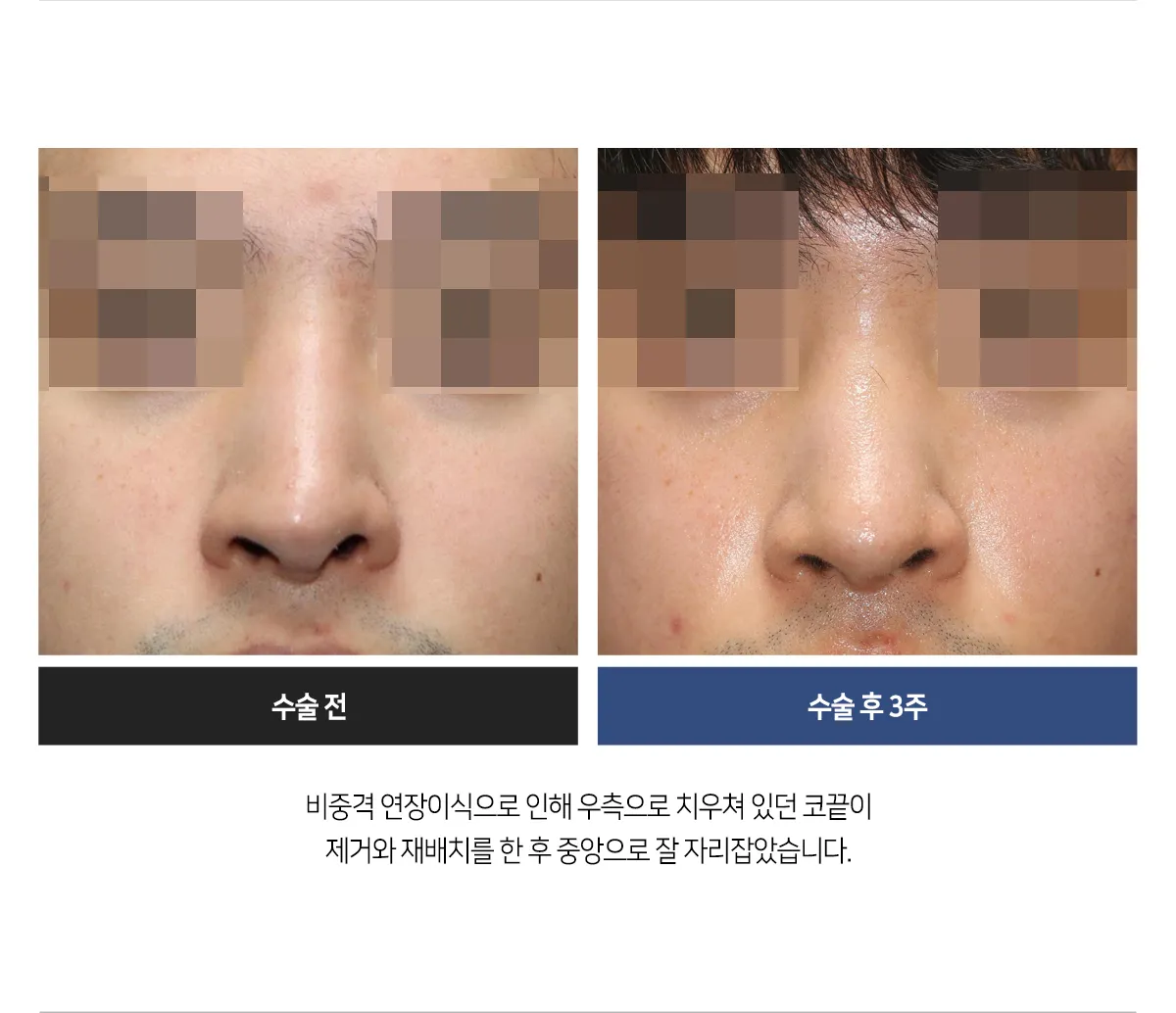
The tip, which had been displaced to the right by the septal extension graft,
settled well in the center after removal and repositioning.


The tip, which had looked exaggerated because it was long, pointed, and high, became natural.
The patient was pleased that the tightness in the tip was gone and the nose felt comfortable.
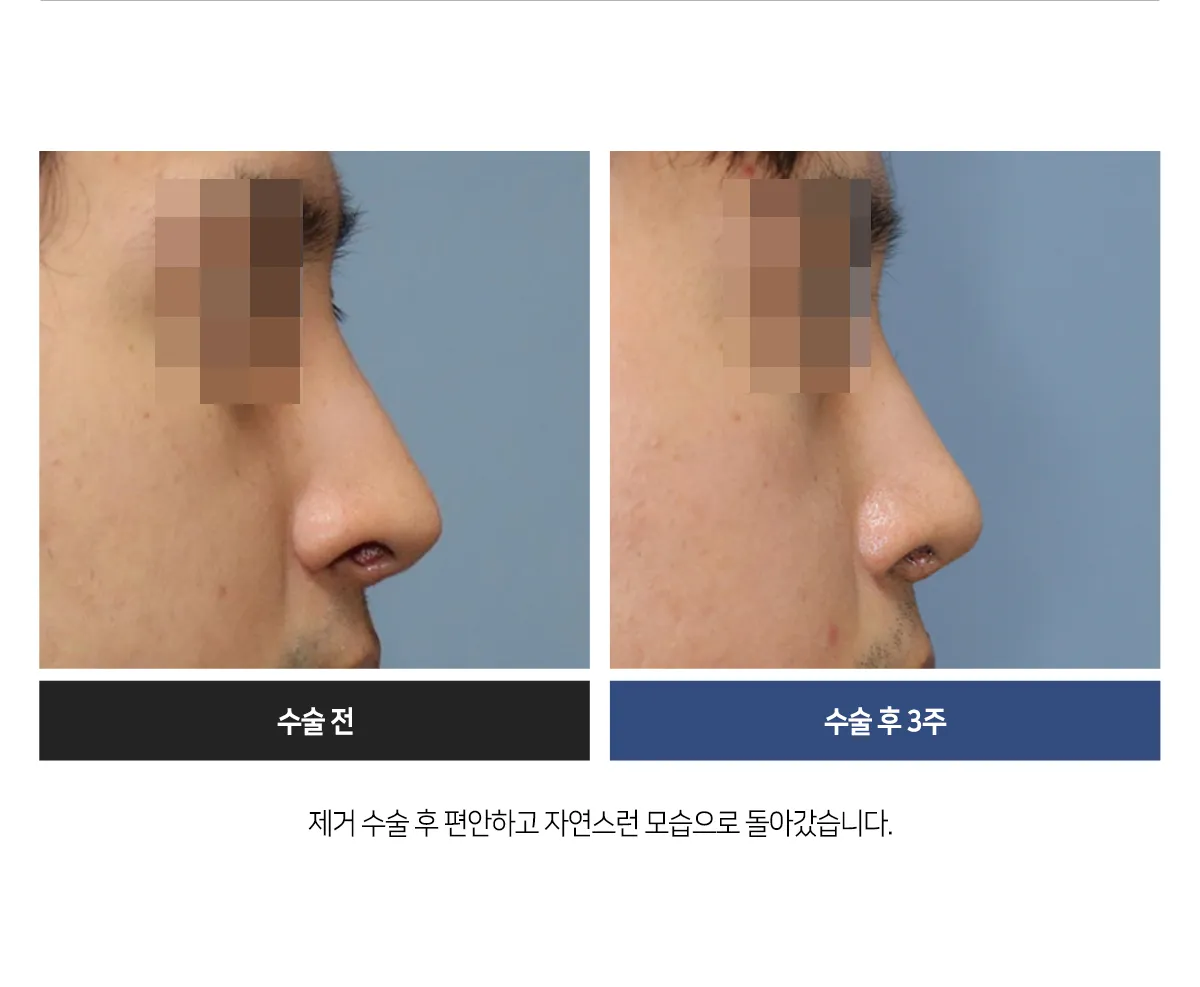
After the removal surgery, the nose returned to a comfortable, natural appearance.

A man in his 20s. He, too, had received silicone on the dorsum and a septal extension graft at the tip during dorsal hump surgery at another clinic.
Because the silicone, together with the hump, made the dorsum higher,
the tip had to be raised even higher, leaving it pointed and under considerable tension.
When silicone is placed during dorsal hump surgery in this way, the nose becomes too large and the tip comes under considerable tension,
so a poor result is inevitable.
A deviated nose or a dorsal hump must be operated on with autologous cartilage alone.
About 70% of dorsal humps are accompanied by a deviated dorsum.
This is because the growth center of the nose lies where the nasal bones meet the middle cartilages,
and during adolescence,
excessive growth at this growth center produces a hump and, at the same time,
causes the nose to deviate to one side.
The hump then forms at the midpoint of the nose, where the nasal bones meet the dorsal cartilages.
The protruding, deviated framework of the nose therefore has to be reshaped and straightened,
and artificial materials such as silicone, mesh, or Medpor should not be used for this, nor are they needed.

In the frontal photo, the axis of the nose can be seen to be bent:
the dorsal line running down from the glabella slants toward the patient's left
and then bends back toward the center at the tip. In the lateral photo, a hump bulging from the dorsum
is visible, and the tip also droops slightly. In the photo taken from below, the columella and
the septum, marked with a yellow line, can be seen to be out of alignment with each other.
In other words, the septum is deviated toward the patient's left.
A hump is never corrected simply by rasping the hump itself,
because rasping only one point does not straighten the dorsal line, and a bulging hump still remains.
The hump therefore has to be resected over a long segment, and, measured at its most prominent point,
at least 3mm must be removed.
After this reduction, a spreader graft, which rebuilds the open roof, must be performed.
The spreader graft not only rebuilds the roof but also serves to straighten the deviated septum.
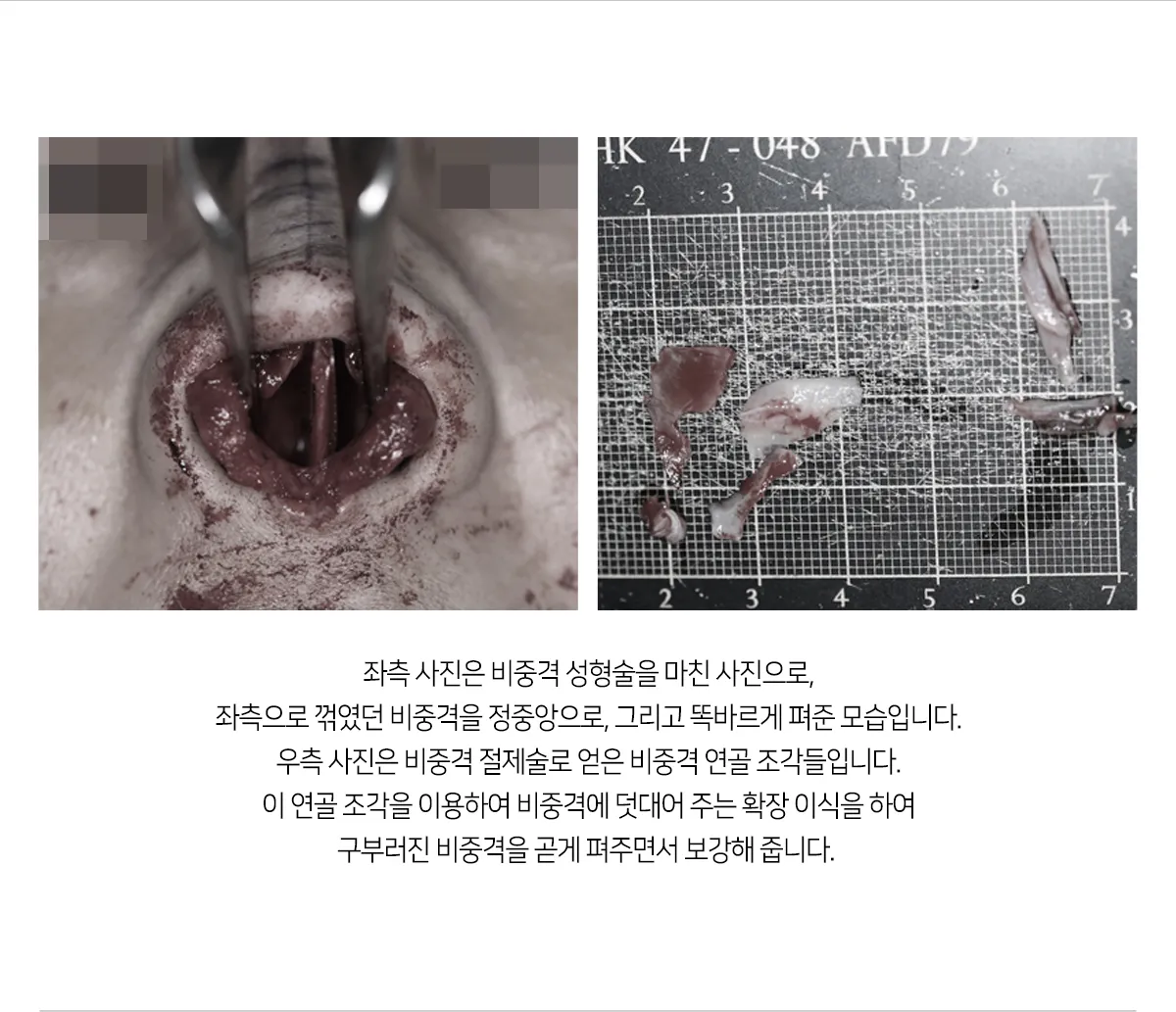
The photo on the left was taken after septoplasty:
the septum, which had been bent to the left, has been brought to the midline and straightened.
The photo on the right shows the pieces of septal cartilage obtained through septal resection.
These cartilage pieces are used as spreader grafts placed alongside the septum,
straightening and reinforcing the curved septum.
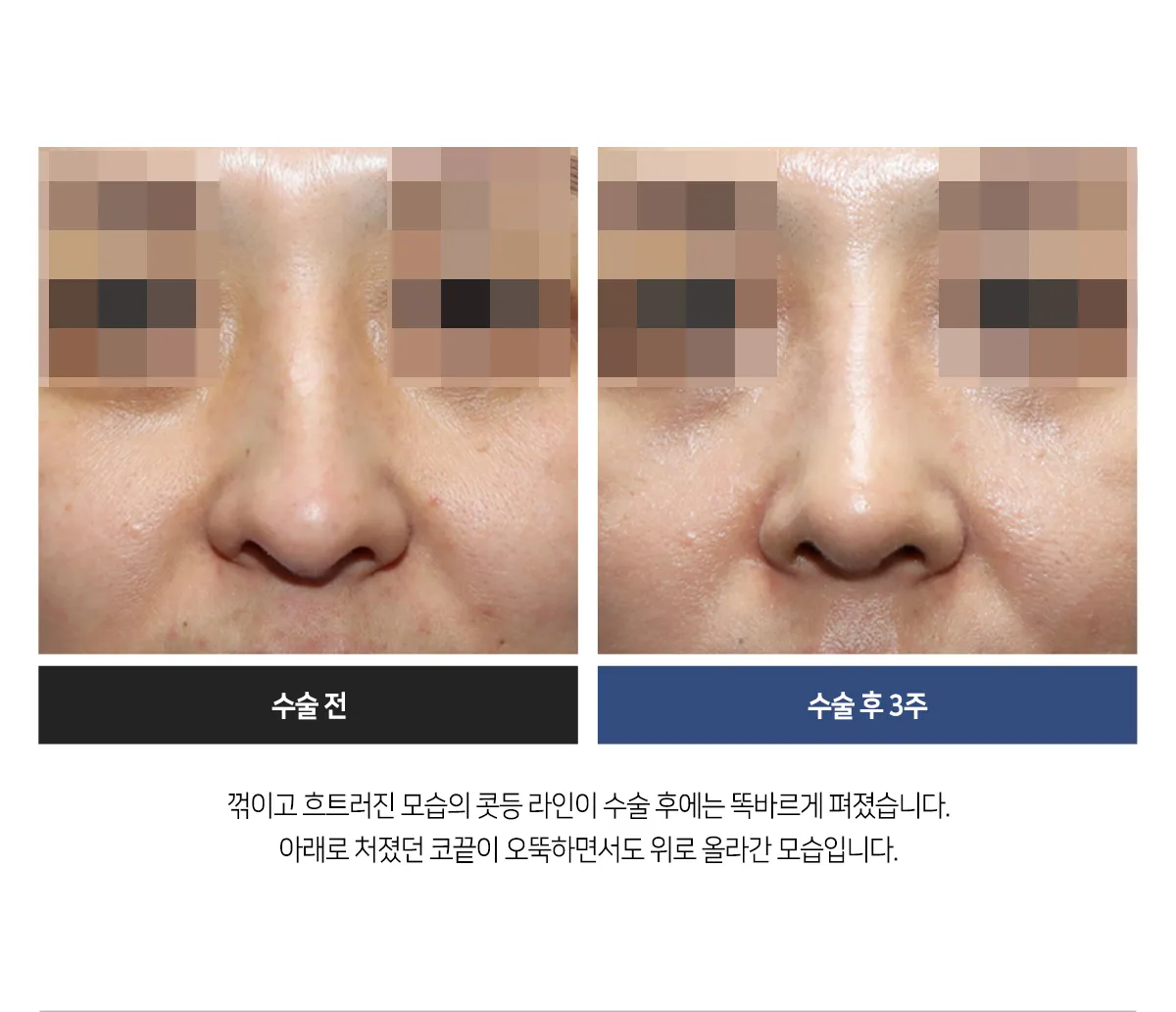
The dorsal line, which had been bent and irregular, became straight after surgery.
The tip, which had drooped downward, is now well defined and lifted.
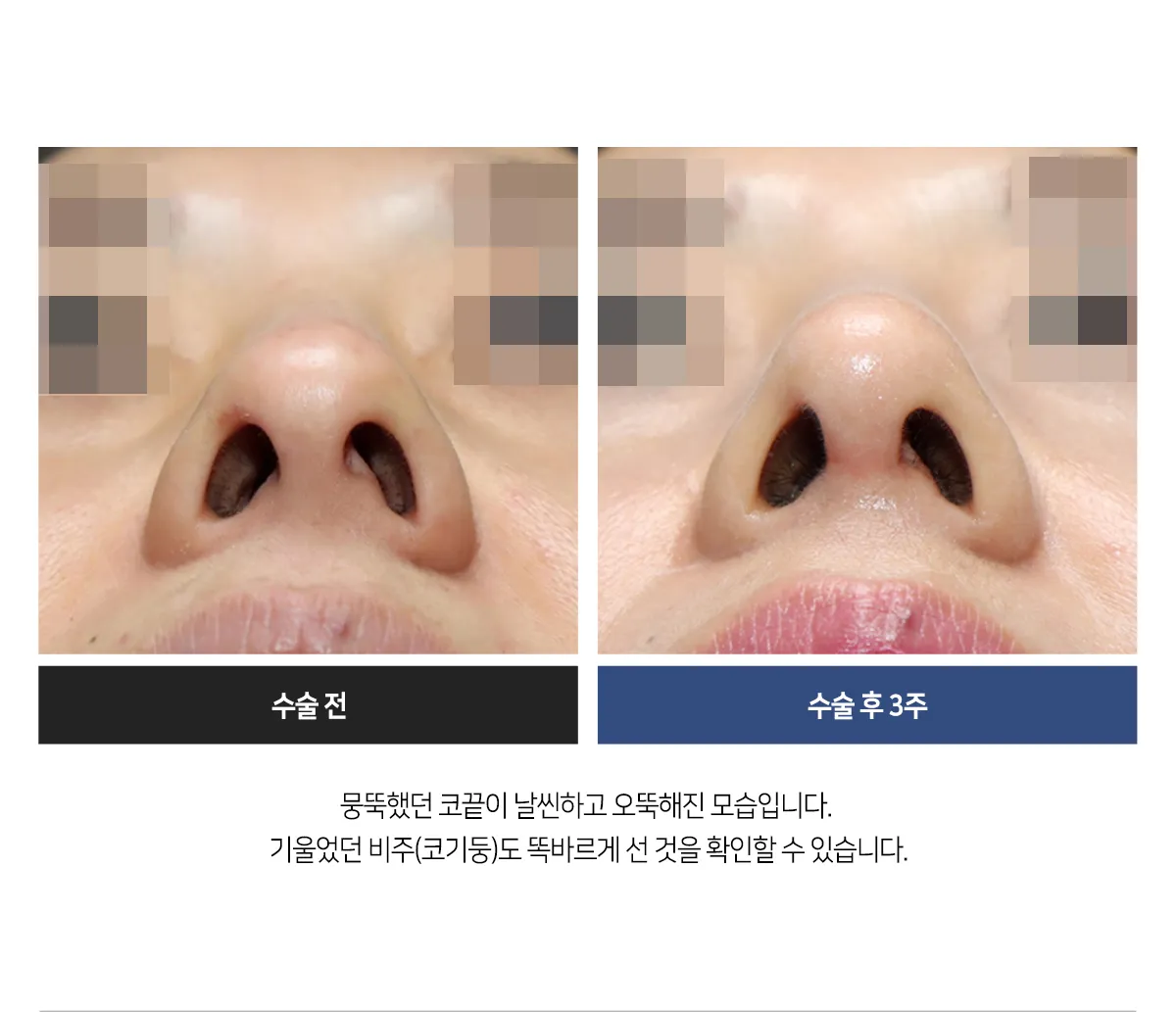
The tip, which had been bulbous, is now slim and well defined.
The columella, which had been tilted, can also be seen to stand straight.
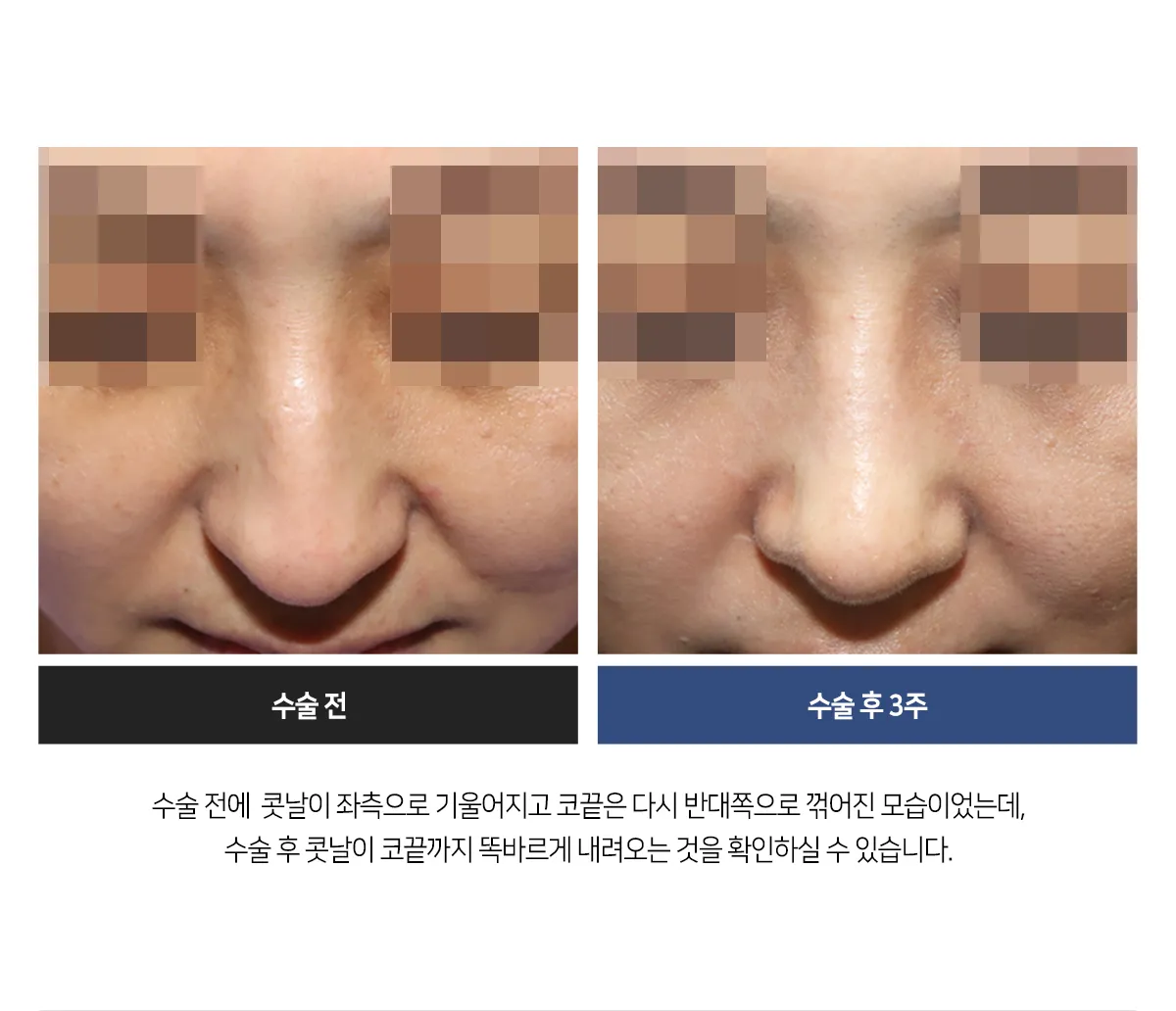
Before surgery, the bridge leaned to the left and the tip bent back in the opposite direction,
but after surgery the bridge can be seen to run straight down to the tip.

A typical dorsal hump, with a bulging dorsum and a drooping tip, became a straight, slim nose after surgery.
At the same time, the nose became neither lower nor too large.
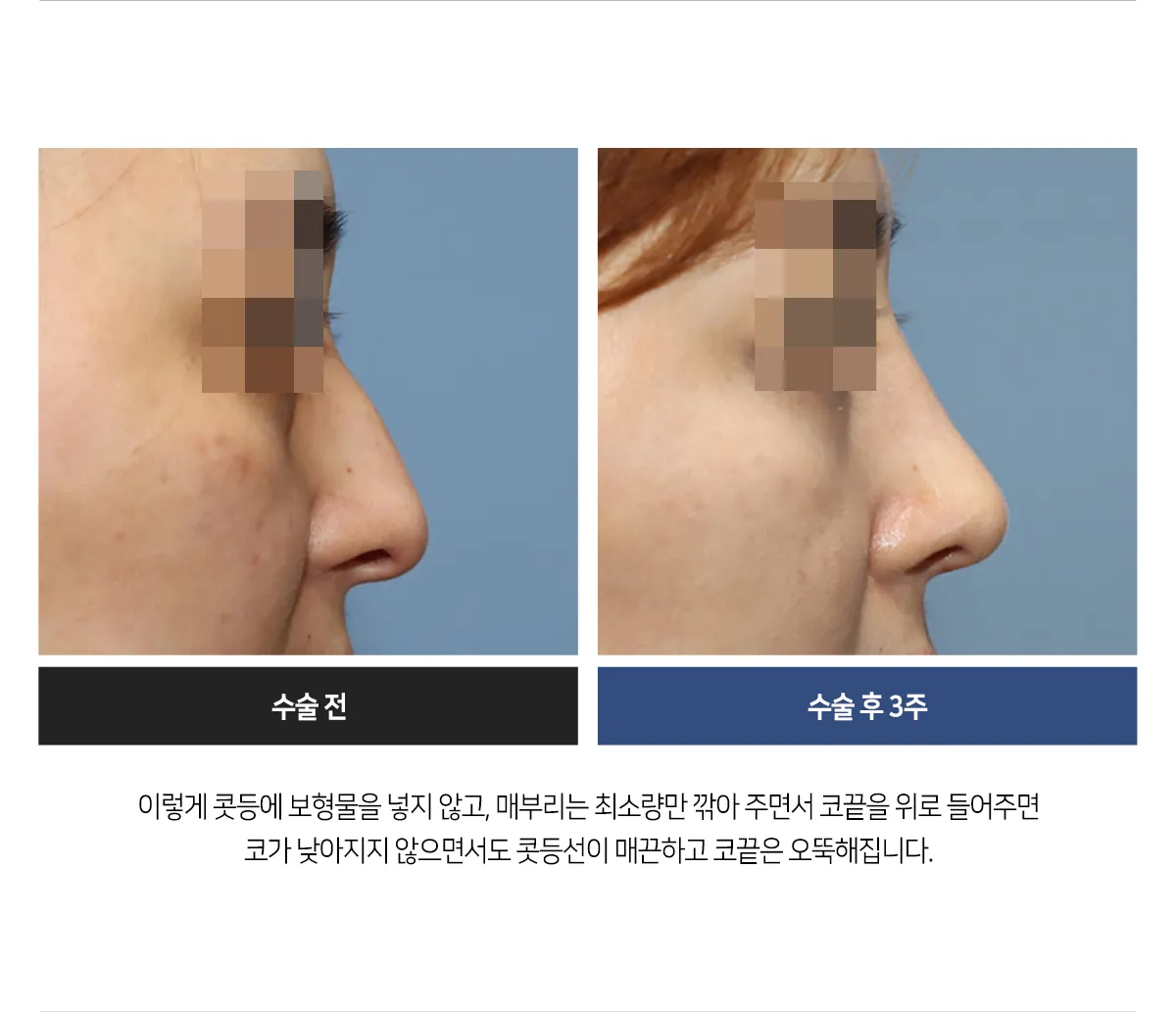
When no implant is placed on the dorsum, only the minimum amount of the hump is removed, and the tip is lifted in this way,
the dorsal line becomes smooth and the tip well defined without the nose becoming lower.

Not only was the dorsal line uneven, but the width of the dorsum was also irregular;
after surgery, the dorsal line became straight.

The dorsum is straight and the tip well defined, yet the nose is neither too high nor too small, giving a balanced appearance.