

Nasal Silicone Side Effects: An Actual Case of a Contracted Nose Corrected with "Ear Cartilage"
Compared with surgery on other areas, rhinoplasty
tends to have notably more side effects.
It would be good if a successful course
could be achieved from the very first rhinoplasty, but
✅ Dissatisfaction with the design
✅ The implant chosen for the rhinoplasty
for these and various other reasons,
side effects sometimes occur.
Among them, the side effects of "silicone implants"
are wide-ranging.
A representative side effect
is the contracted nose.
A contracted nose is
a condition in which scar tissue (fibrosis) inside the nose or
a reaction around the implant
pulls the nose upward,
making it look short and upturned.
For a patient troubled by contracture,
revision rhinoplasty was performed;
we would like to introduce this actual case.
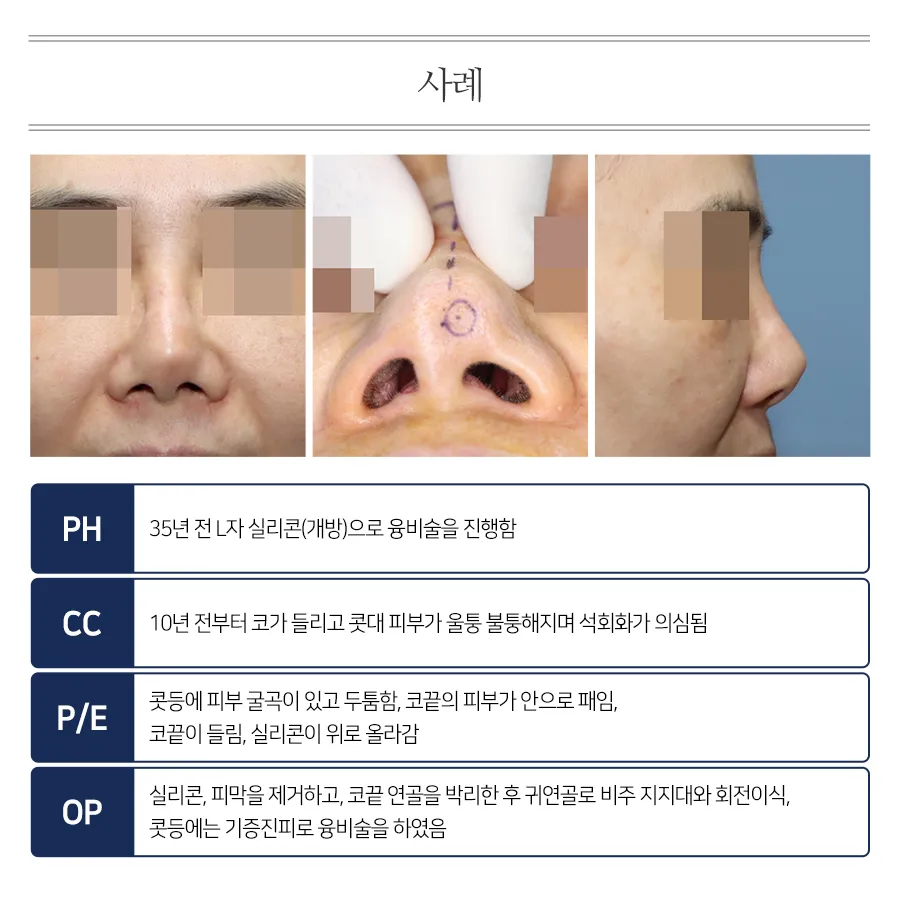
PH:
35 years ago: augmentation rhinoplasty with an L-shaped silicone implant (open approach)
CC:
For the past 10 years the nose has been turning up,
and the skin over the bridge has become uneven, with calcification suspected
P/E:
- The skin of the dorsum is uneven and thick
- The skin of the tip is indented
- The tip is upturned
- The silicone has migrated upward
CC:
The silicone and capsule were removed,
the tip cartilages were dissected,
a columellar strut + derotation graft were placed using ear cartilage,
and the dorsum was augmented with acellular dermal matrix.
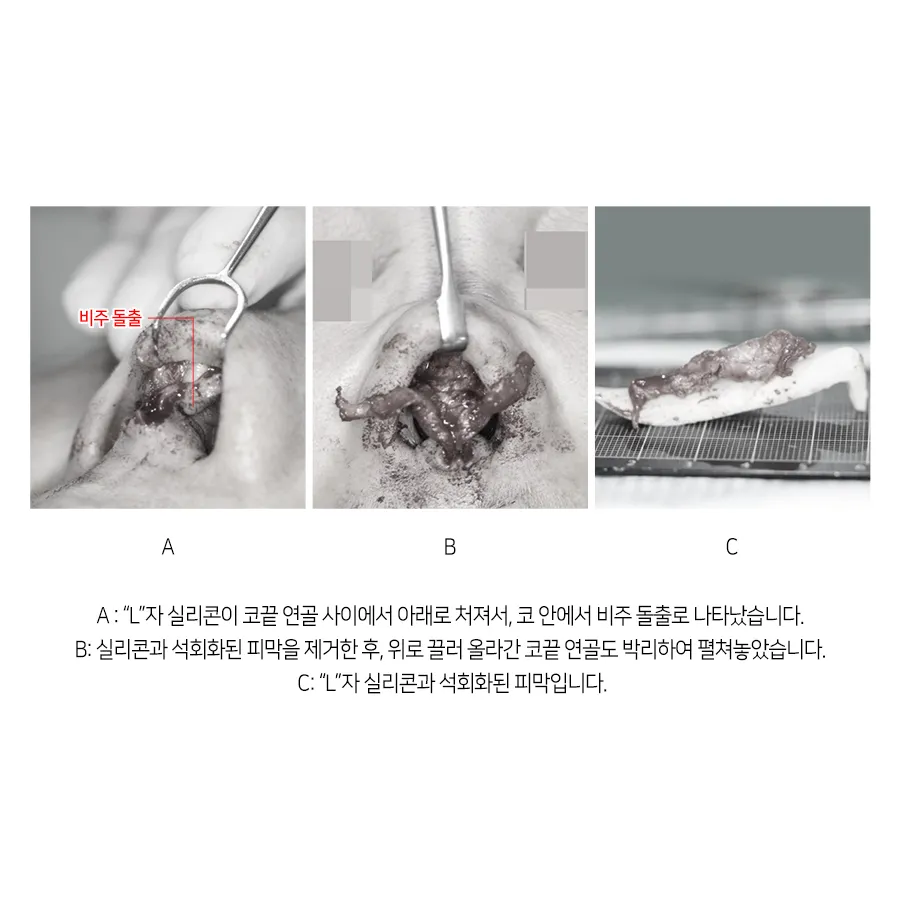
In photo A,
the "L"-shaped silicone implant, between the tip cartilages,
had sagged downward
and presented as columellar protrusion inside the nose.
Photo B shows
the state after the silicone and calcified capsule were removed,
with the tip cartilages, which had been pulled upward, also dissected
and spread out.
Photo C shows
the "L"-shaped silicone implant and the calcified capsule.
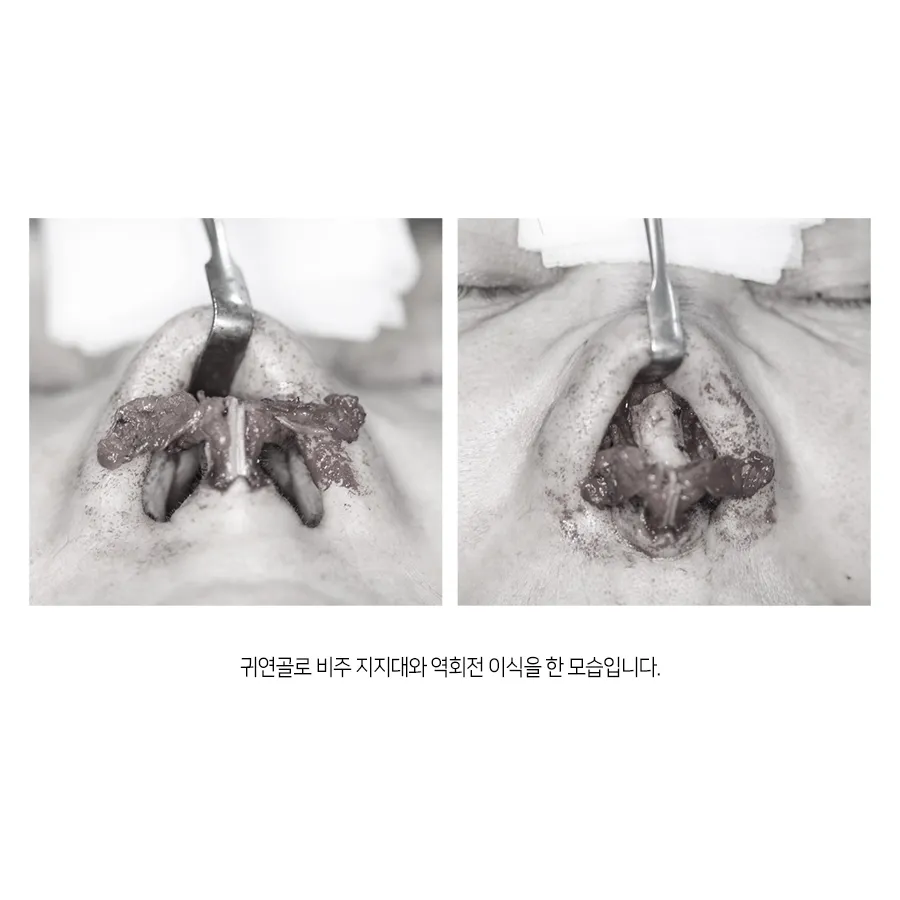
This shows the columellar strut and
derotation graft made with ear cartilage.
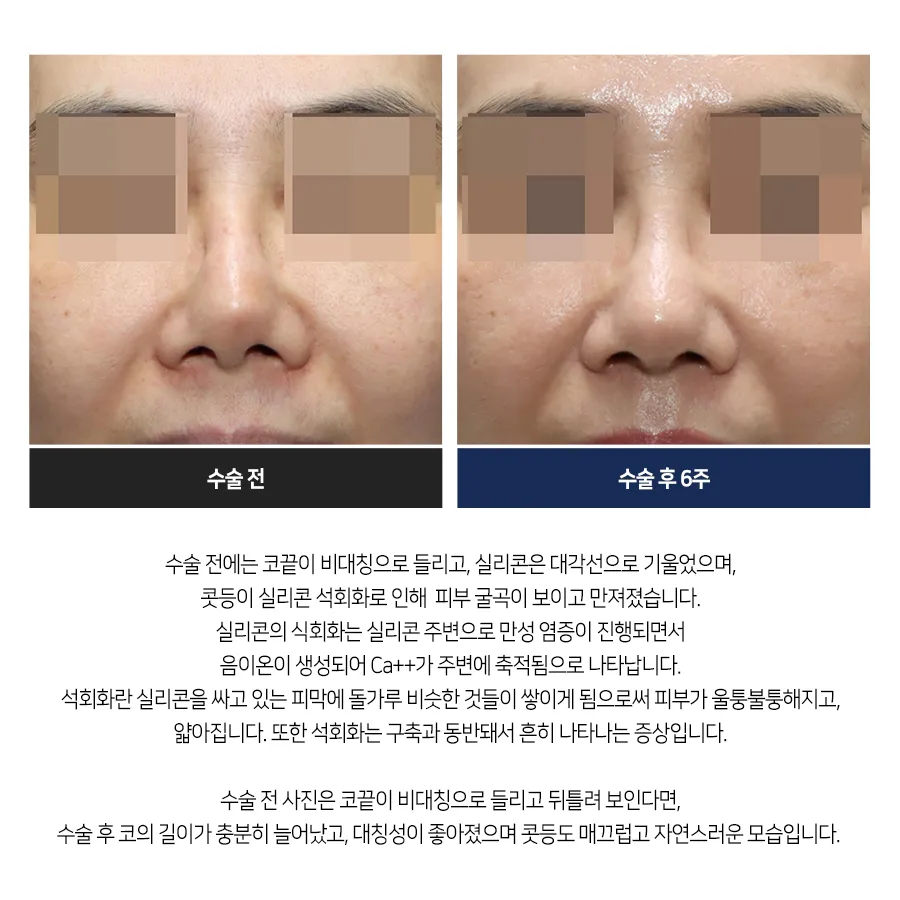
Before surgery, the tip was asymmetrically upturned,
the silicone was tilted diagonally,
and because of calcification of the silicone,
irregularities of the skin on the dorsum could be seen and felt.
Calcification of silicone occurs when, around the silicone,
chronic inflammation progresses,
anions are generated, and Ca++
accumulates in the surrounding area.
Calcification means that on the capsule surrounding the silicone,
deposits resembling stone powder build up,
and the skin becomes uneven and thinner.
Calcification is one of the symptoms
that commonly accompany contracture.
In the preoperative photo, the tip looks asymmetric
and twisted,
whereas in the postoperative photo the nose has been sufficiently lengthened,
symmetry has improved,
and the dorsum is smooth and natural.
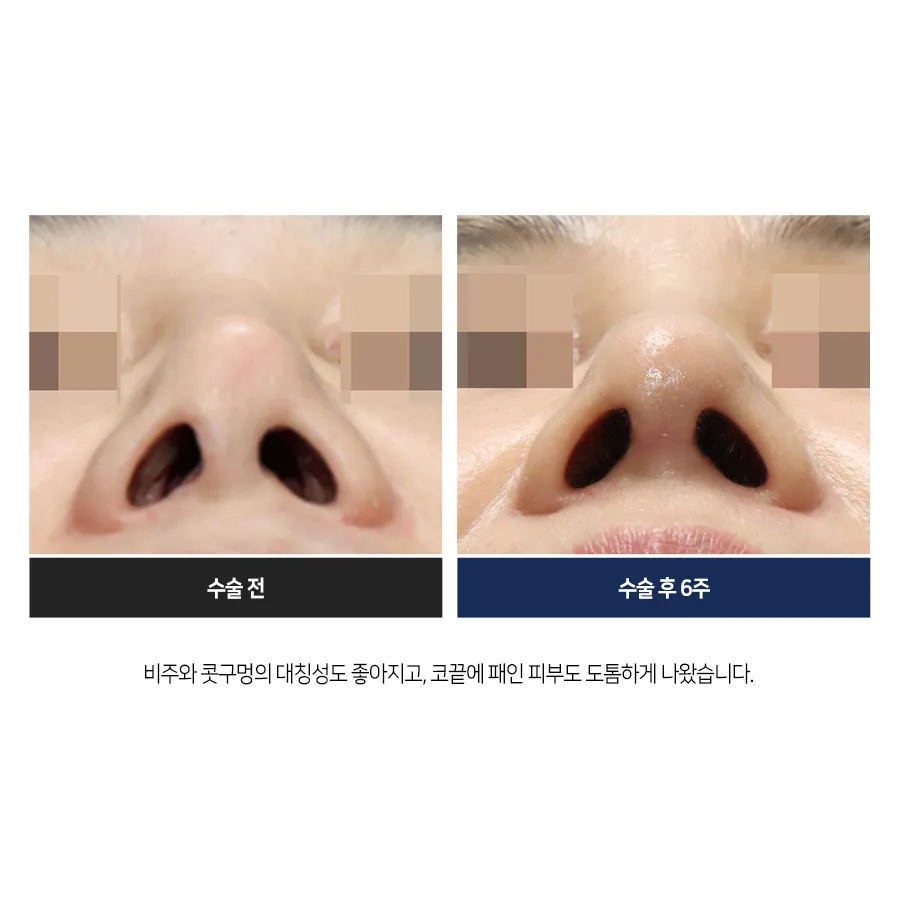
The symmetry of the columella and nostrils has also improved,
and the indented skin at the tip
can be seen to have filled out.
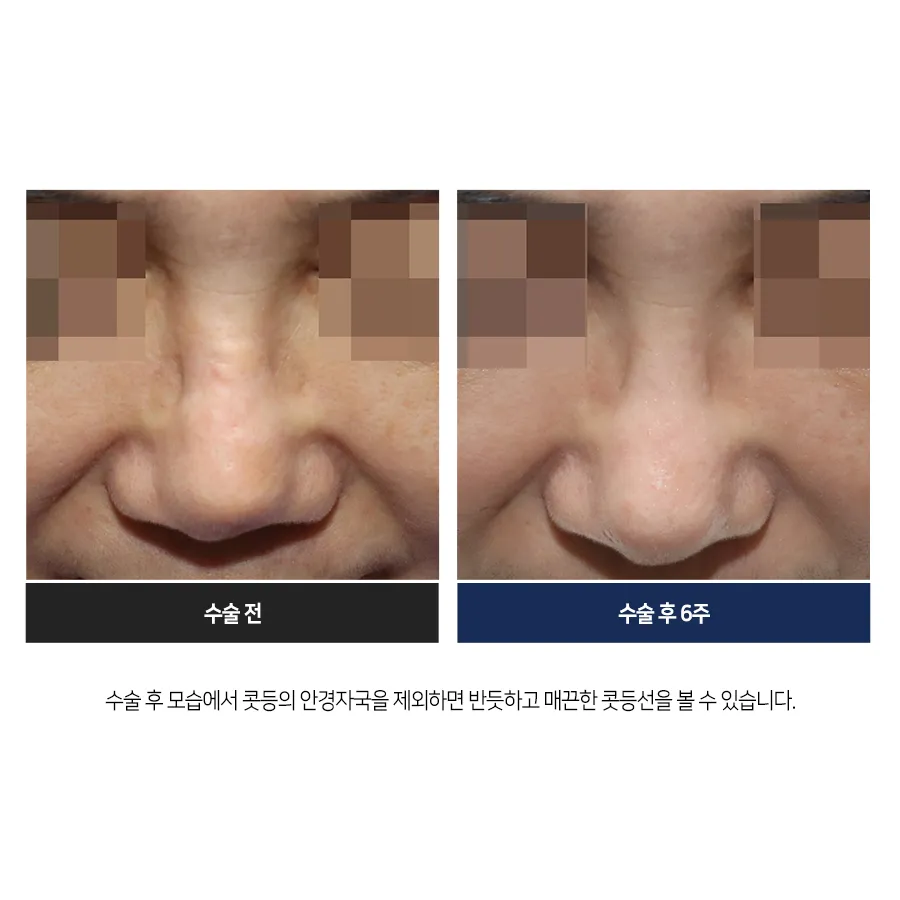
In the postoperative view, apart from the marks left by glasses on the dorsum,
a straight, smooth dorsal line
can be seen.

That the tip came down and became natural after surgery
can also be seen at a glance.

The upturned tip has come down naturally,
and the tip, which had looked unnatural,
is now round and full.
--------------------------------
In this way, using ear cartilage,
the contracted nose could be corrected.
Because the causes of a contracted nose also vary,
a diagnosis tailored to each symptom and cause
and a surgical plan need to be established
please keep this in mind.