

Contracted Nose with a Twisted Tip
Surgical Case of a Contracted Nose with a Twisted Tip
A contracted nose is a deformity in which the skin and soft tissue shrink and the structures of the nose draw inward.
In particular, the tip cartilages, being the soft part, are deformed most severely, and upturning or twisting of the tip is common.
Nostril asymmetry, pinching, triangular nostrils, and similar findings also appear.

After the silicone, capsule, scar tissue, and other material are removed, a lateral crural strut graft using ear cartilage
corrects the triangular nostrils, columellar tilt, asymmetry, and related problems.
For dorsal augmentation, silicone must not be used again; acellular dermal matrix is used instead,
so that the contracture does not recur and the dorsal line is natural.
History
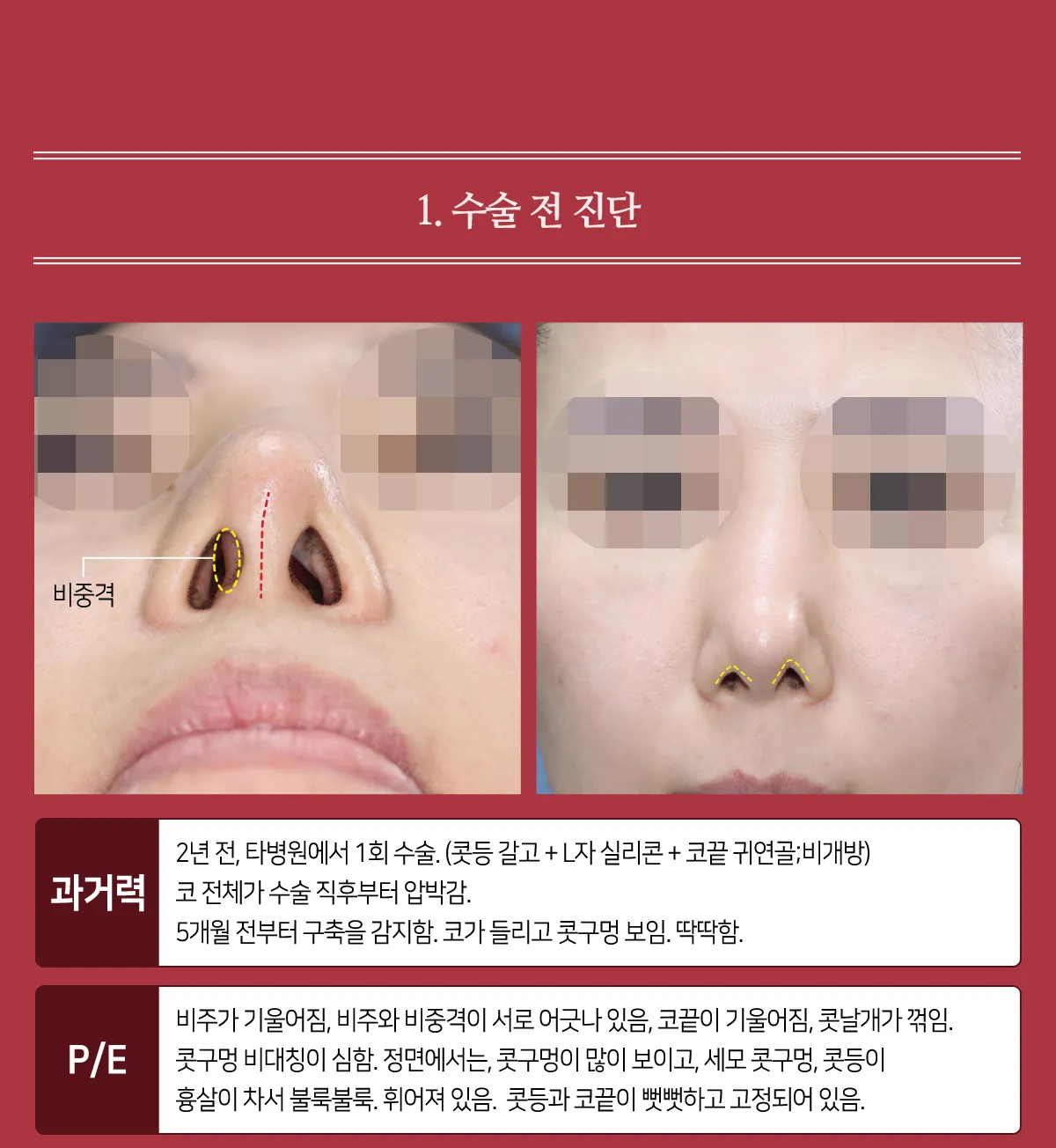
2 years ago: 1 surgery at another clinic. (Dorsal rasping + L-shaped silicone + ear cartilage to the tip; closed approach)
A sense of pressure throughout the nose since immediately after surgery.
Contracture noticed beginning 5 months ago. The nose turned up and the nostrils showed. Hardness.
History
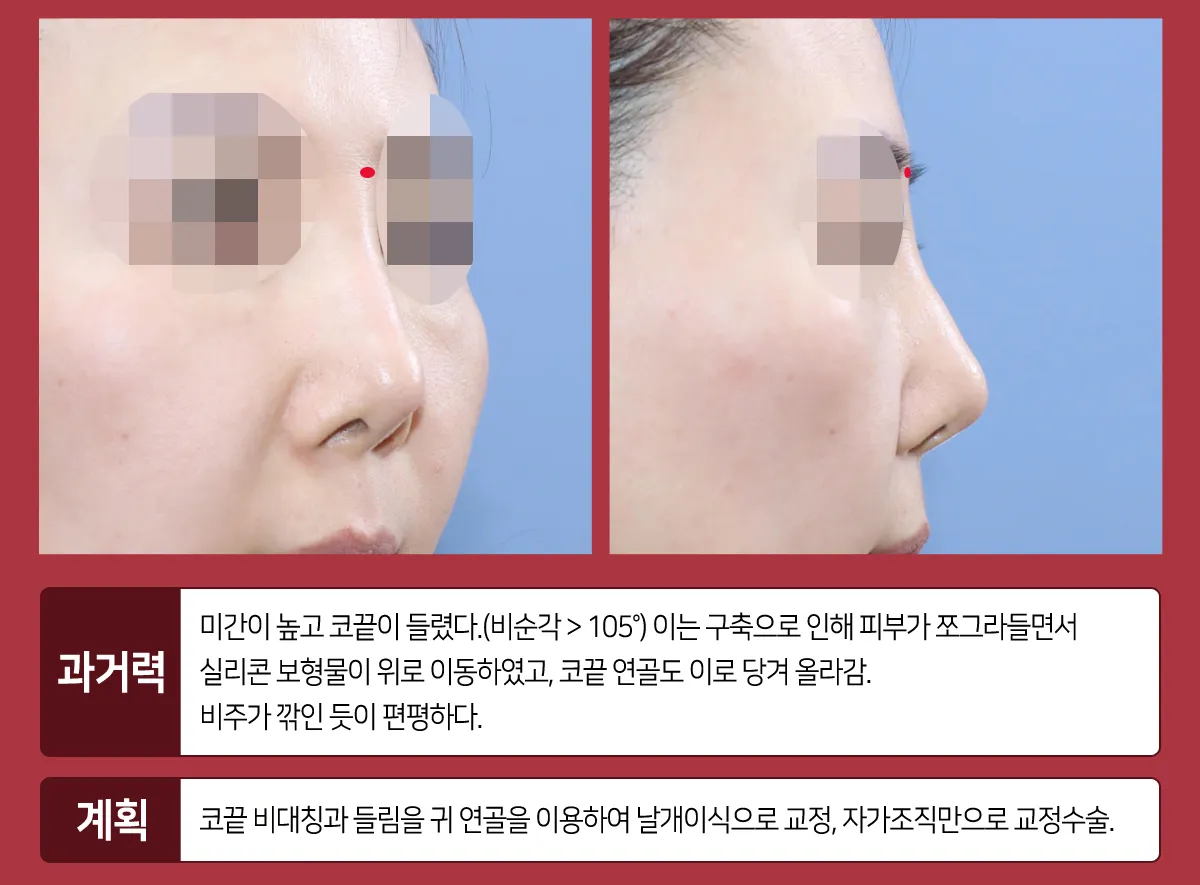
The glabella is high and the tip is upturned. (Nasolabial angle > 105°) This is because, as the skin shrank from contracture,
the silicone implant migrated upward and pulled the tip cartilages up with it.
The columella is flat, as if shaved down.
Plan
Correct the tip asymmetry and upturning with an lateral crural strut graft using ear cartilage; corrective surgery with autologous tissue alone.
Procedures Performed
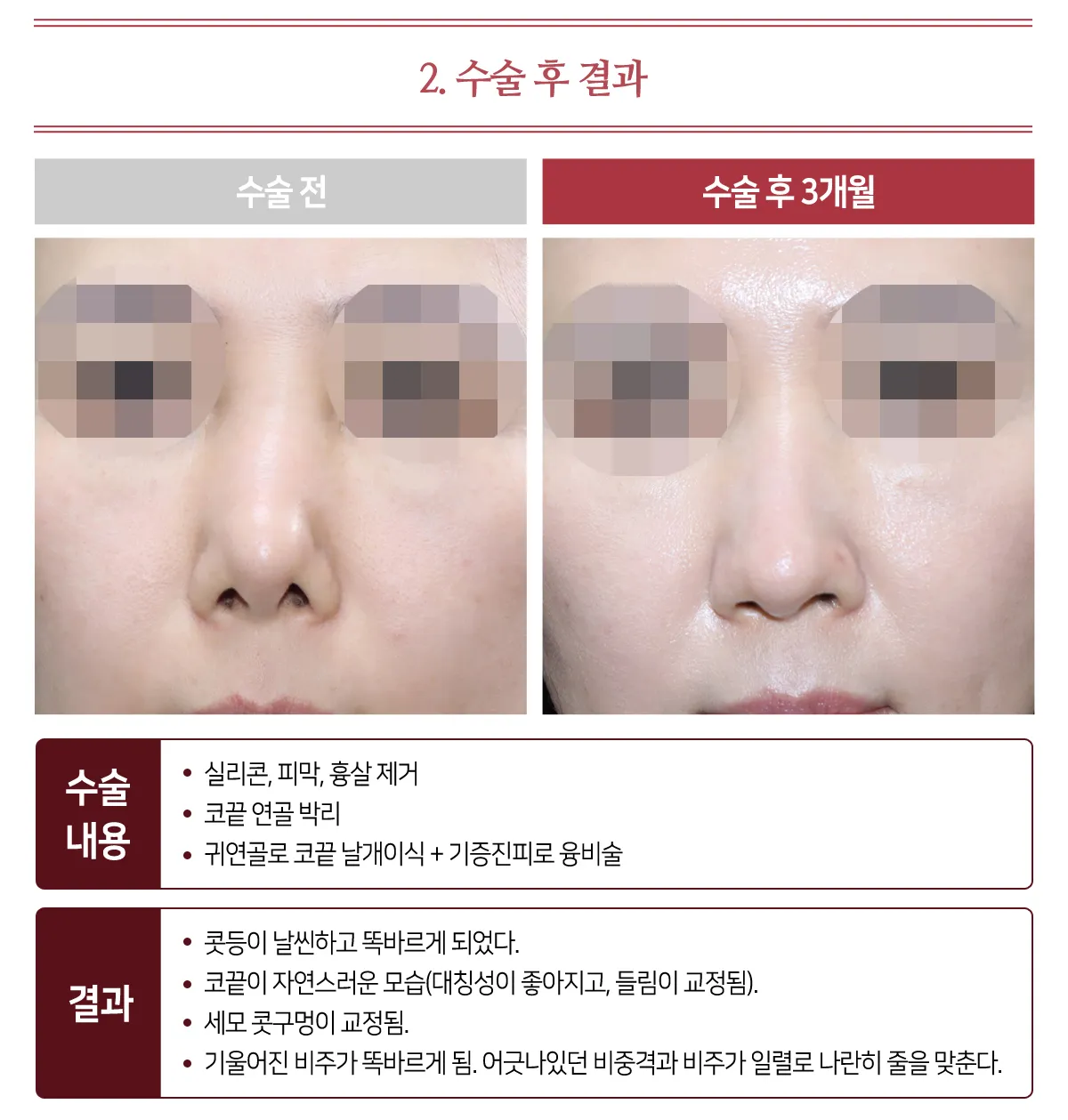
●Removal of silicone, capsule, and scar tissue
●Tip cartilage dissection
●Lateral crural strut graft with ear cartilage + augmentation rhinoplasty with acellular dermal matrix
Results
●The dorsum is slim and straight.
●The tip looks natural (symmetry improved and upturning corrected).
●The triangular nostrils are corrected.
●The tilted columella is straight. The septum and columella, once out of alignment, now line up in a row.

The tilted columella is now straight, and the septum and columella, once out of alignment,
now line up in a row.
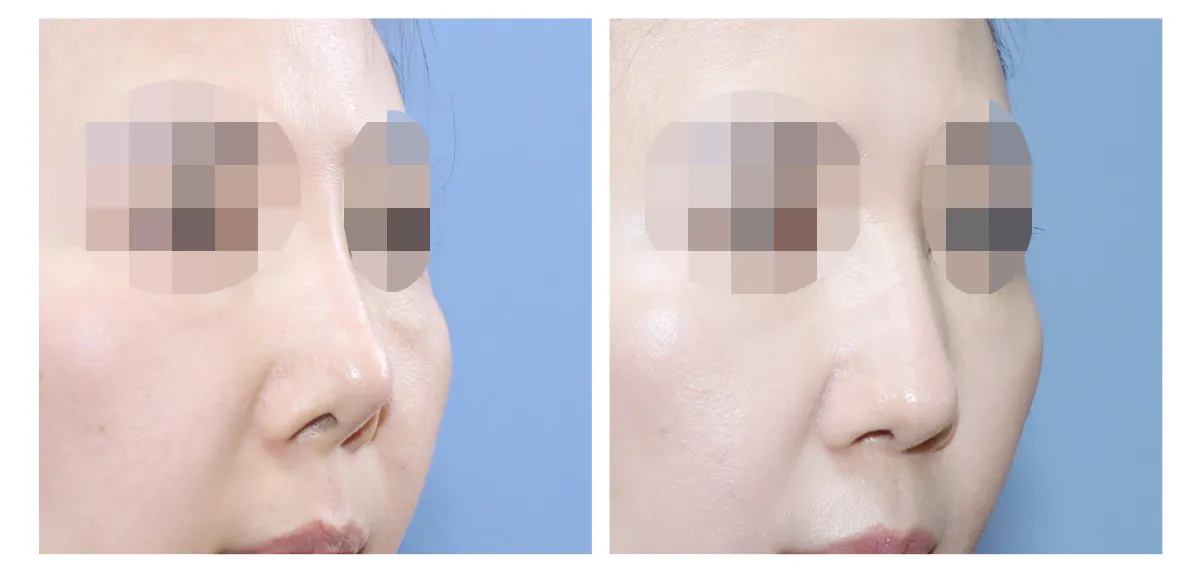
The lumpy dorsum has become slim and straight.
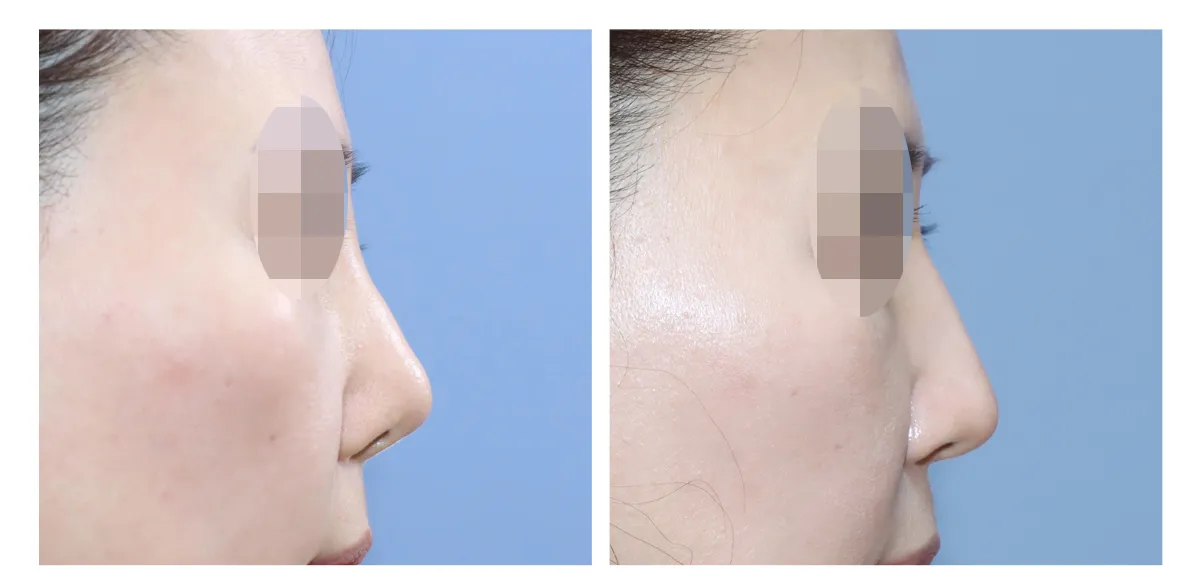
The nasolabial angle has decreased from more than 105° to about 95°. In other words, the nose has been fully lengthened.