

Correcting Contracted Nose Deformity After Silicone Rhinoplasty #ContractedNose #RevisionRhinoplasty #NasalImplantRemoval #UpturnedNose

Rhinoplasty with silicone not infrequently leads to chronic inflammation or contracture.
Contracture means that, because of chronic inflammation around the silicone, the capsule surrounding the silicone
grows progressively tougher and thicker, causing the skin and soft tissue around the capsule
to shrink progressively, so that various deformities appear, mainly around the tip.
The various nasal deformities caused by contracture
typically include an upturned tip, pinching, nostril asymmetry, and twisting.

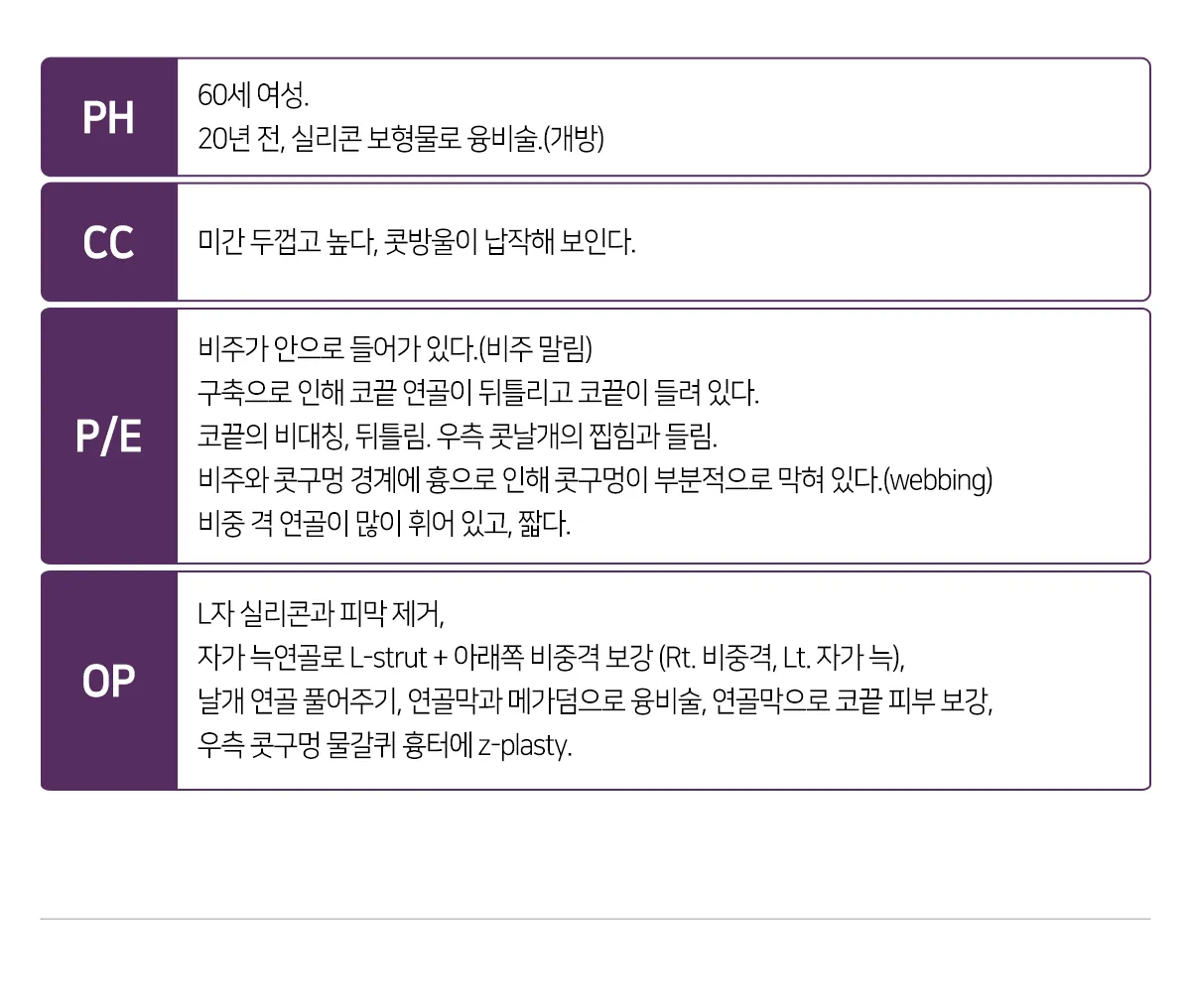
PH
60-year-old woman.
20 years ago, the patient had augmentation rhinoplasty with a silicone implant (open approach).
CC
The glabella is thick and high, and the alae look flat.
P/E
The columella is drawn inward (columellar retraction).
Because of contracture, the tip cartilages are twisted and the tip is upturned.
Asymmetry and twisting of the tip. Pinching and retraction of the right ala.
Scarring at the border between the columella and the nostril partially blocks the nostril (webbing).
The septal cartilage is markedly deviated and short.
OP
Removal of the L-shaped silicone implant and capsule,
L-strut with autologous costal cartilage + reinforcement of the lower septum (Rt. septal cartilage, Lt. autologous costal cartilage),
release of the alar cartilages, augmentation rhinoplasty with perichondrium and MegaDerm, reinforcement of the tip skin with perichondrium,
and z-plasty for the webbing scar of the right nostril.
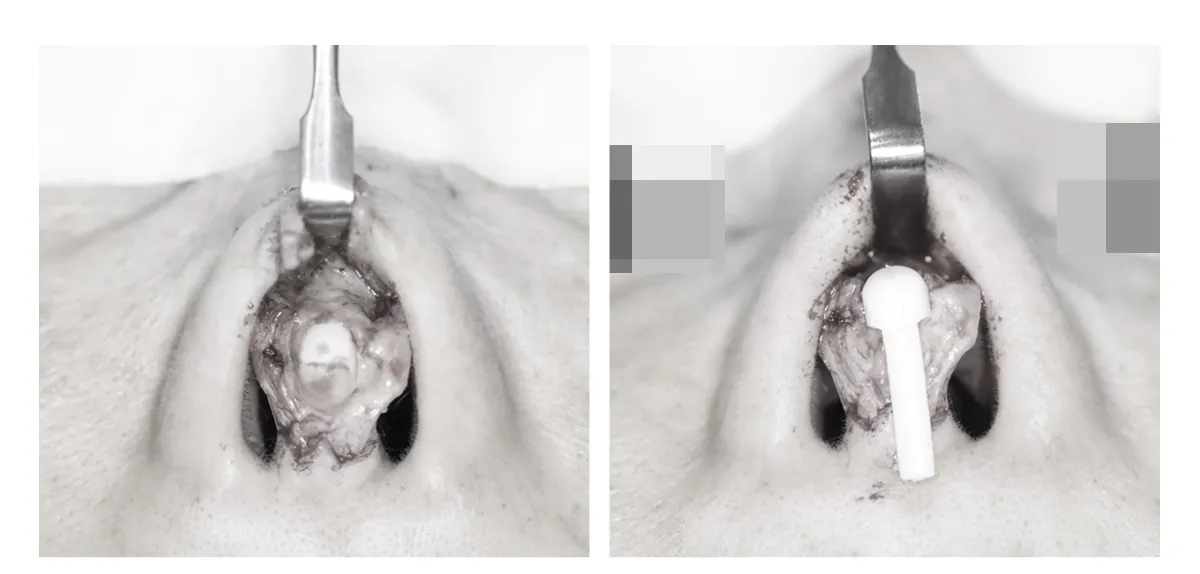
Removal of the silicone implant: a long “L”-shaped silicone implant.

A: To straighten the deviated septum, septal resection + septal repositioning (swing door) were performed.
B: The resected septal cartilage.

A: The harvested costal cartilage and perichondrium.
B: Using costal cartilage on both sides of the septum,
extended spreader grafts (septal extension grafts) and
a vertical graft at the tip (caudal vertical strut) were placed to build an “L”-shaped framework.
Perichondrium was laid over this to smooth the dorsum.
C: The removed “L”-shaped silicone implant and capsule.
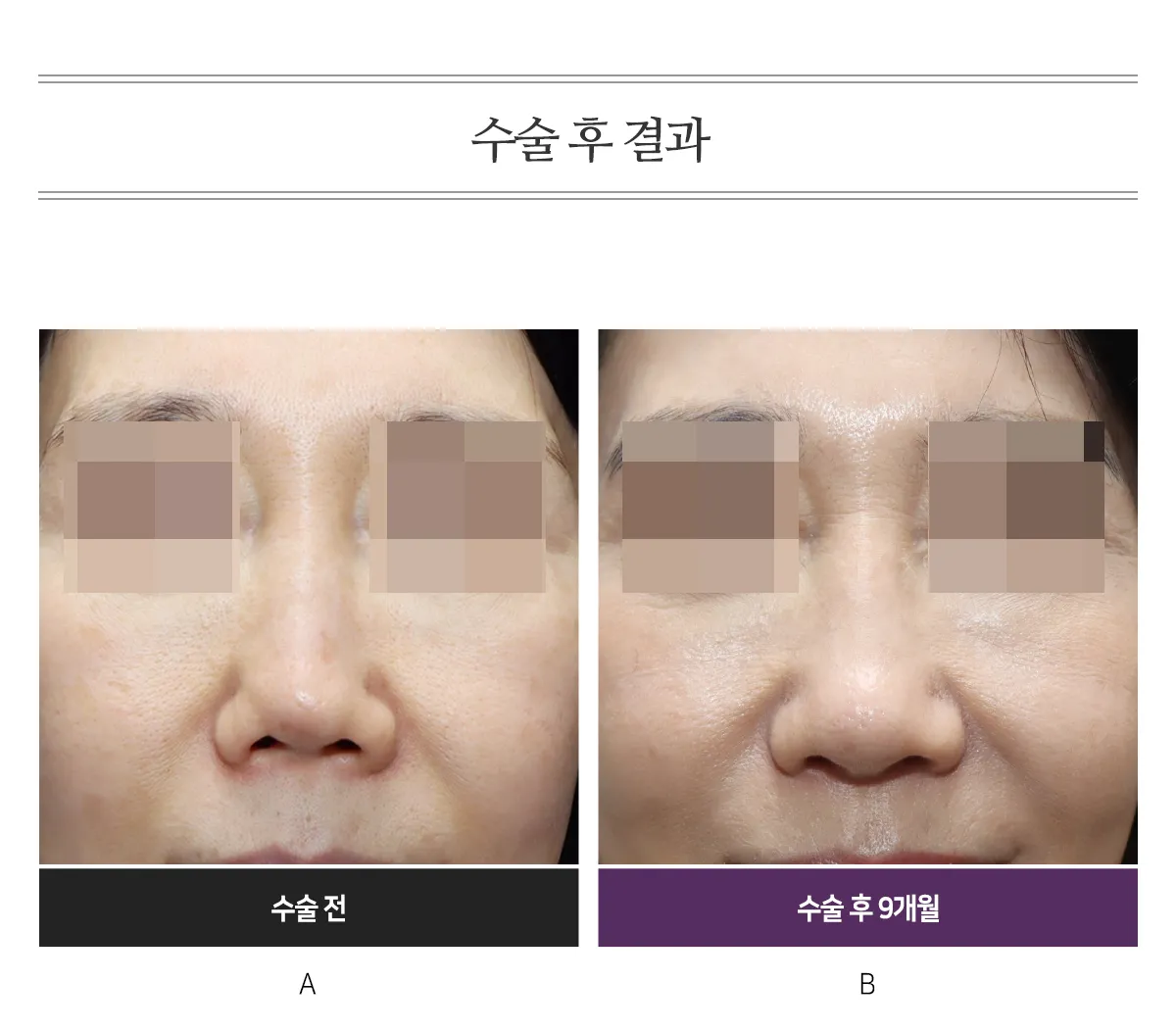
A: The silicone extends up above the glabella, making the nose look long and masculine in shape.
At the tip, contracture has left the nose short and upturned, and the tip is uneven.
The columella is drawn inward (columellar retraction).
The tip is pinched. The nostrils are pointed and triangular.
B: The tip is fuller and has come down, and the nostrils are covered from above and clearly symmetric.
With the glabella lowered, the nose has taken on a natural shape.

A: Before surgery, a webbing scar is visible at the border of the right nostril.
The tip leans to the left. The columella and tip are drawn inward.
B: The heights of the nostrils are now symmetric, and the pinched tip has opened out into a rounded shape.
The columella and tip now project with a rounded contour.

A: The tip is twisted and asymmetric.
The tip descends to a different degree on the left and right. The tip and columella are flat.
B: The left-right asymmetry of the tip has clearly improved, and the columella and tip have come down with a rounded contour.

The tip, upturned before surgery, has come down naturally, and the flat tip and columella have come down with a rounded contour.

The upturned tip has come down naturally, and the columella and tip have become rounded and full.
contracted nose, revision rhinoplasty, nasal implant removal, upturned nose
Revision Rhinoplasty Plastic Surgery, Won-Suk Kook