

Side Effects of a Calcified Silicone Nasal Implant and Removal Surgery (Nasal Implant Removal Surgery / Revision Rhinoplasty)

As time passes, a silicone implant develops, between the capsule and the implant,
calcification, a buildup of calcium deposits, a stone-like substance.
Calcification is the accumulation of hard calcium deposits caused by a chronic inflammatory reaction around the silicone.
At first it cannot be felt, but as it gradually thickens, it feels
bumpy, as if small pebbles were inside the dorsum, and the skin covering it grows steadily thinner;
in severe cases, perforation, in which the skin breaks open, is not uncommon.
Once perforation occurs, the infection spreads and contracture, in which the nose gradually turns upward, progresses.
Therefore, if hard, bumpy irregularities can be felt, calcification should be suspected,
and the silicone and capsule should be removed promptly and cleanly without rupturing them.

The bulge descending inside the right nostril was the tip cartilage, buckled under pressure from the ear cartilage graft laid on the tip,
and it was corrected with "combined tip cartilage repositioning."

55-year-old woman
PH
Augmentation rhinoplasty with silicone and ear cartilage 30 years earlier. (Closed approach)
CC
Since early this year, something bumpy had been felt on the dorsum.
P/E
The dorsum was bumpy. Something like hard stone fragments was palpable.
The tip was upturned. Protruding cartilage was palpable inside the right nostril on the columellar side.
OP
Open approach; careful, clean dissection so that the capsular pocket would not tear.
The calcified silicone and capsule, and the ear cartilage at the tip, were all cleanly removed.
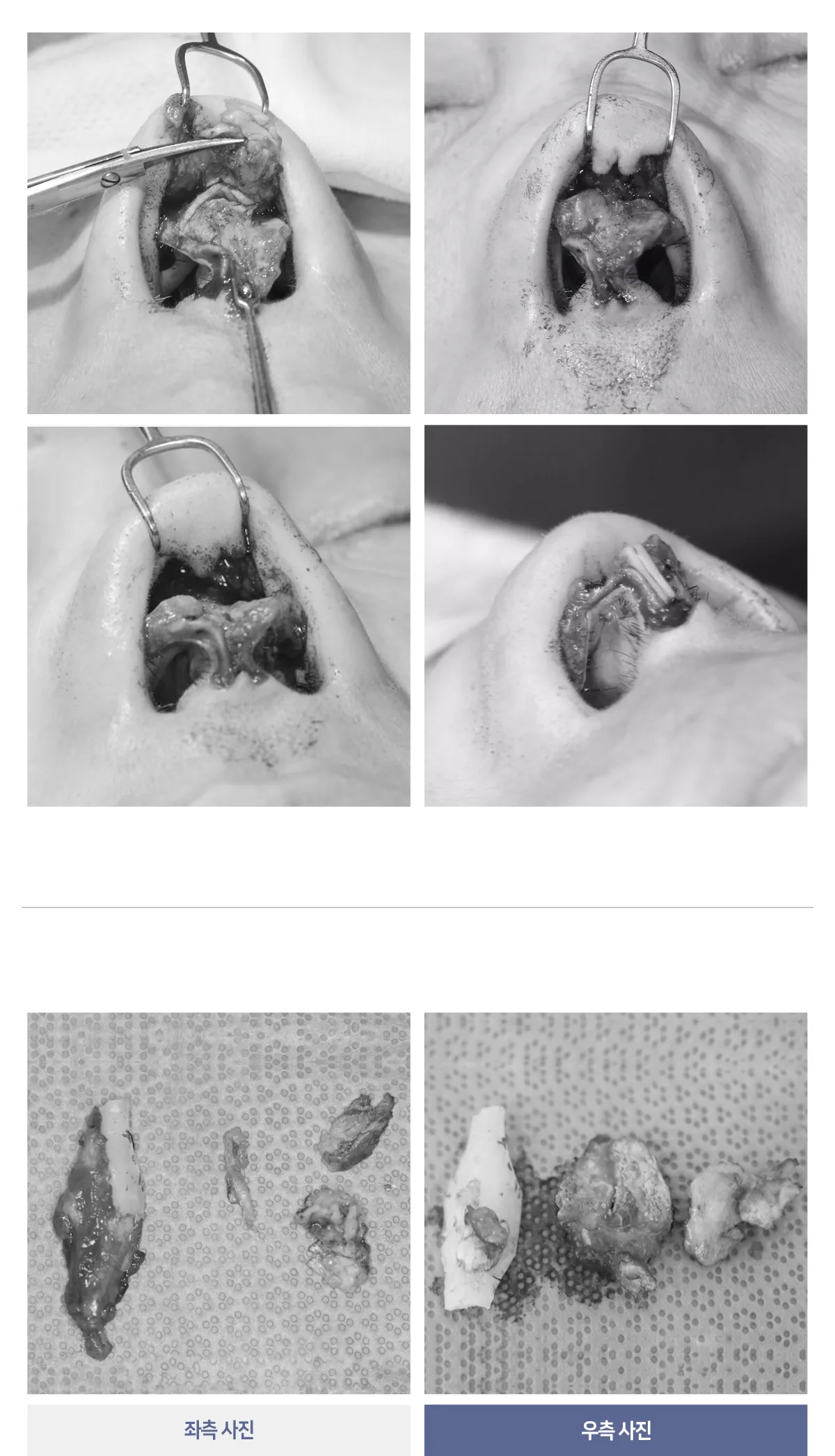
The left photo shows the capsule enclosing the calcified silicone;
the ear cartilage that had been laid on the tip was removed as well.
When the capsule was cut open, calcium deposits were found thickly built up between the silicone and the capsule.
The capsule itself had also thickened considerably,
which can be regarded as evidence that contracture was well advanced.
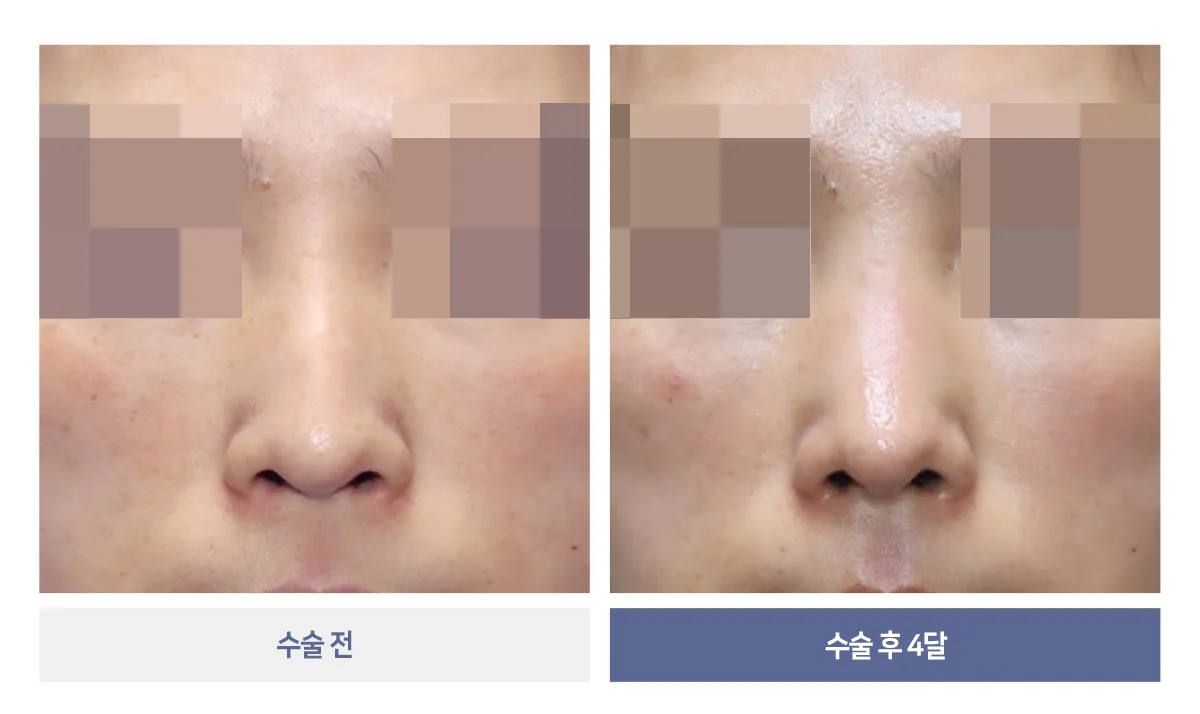
Bumpy irregularities were palpable on the dorsum,
and as contracture progressed, the silicone gradually migrated upward, making the glabella bulge.
This is the appearance 4 months after removal,
clean and natural, without any side effects.
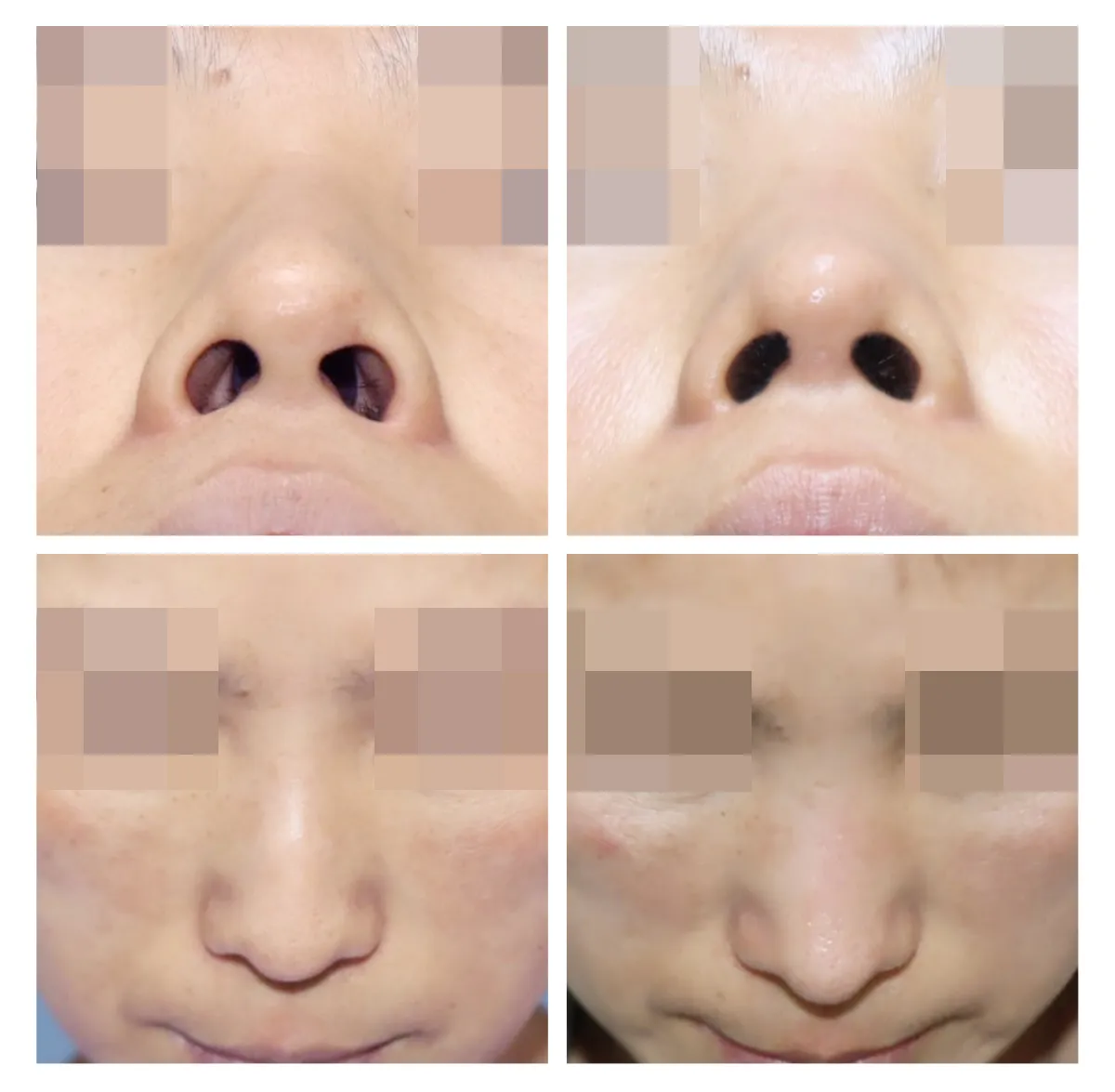
The dorsum can be seen to be smooth and natural.
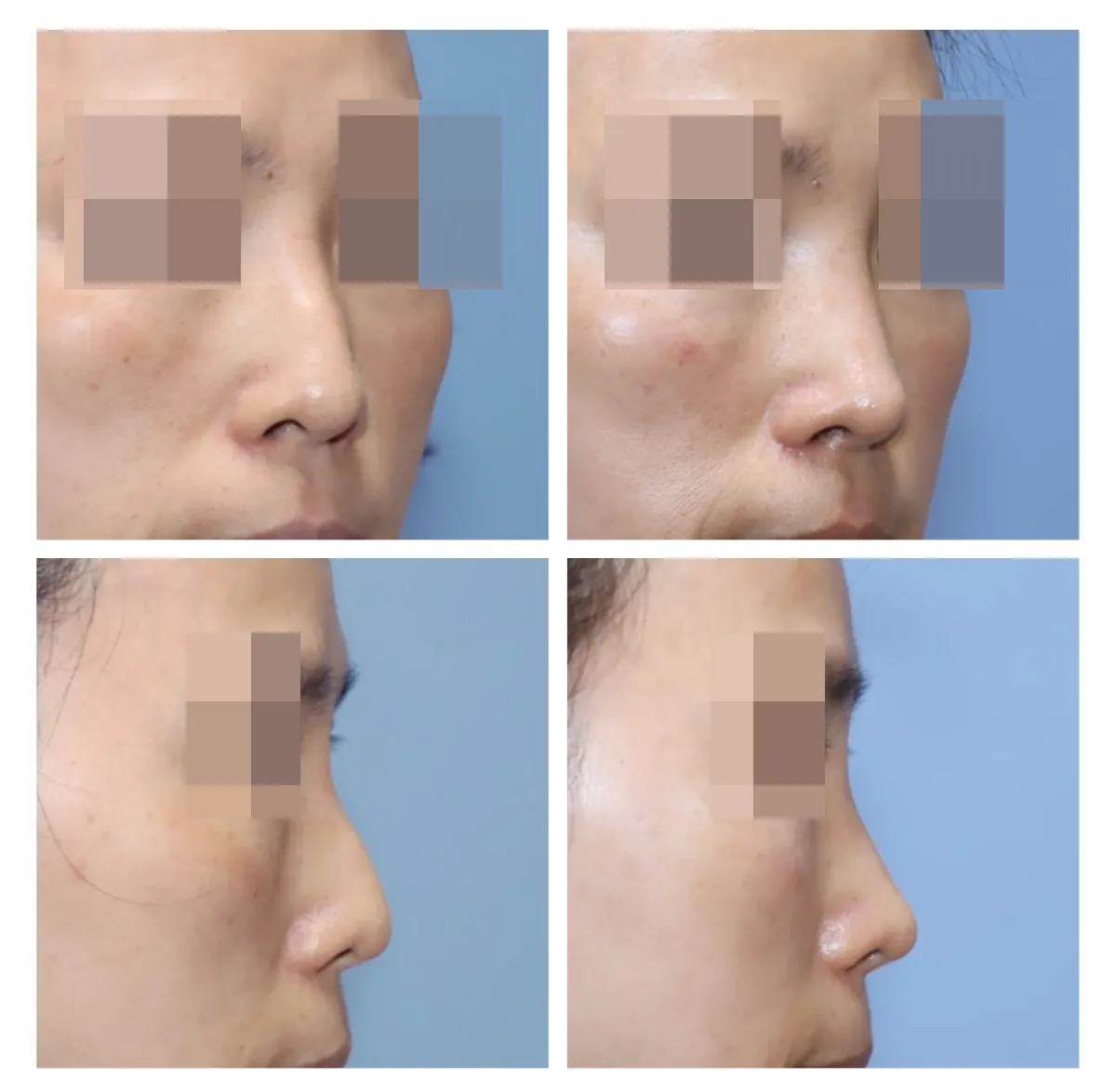
After removal, the dorsal line looks much more natural and attractive.

60-year-old woman
PH
She had augmentation rhinoplasty with silicone more than 40 years earlier.
CC
One month earlier a blister formed on the dorsum; after she squeezed it herself, pus and blood kept coming out and it was painful.
P/E
The skin of the dorsum was perforated, and discharge was coming from the opening.
There was also a perforation inside the right nostril. The dorsum was bumpy, and hard calcified fragments were palpable.
OP
Through a closed approach, the capsule and calcified silicone were removed, along with tip cartilage repositioning.

Left photo The mucosa inside the right nostril is perforated, exposing the silicone implant.
Right photo The calcified silicone and capsule were removed.

The perforated wound on the dorsum healed well by 1 month after removal surgery,
and the scar is less noticeable than expected and in good condition.
At 2 months, the wound will be checked, and PRP injection is planned for the depressed area and for scar regeneration,
PRP injection helps tissue regeneration in areas where the skin has undergone necrosis and sunk because of infection,
and has the effect of making the area smooth and soft.
When a patient presents with perforation already present and the implant is removed, a depressed scar remains,
and it takes much longer for the skin to settle smoothly.

The height and shape of the tip are slimmer and more refined.
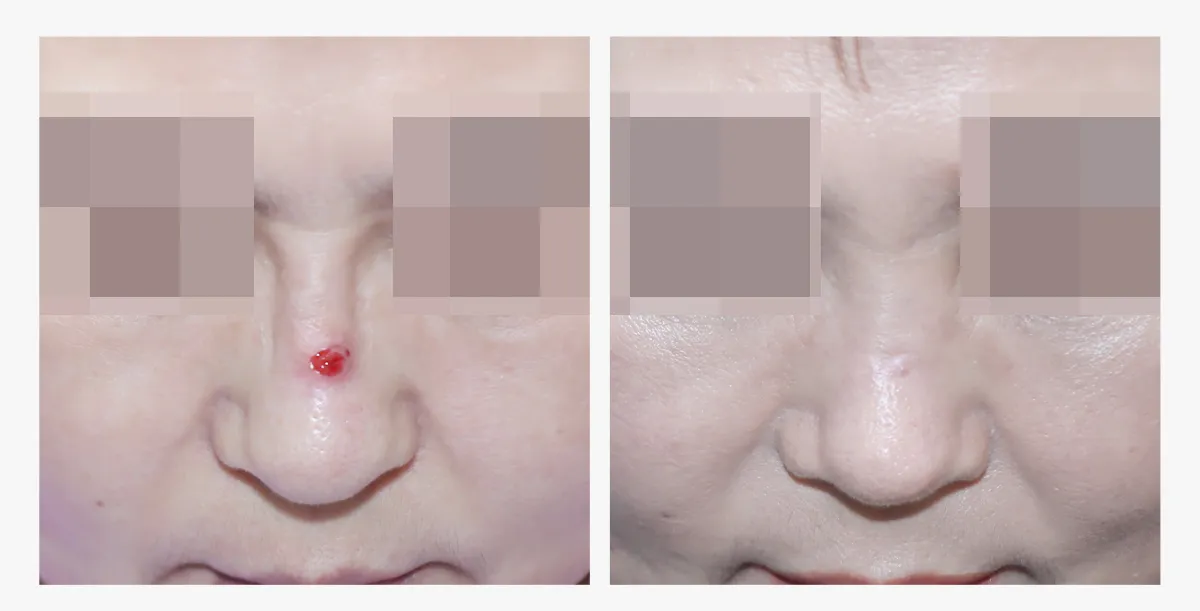
PRP injection is planned one month later to improve the scar and irregularities.
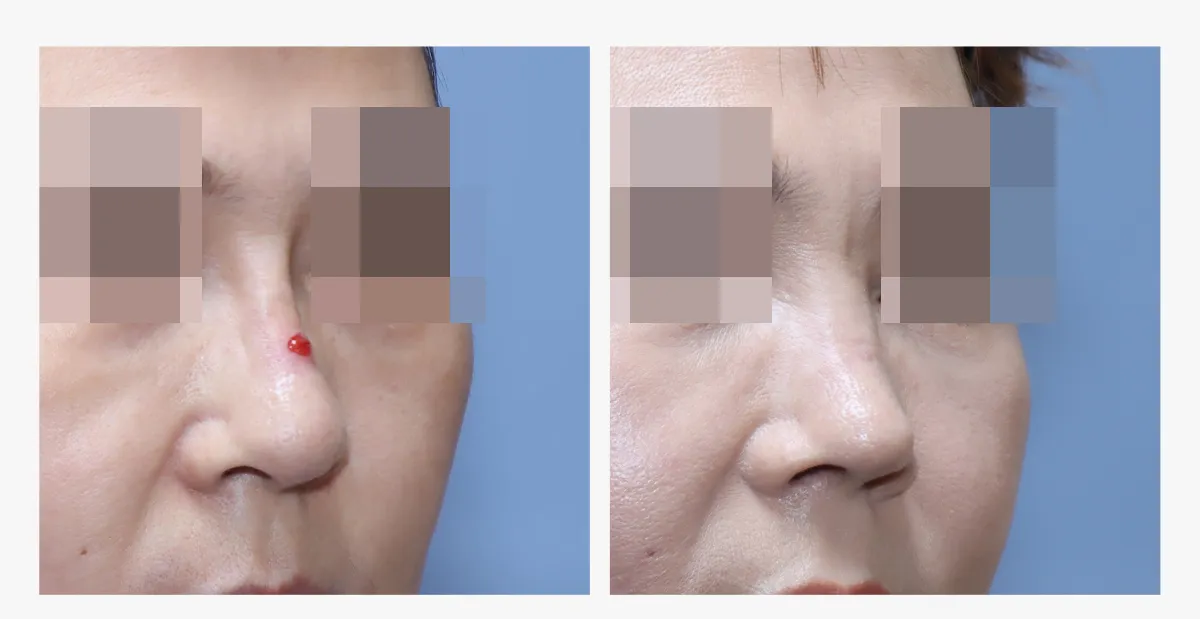
The infected tissue and calcified silicone were all removed and the perforated wound inside the nose was sutured;
the skin was thin at the time, but as it healed the shape of the nose settled reasonably well,
and it is expected to look more natural with time.

The profile after surgery looks very natural, with no aftereffects remaining at all.