

Why I Dislike Using Silicone Nasal Implants #7 (Nasal Implant Removal, Silicone Show-Through)

Silicone implants remain, in Asia and
It is the most widely used material worldwide for raising the dorsum.
The association is so direct that "rhinoplasty" brings "silicone" to mind.
In Asia in particular, when it comes to "rhinoplasty," both doctors and patients
I often see it taken for granted that silicone will be used.
In rhinoplasty, this is a highly inappropriate and even dangerous notion.
For example, even in rhinoplasty whose goal is not to raise the bridge, such as dorsal hump correction or deviated nose surgery,
I see many patients in whom silicone was used even in such rhinoplasty.
When such patients come for a revision consultation and are examined, we often find that the silicone
In many cases it has been of no help at all and has instead caused side effects.
In fact, having seen many side effects from silicone and artificial materials over years of revision rhinoplasty,
I had long wanted to organize this systematically and present it someday.
So today, under the title "Reasons I Dislike Using Nasal Silicone (in Rhinoplasty)!",
I have prepared case studies on each of the side effects.


Dorsal Skin That Thins and Turns Red,
With the Silicone Showing Through
Of the 8 problems with silicone implants, this is the most common and yet has no adequate alternative.
A silicone implant raises the bridge and tip,
but at the same time it stretches the skin, so the skin naturally becomes thinner.
The mid-dorsum naturally has thin skin and crossing blood vessels, so vessels often show through there;
even without much pressure, the skin in this area stretches and thins, and the vessels of the dermis
are pushed close to the epidermis and show through, so the skin often turns red.
When an "L"-shaped silicone implant is placed, the corner of the L sits at the tip,
where it exerts stronger pressure than on the dorsum, so the skin there thins the most.
In particular, when ear cartilage is laid on top of the silicone at the tip or the tip cartilages, the pressure on the skin becomes severe, the tissue breaks down,
and the skin thins rapidly, so the silicone or tip cartilage graft shows through.
In such cases, it is best to remove the silicone and the tip cartilage graft and then observe.
The method of laying cartilage or silicone on top of the tip cartilages to make the tip more projected
thins the tip skin in this way, so a strut should be placed between the tip cartilages to lengthen the tip cartilages themselves,
with no cartilage or implant rising above them; only then can thinning of the skin be prevented.

PH
Woman in her 20s. Augmentation rhinoplasty with silicone 6 years earlier, with an ear cartilage graft at the tip
CC
The ear cartilage showed through at the tip, the skin felt tight, and in cold weather the tip turned red and painful.
P/E
The skin of the dorsum and tip was very thin, so the silicone and tip cartilage graft showed through with their outlines visible.
The tip skin was red and congested.
OP
Through an incision inside the nose, the silicone, capsule, tip shield graft, and other material were removed, and tip cartilage repositioning was performed.

The pointed, sharp tip has changed to a soft, natural one.
The thinned skin has also recovered to its original state.

After the tip cartilage graft, which had shown through and was displaced to one side, was removed, the skin returned to normal and symmetry also improved.

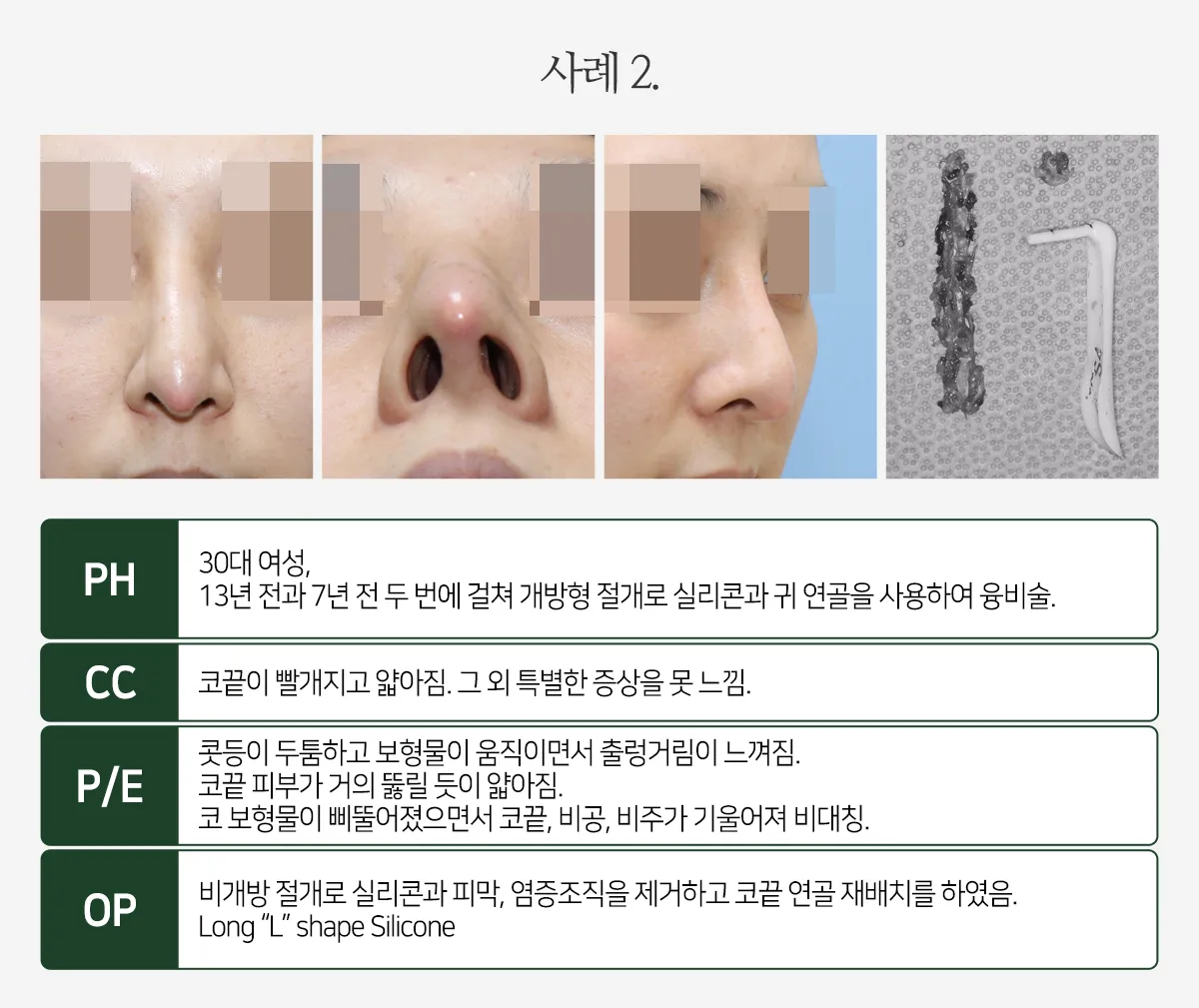
PH
Woman in her 30s,
augmentation rhinoplasty on two occasions, 13 years and 7 years earlier, using silicone and ear cartilage through an open approach.
CC
The tip had turned red and thin. She noticed no other particular symptoms.
P/E
The dorsum was thick, and fluctuance was felt as the implant moved.
The tip skin had thinned almost to the point of perforation.
The nasal implant was crooked, and the tip, nostrils, and columella were tilted and asymmetric.
OP
Through a closed approach, the silicone, capsule, and inflamed tissue were removed and tip cartilage repositioning was performed.
Long “L” shape Silicone
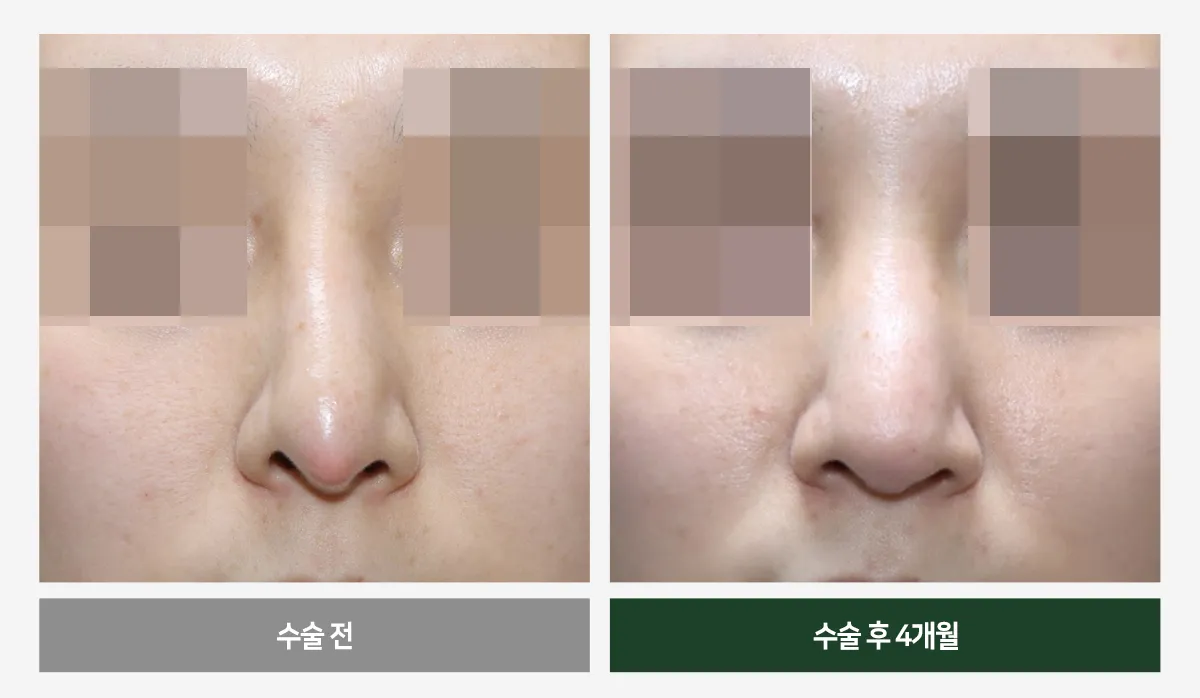
The tip skin had become so thin that there was concern it might be left pitted like a pockmark after silicone removal,
but it regenerated well and settled smoothly.
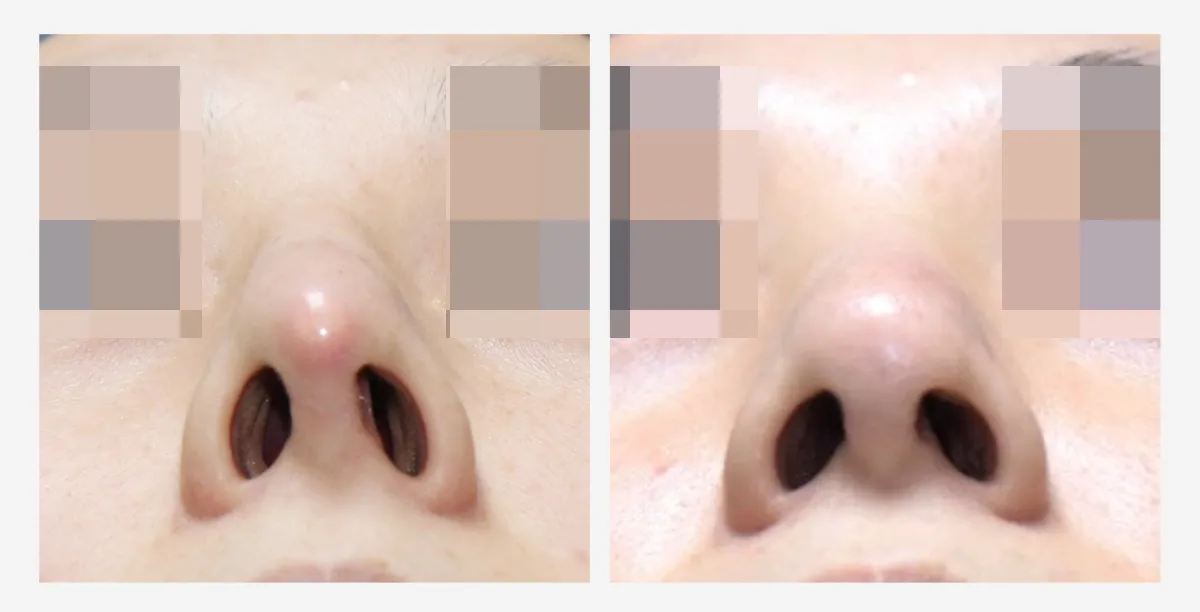
The tilted, crooked tip, columella, and nostrils were straightened through repositioning.

Even after silicone removal, the height of the dorsum did not decrease much, so there was no sense of loss.


PH
Woman in her 20s. Augmentation rhinoplasty using silicone and ear cartilage through an open approach 4 years earlier.
CC
Starting 2 years earlier, the glabella repeatedly bulged as if a cyst had formed and then subsided. It swelled and turned red when she was tired.
P/E
The tip (columella) was red, and the skin had thinned to the point that the implant was about to break through.
The edge of the silicone at the glabella bulged, and the dorsum was thick. Because of the inflammatory reaction,
the capsule and scar tissue had grown thick.

There was thick capsule and inflamed tissue around the dorsal silicone,
and after these were removed the height decreased considerably, but the overall balance became much better.
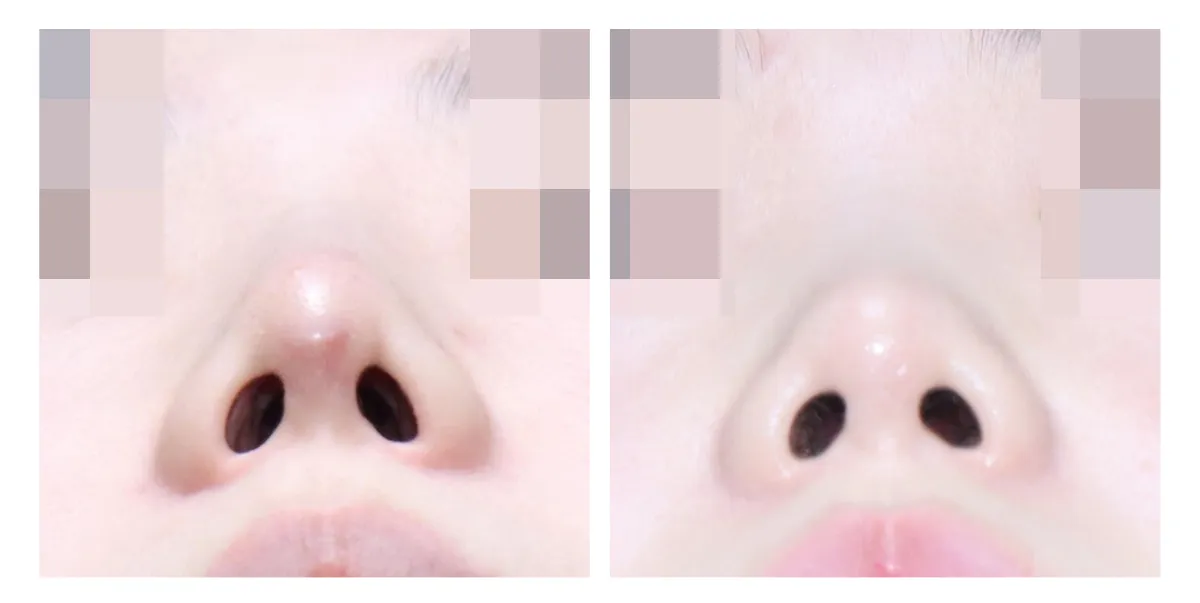
The skin that had seemed about to perforate regenerated well after removal and has almost returned to normal.

The glabella was thick and high, giving an unnatural straight-line nose, but it became natural after removal.