

Short, Low Nose Case

In recent years, Korean facial features have become considerably more Western,
and surgeries mainly performed on Westerners, such as dorsal hump correction, have become more common.
Even so, augmentation rhinoplasty, which turns a short, low nose into a defined, straight one, is still more common.
Unlike simple augmentation rhinoplasty, which only raises the nasal bridge, surgery for a short, low nose lengthens the nose,
refines the bulbous tip into a defined, delicate shape, and raises the bridge at the same time, so it is relatively demanding;
however, with autologous cartilage and human donor tissue, a safe and natural result can be achieved.
This case shows how, in surgery for the low, short nose often seen in Koreans,
a natural and attractive nose can be achieved.
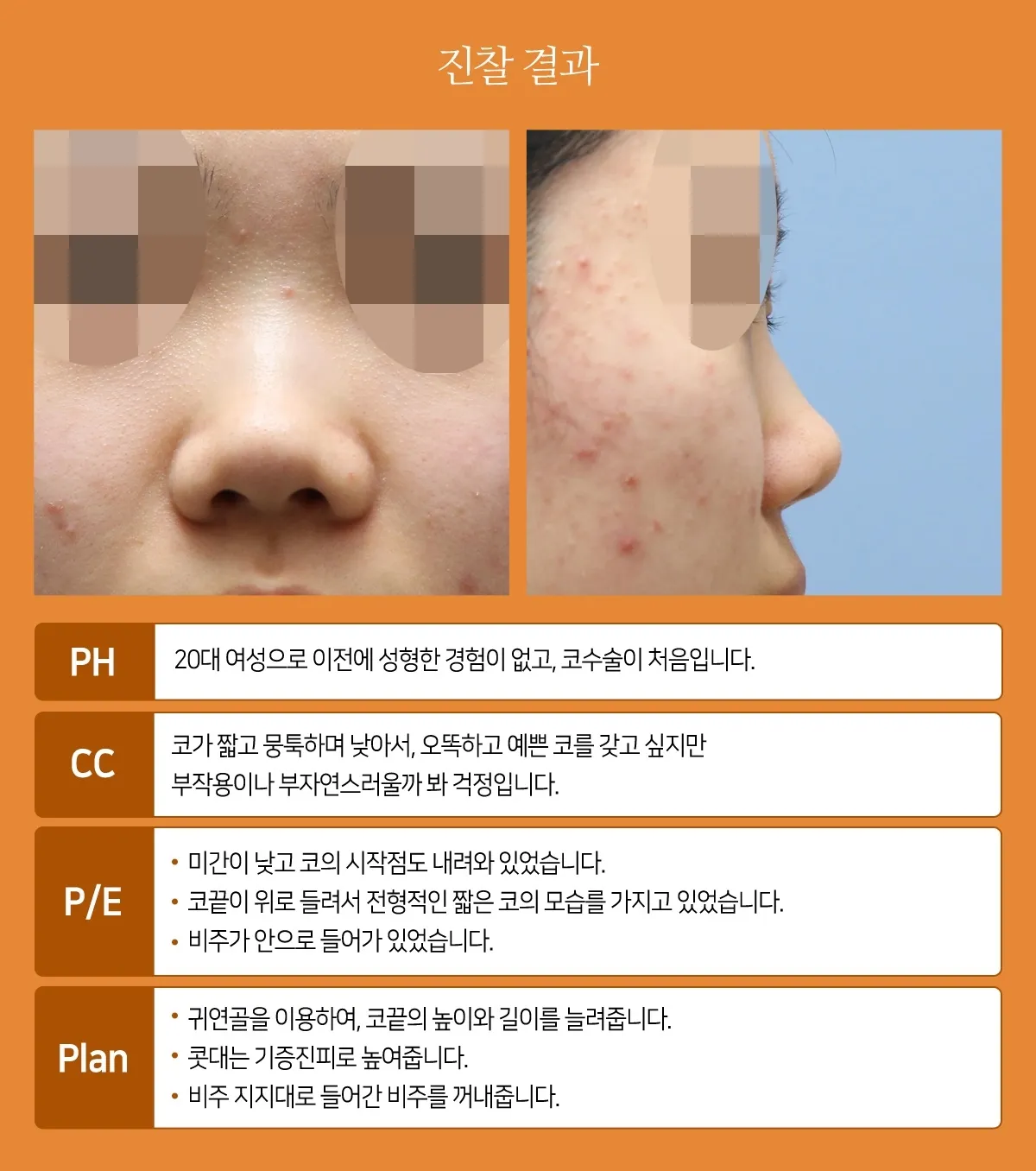

The alae were somewhat flared but narrower than the glabellar width, so alar reduction was not planned;
narrowing the tip and supporting it from below was expected to bring the alae in naturally and improve the proportions.
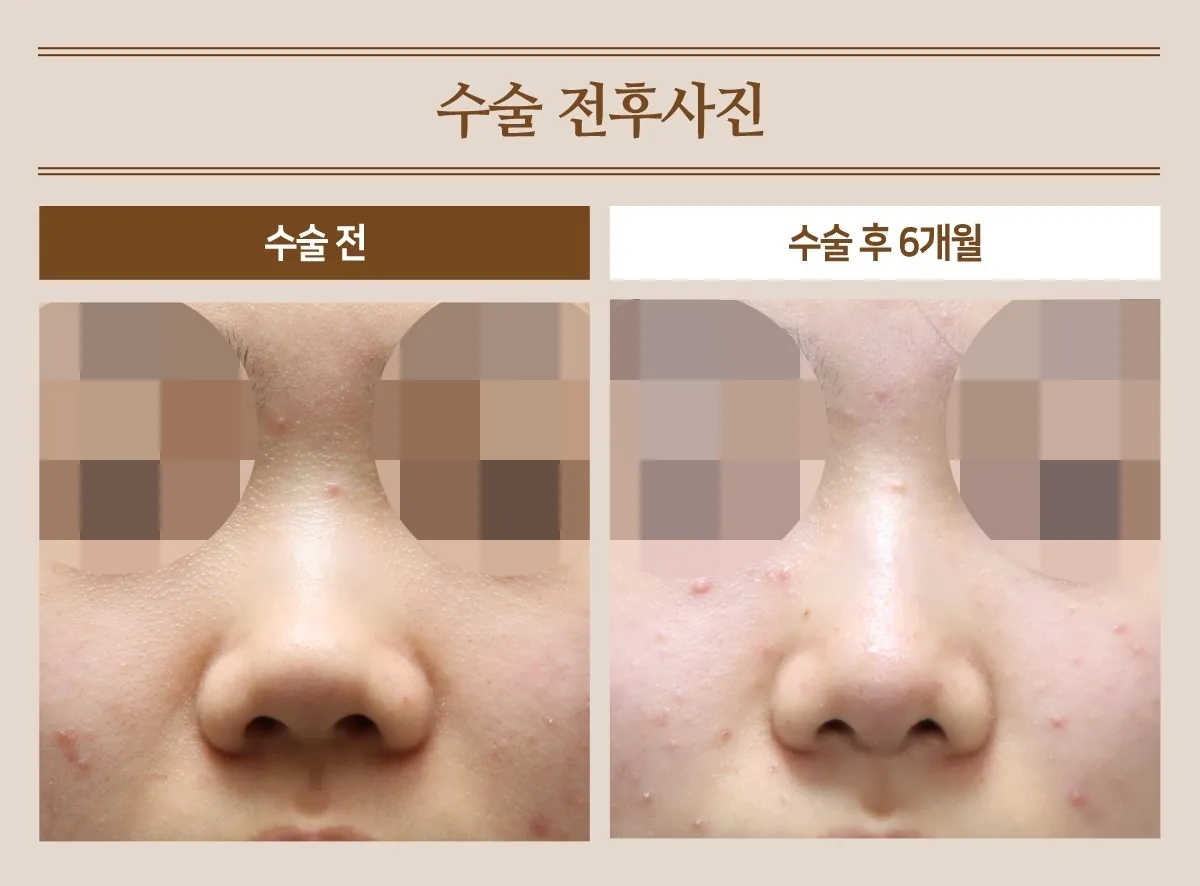
The preoperative plan was to raise the nasal bridge by about 3.5 mm
and to lengthen the tip by about 5 mm.
Accordingly, 5-6 mm of acellular dermal matrix was placed in the dorsum at surgery,
and the height and length of the tip were increased with a columellar strut and a derotation graft made from ear cartilage.
In the frontal photo, the tip is slimmer and more refined, and the retracted columella has come forward naturally.
The alae have been brought in and the dorsum has been raised naturally, with no sign at all that the dorsum was augmented.
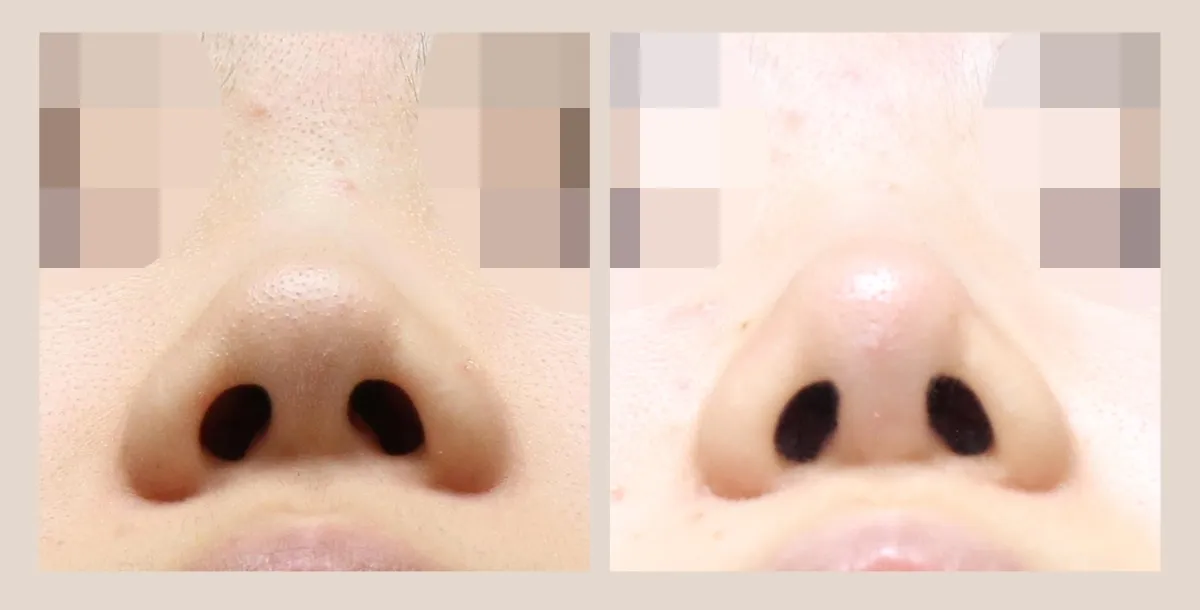
With the tip and alae brought in, the nose looks slim and well defined.
At this point, however, care must be taken not to narrow the tip so much that it becomes a pinched nose (pinched tip, notching).
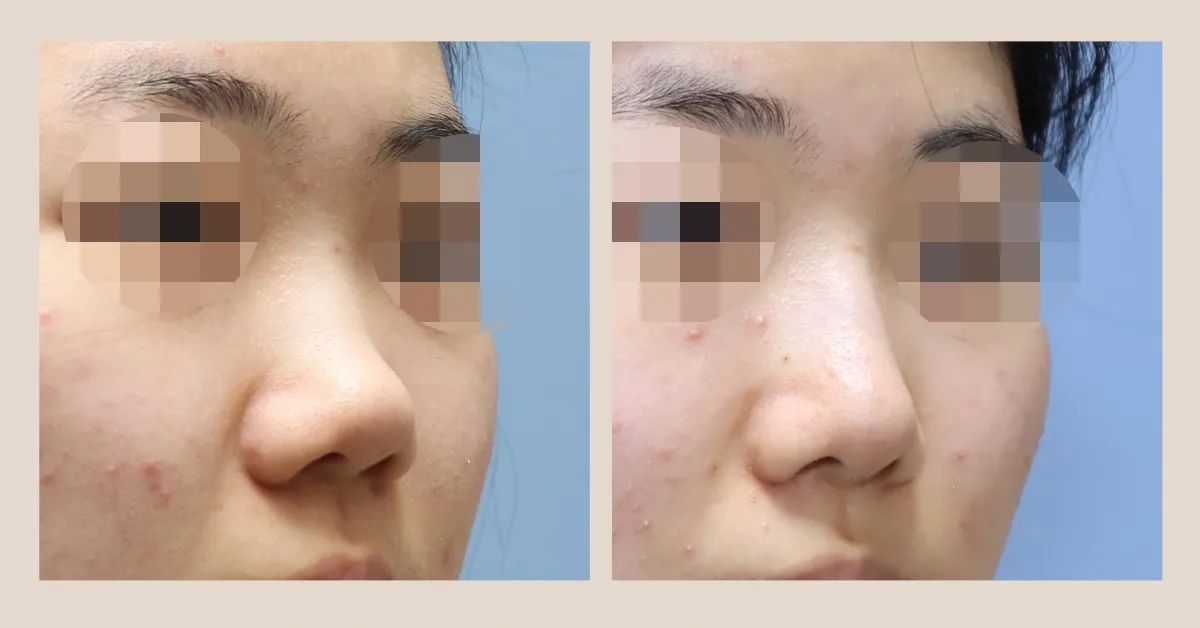
Before surgery, the dorsum was very low and sunken, so that only the tip looked large and the dorsal line was sharply angled,
but after surgery the dorsal line is straight and connects naturally with the tip.
The acellular dermal matrix in the dorsum had been replaced by the patient's own tissue, and there was no foreign body sensation at all, either in appearance or to the touch.
Because acellular dermal matrix generally loses 30-40% of its volume from 3-6 months after surgery,
5-6 mm of acellular dermal matrix was placed at surgery, with a final height increase of about 3.5 mm planned.
6 months after surgery, the dorsal height is being maintained well, as planned.

The nasolabial angle was 95 degrees before surgery; after surgery the nose is sufficiently longer and the angle is 87 degrees.
In general, a nasolabial angle of about 95-100 degrees is considered attractive in Asian women,
but this patient's mouth is somewhat protrusive, so her nasolabial angle is smaller than average.
After surgery, the dorsum has been raised to an appropriate height,
and the nasion sits 1 mm above the center of the iris, which looks natural.