

Mentalis Resuspension III
After chin surgery such as V-line chin surgery, T-osteotomy, chin advancement (advancement genioplasty),
silicone chin augmentation for a receding chin (augmentation genioplasty), metal plate removal, or implant removal,
various problems can arise: the chin muscle sags, the chin does not move naturally, and lip movement
becomes unnatural.
To operate on the chin, an intraoral incision is made, all the muscles attached to the chin bone are dissected,
and then the bone surgery is performed. After the bone surgery, the dissected chin muscles
must be reattached to the bone; however, when silicone is inserted or the bone is reduced in size,
the muscles become loose, fail to adhere to the bone, and sag.
If only the muscle at the incision opening is sutured at this point, the muscle below sags,
and this is called Witch's chin. With chin muscle restoration (mentalis resuspension),
the position and movement of the chin and lips can be restored to normal very effectively.
In chin muscle restoration, only an incision of about 3-4 cm is made inside the mouth, the chin muscle is dissected,
and it is fixed to the bone below the gums higher up, lifting the sagging chin muscle
so that movement becomes natural and the chin feels comfortable.
Through a case of chin muscle restoration, let us look at how the muscle sags and how
it was improved at Won-Suk Kook Plastic Surgery.

How Witch's Chin Develops
This illustration shows how the muscles sag
after chin surgery.
The upper illustration shows that when bone is resected or an implant is removed,
the attached muscles sag downward.
The lower illustration shows that not only do the chin muscles sag,
but the lower lip and the groove below
the front teeth (vestibular sulcus) also drop
downward with them.
When this happens, the mouth does not close well,
and the gums show when smiling.
The area under the chin bulges and sags downward, so that from the front
the chin looks longer.


In the side view, the Witch's chin appearance, with the tip of the chin sagging, can be seen.
Tension is visible when the mouth is closed.

Surgical Procedure (Mentalis Resuspension)
In this technique, holes are drilled in the bone below the lower gums, and the lower chin's
sagging muscle (ptotic mentalis muscle)
is pulled upward and fixed in place.

An X-shaped metal plate and pins were present, so after they were removed,
chin muscle restoration (mentalis resuspension)
was performed.
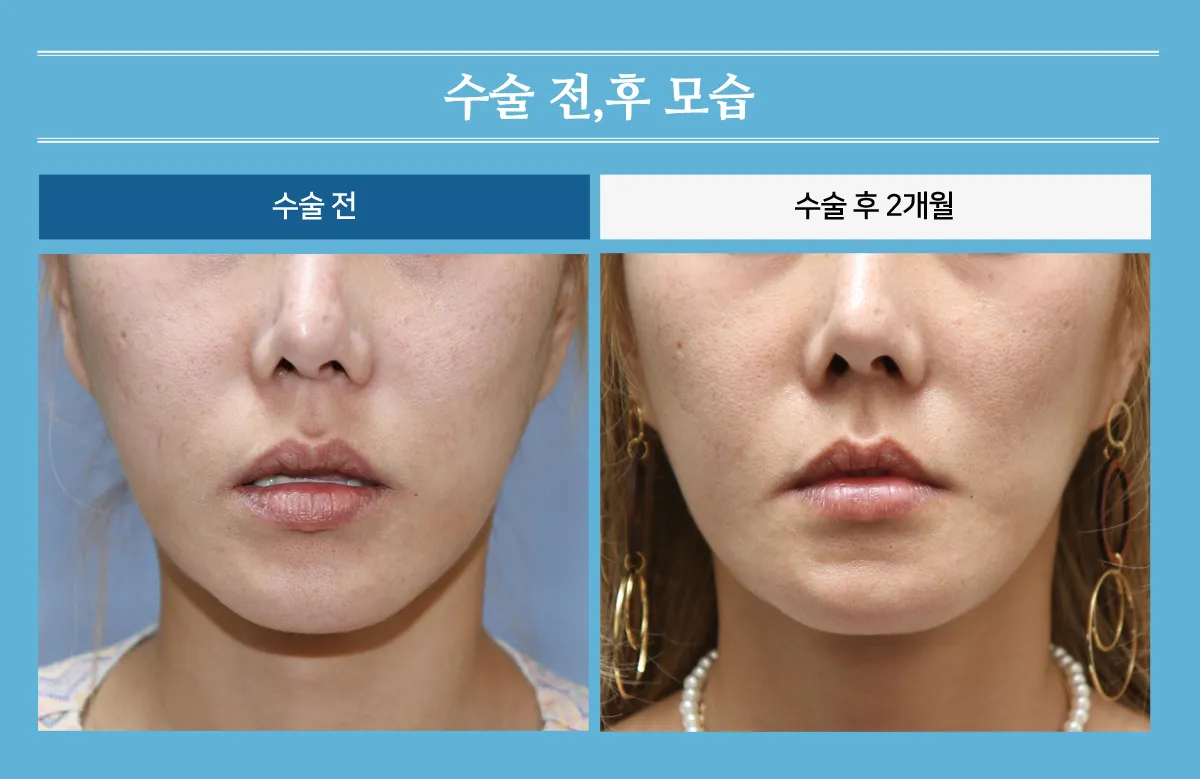
In the relaxed state with tension released (rest position), before surgery the lip sagged downward,
the lips did not close, and the lower teeth were exposed down to the gum line.
After surgery, the lower teeth are completely covered, and even the upper teeth are naturally covered.
From the front, the chin is also noticeably shorter.

With the lips closed, before surgery the patient had to strain the lips to close them,
and muscle tension caused the chin to dimple like a walnut.
After surgery, the mouth closes naturally without straining the lips or chin.

These are side views before and after surgery. Before surgery, the closed mouth
looks unnatural, and the sagging chin creates a visible crease under the chin.
After surgery, the closed lips look natural, and the crease under the chin is gone, leaving a smooth contour.
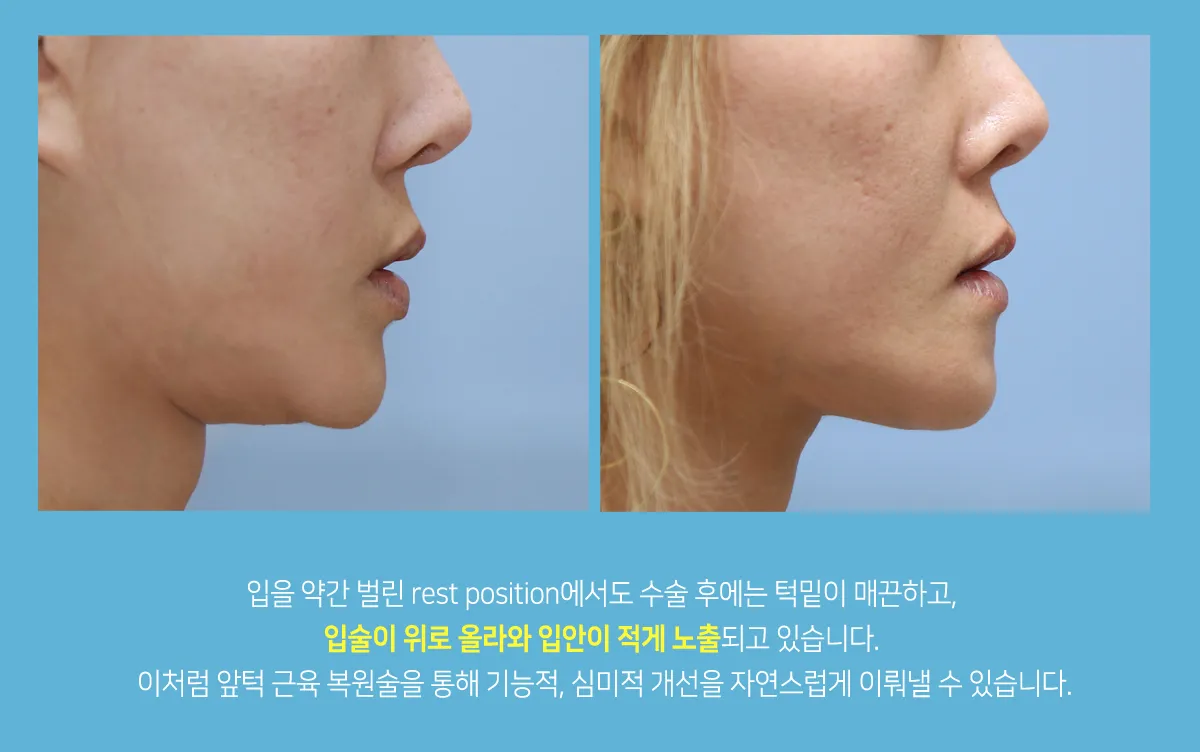
Even in the rest position with the mouth slightly open, after surgery the area under the chin is smooth,
and the lip has moved up, so less of the inside of the mouth is exposed.
In this way, chin muscle restoration can achieve functional and aesthetic improvement in a natural way.
mechanism of mentalis muscle drooping / Jaw surgery / mouthcomfortably / periodicconsultation /augmentationgenioplasty/ frontchin / frontjaw / witch’s chin /chin strain