

Septal Extension Graft and Derotation Graft for Contracted Nose Correction (Correction of Various Nasal Tip Deformities #1)
Correction of Various Nasal Tip Deformities
01 Contracted nose (upturned nose) ▶ Extension graft (SEG), derotation graft
02 Pinched tip ▶ Lateral crural strut graft (LCSG)

Septal Extension Graft and Derotation Graft for Contracted Nose Correction
A contracted nose is a condition in which the soft tissue of the nose (skin, muscle, and fat layer) shrinks because of a silicone implant,
so that the nasal framework wrapped by the soft tissue is drawn in and overlaps, shortening the nose.
This shortening as the nose draws in occurs because the softest structure,
the tip cartilages, is pulled toward the dorsum.
Therefore, to lengthen the nose and restore its original state, the tip cartilages that have been pulled up toward the dorsum
must be freed and brought down, and a cartilage graft that pushes them so they do not ride up again
is needed. The surgical methods for this are (A) the septal extension graft and (B) the derotation graft.
A. Tip Plasty with a Septal Extension Graft
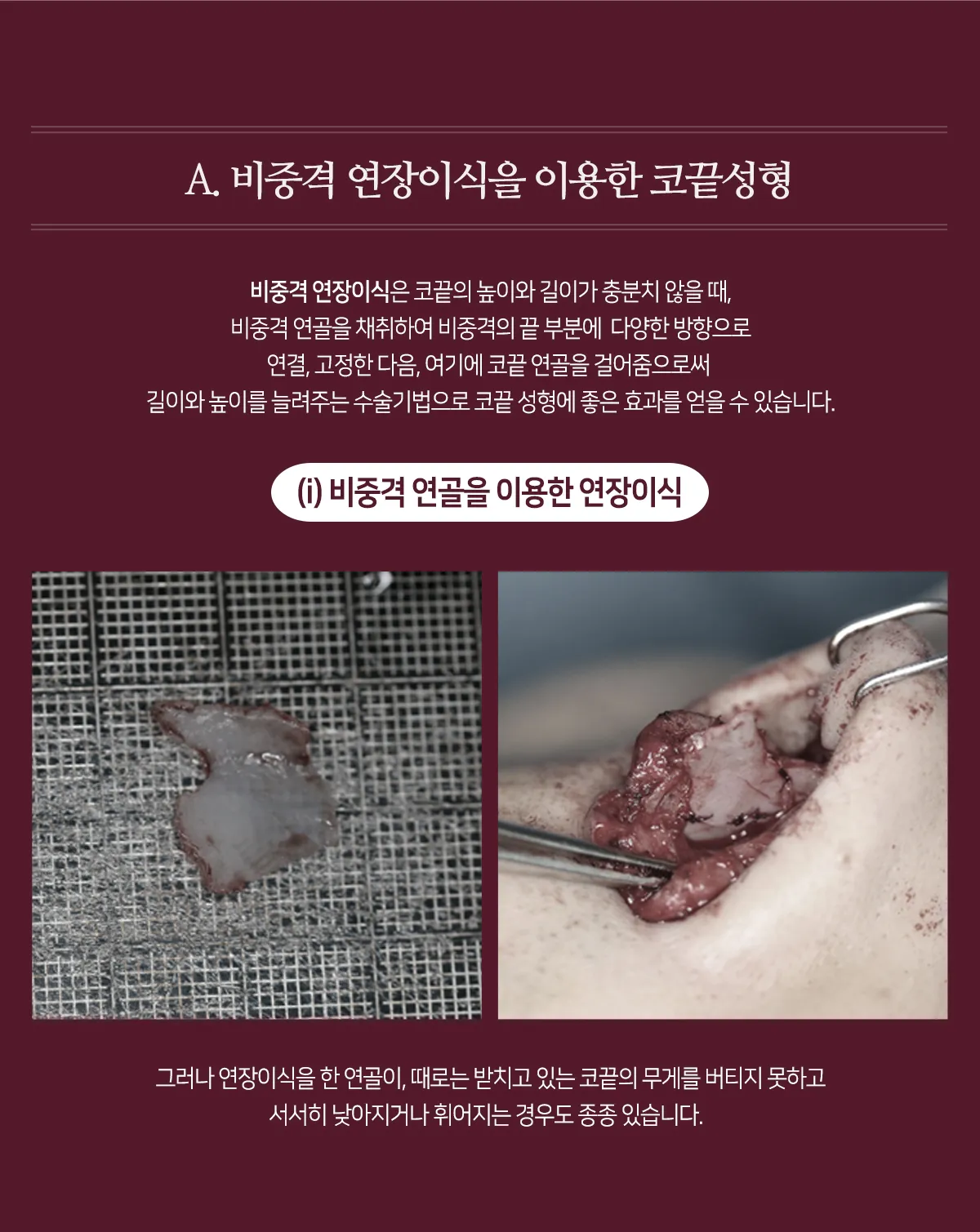
(i) Extension graft using septal cartilage
A septal extension graft is used when the height and length of the tip are insufficient:
septal cartilage is harvested and, at the end of the septum, connected and fixed in various directions,
and the tip cartilages are then anchored to it,
increasing length and height. This surgical technique can achieve good results in tip plasty.
However, the grafted cartilage sometimes cannot withstand the weight of the tip it supports
and gradually sinks or bends.
(A) Tip Plasty with a Septal Extension Graft
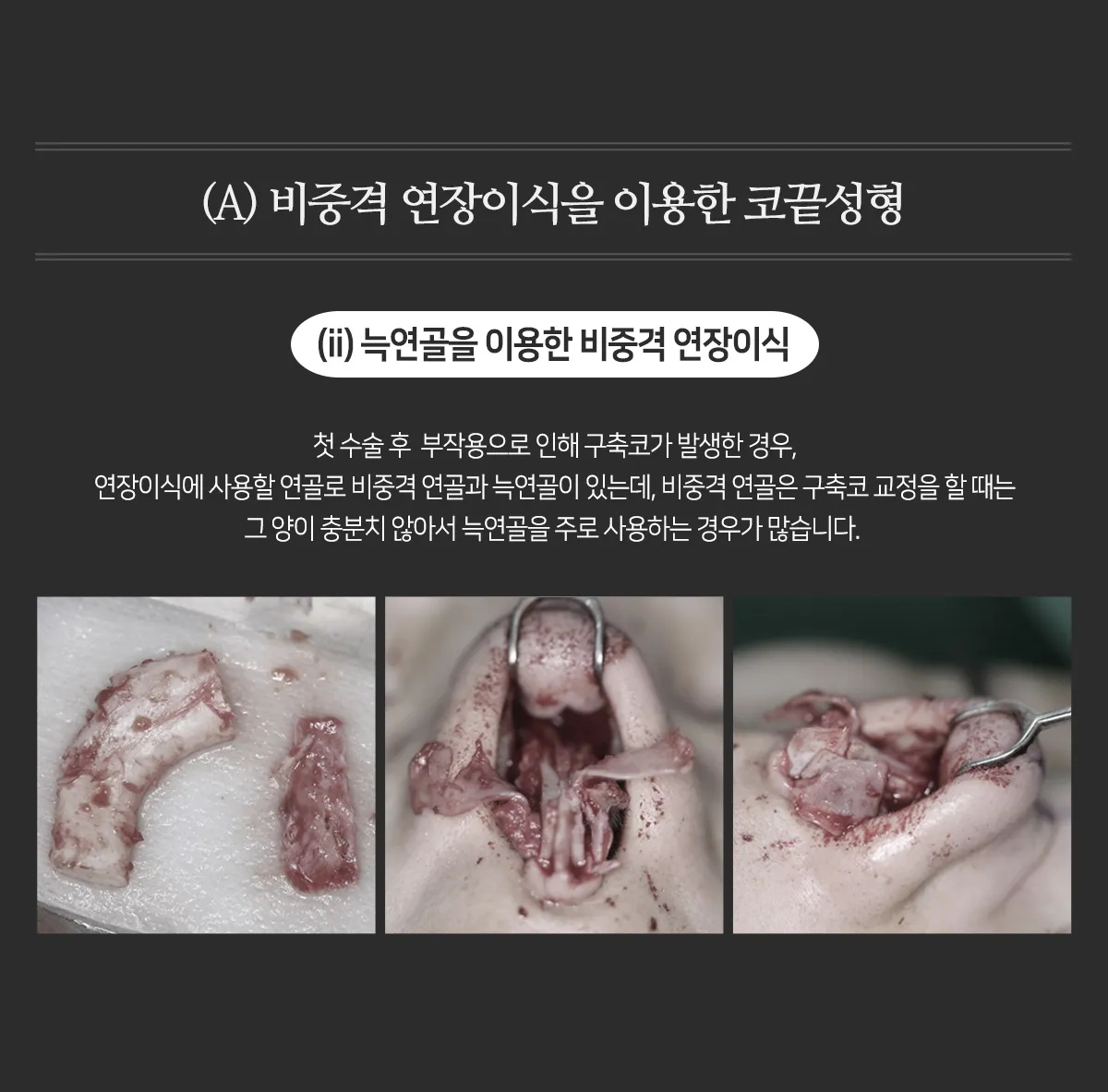
(ii) Septal extension graft using costal cartilage
When a contracted nose has developed as a side effect after the first surgery,
the cartilage available for the extension graft is septal cartilage or costal cartilage; for contracted nose correction, however, septal cartilage
is often insufficient in quantity, so costal cartilage is mainly used in many cases.

(A) Contracted Nose Correction with a Septal Extension Graft
A septal extension graft is used to lengthen a nose that has become
short and upturned through contracture after a previous surgery, but it is also commonly used in a first surgery to increase the length and height of the tip
and give it definition.
Case 1
CC
A woman in her early 20s. The tip and bridge were deviated to the patient's left, the dorsum bulged slightly,
and the tip was bulbous and low.
OP
Septoplasty, septal resection, septal extension graft
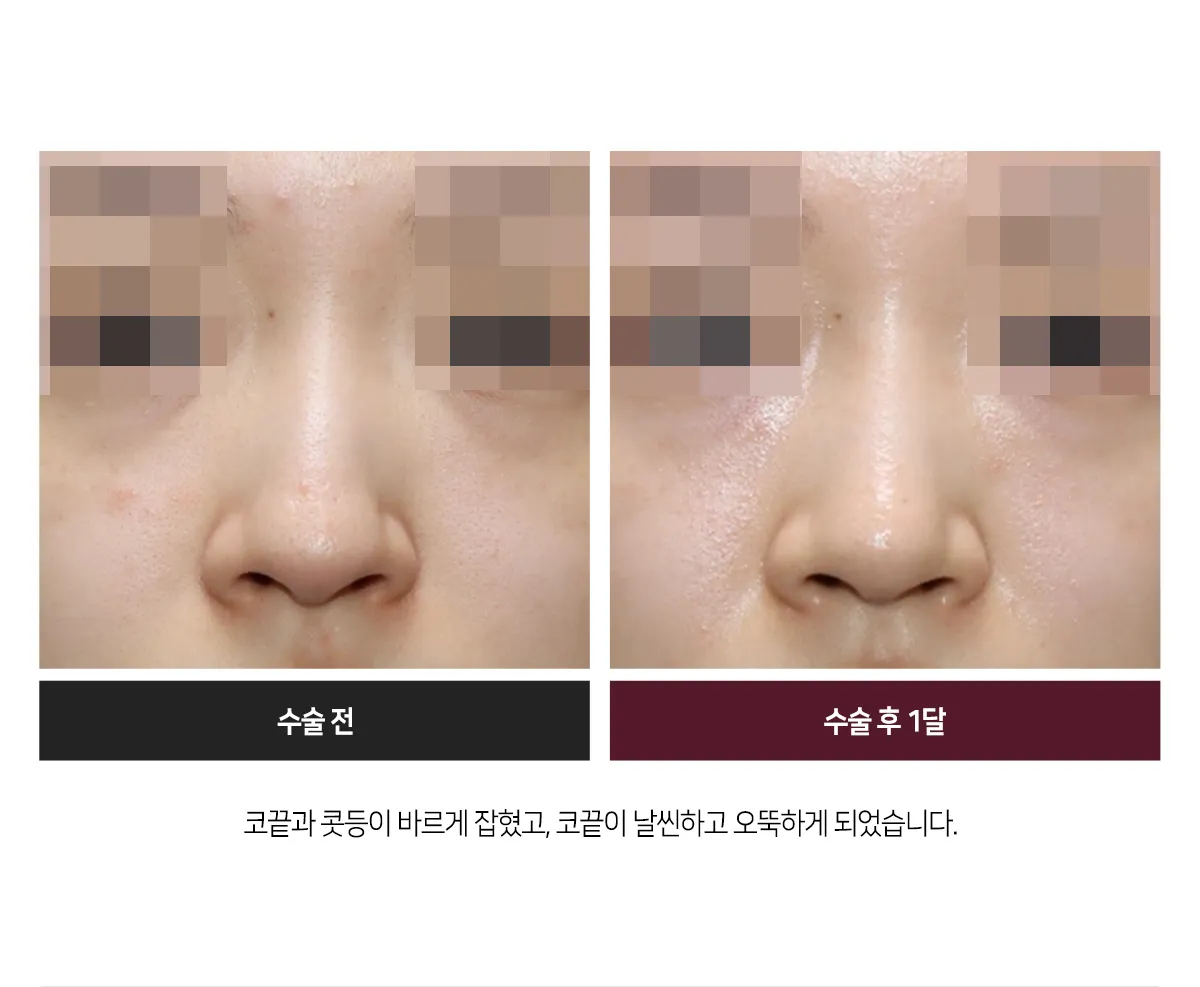
The tip and dorsum were straightened, and the tip became slim and well defined.
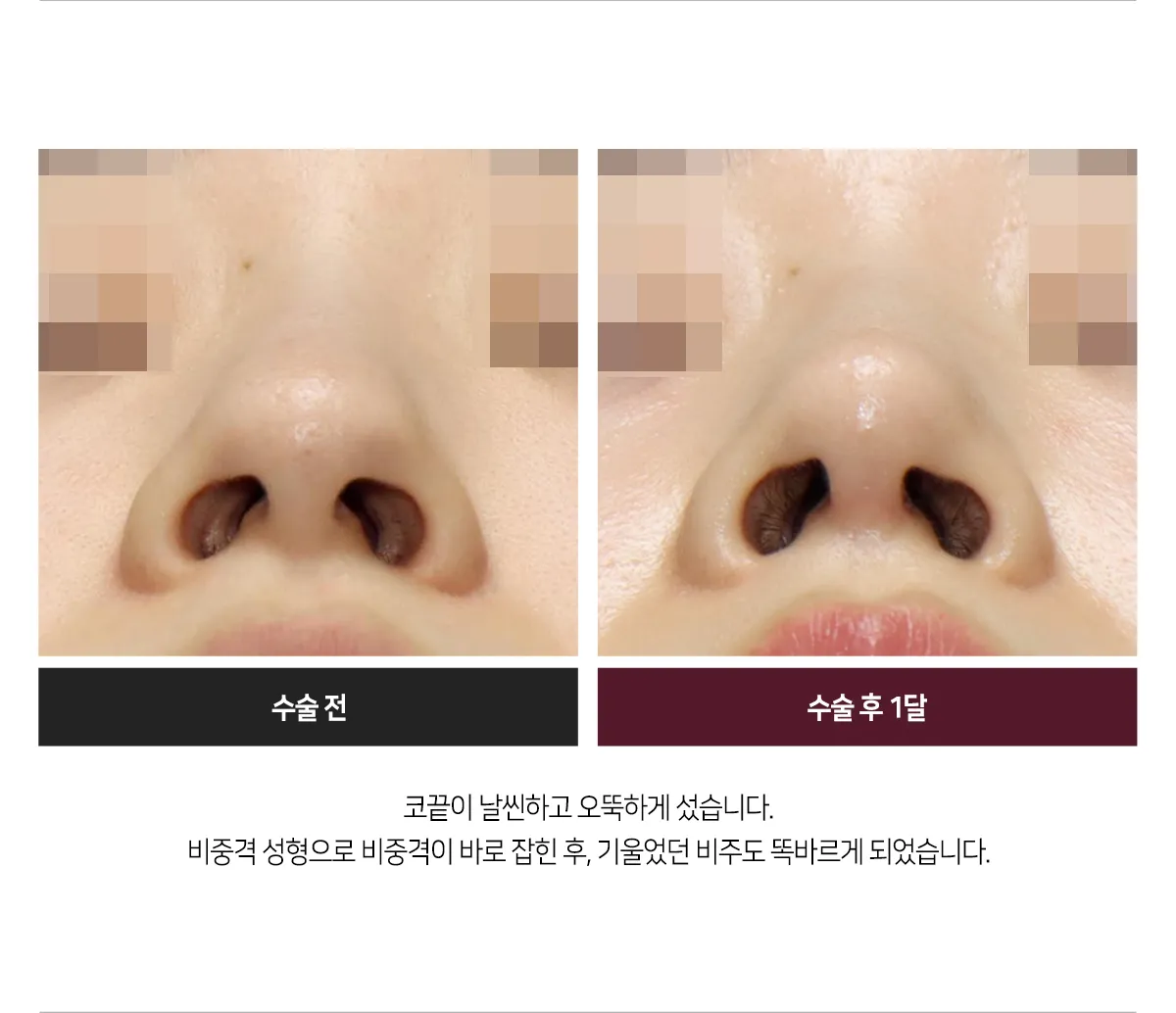
The tip now stands slim and well defined.
After the septum was straightened by septoplasty, the tilted columella also became straight.
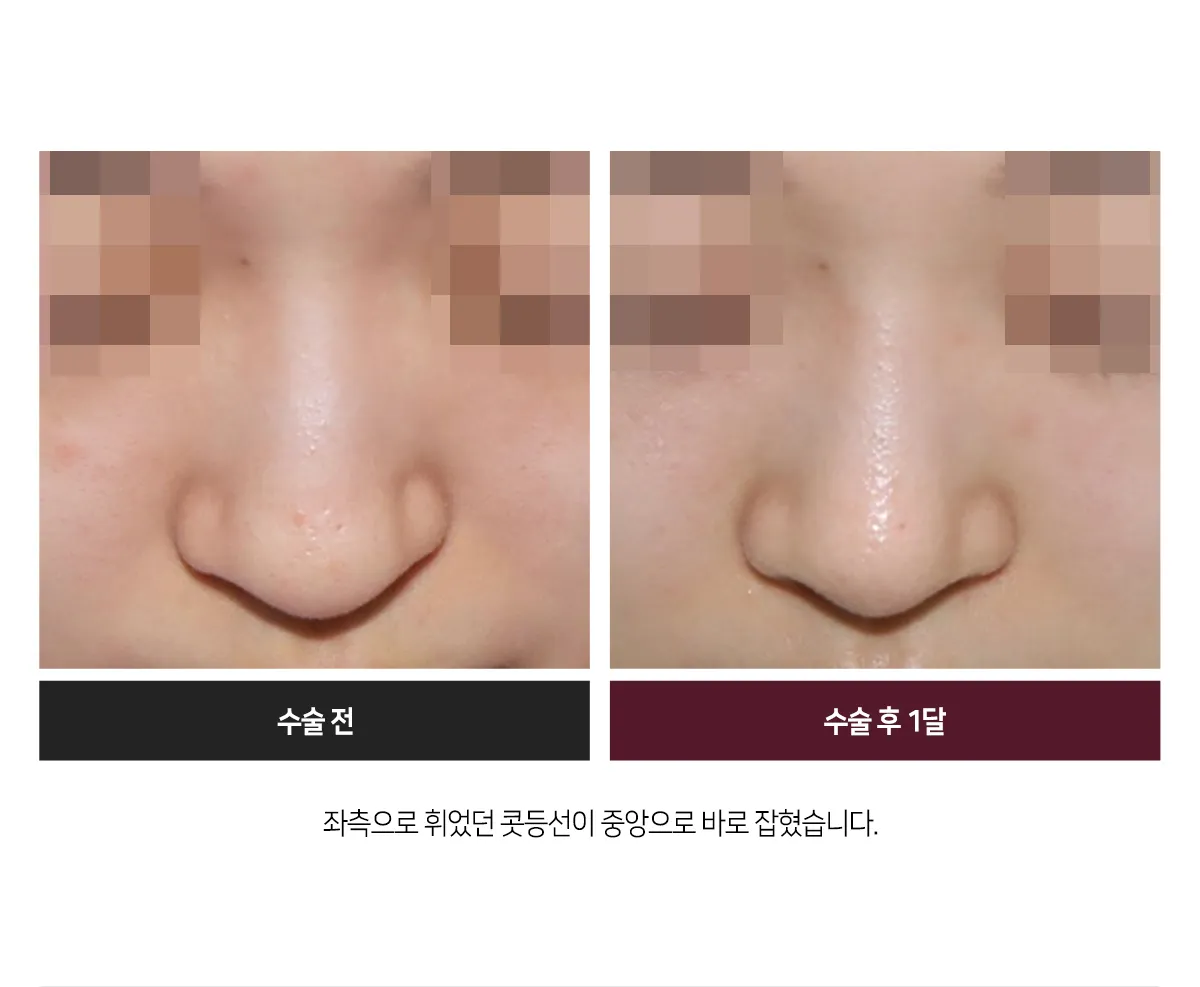
The dorsal line, which had been deviated to the left, was brought back to the center.
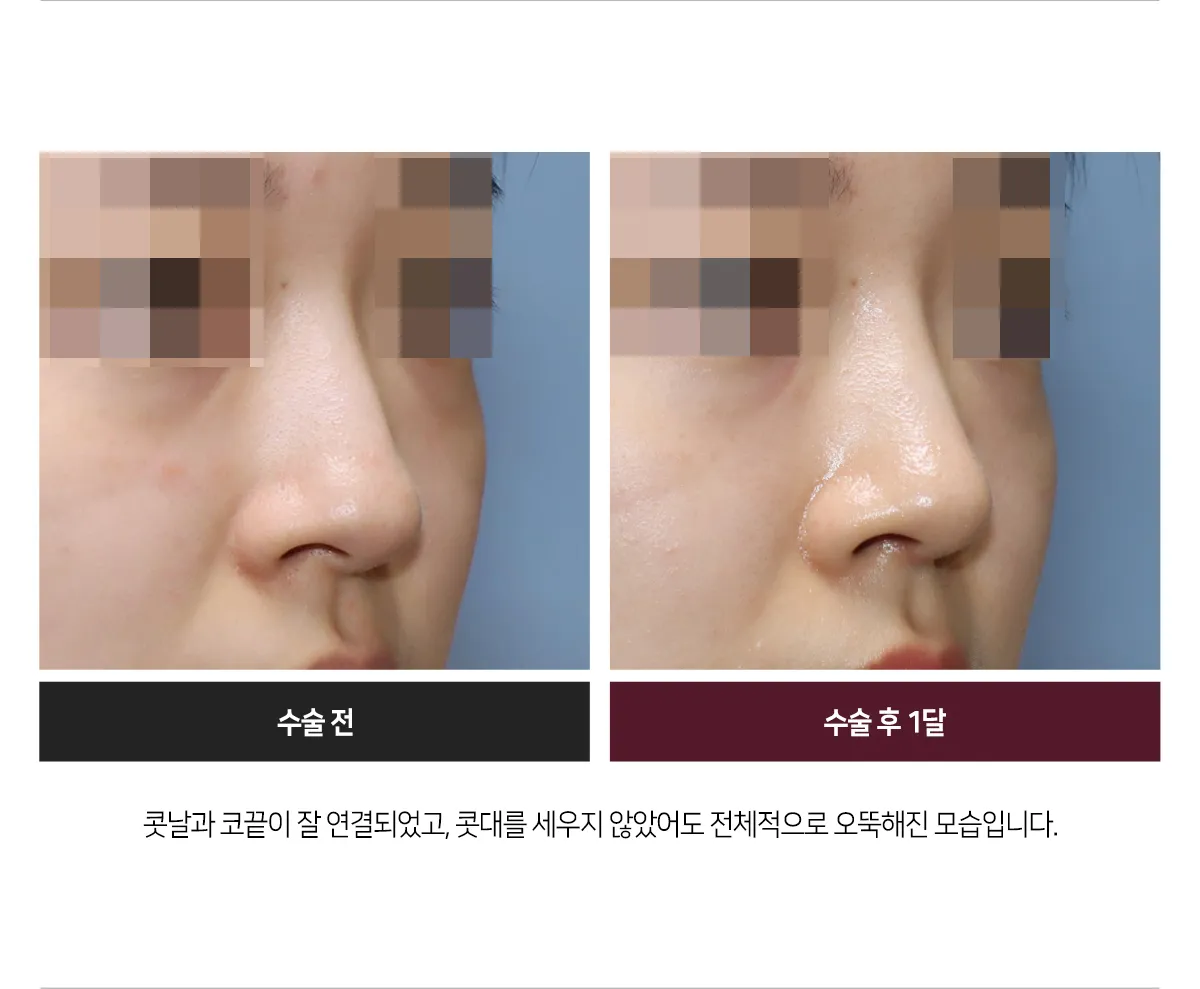
The bridge and tip connect smoothly, and the nose looks more defined overall even though the bridge was not augmented.
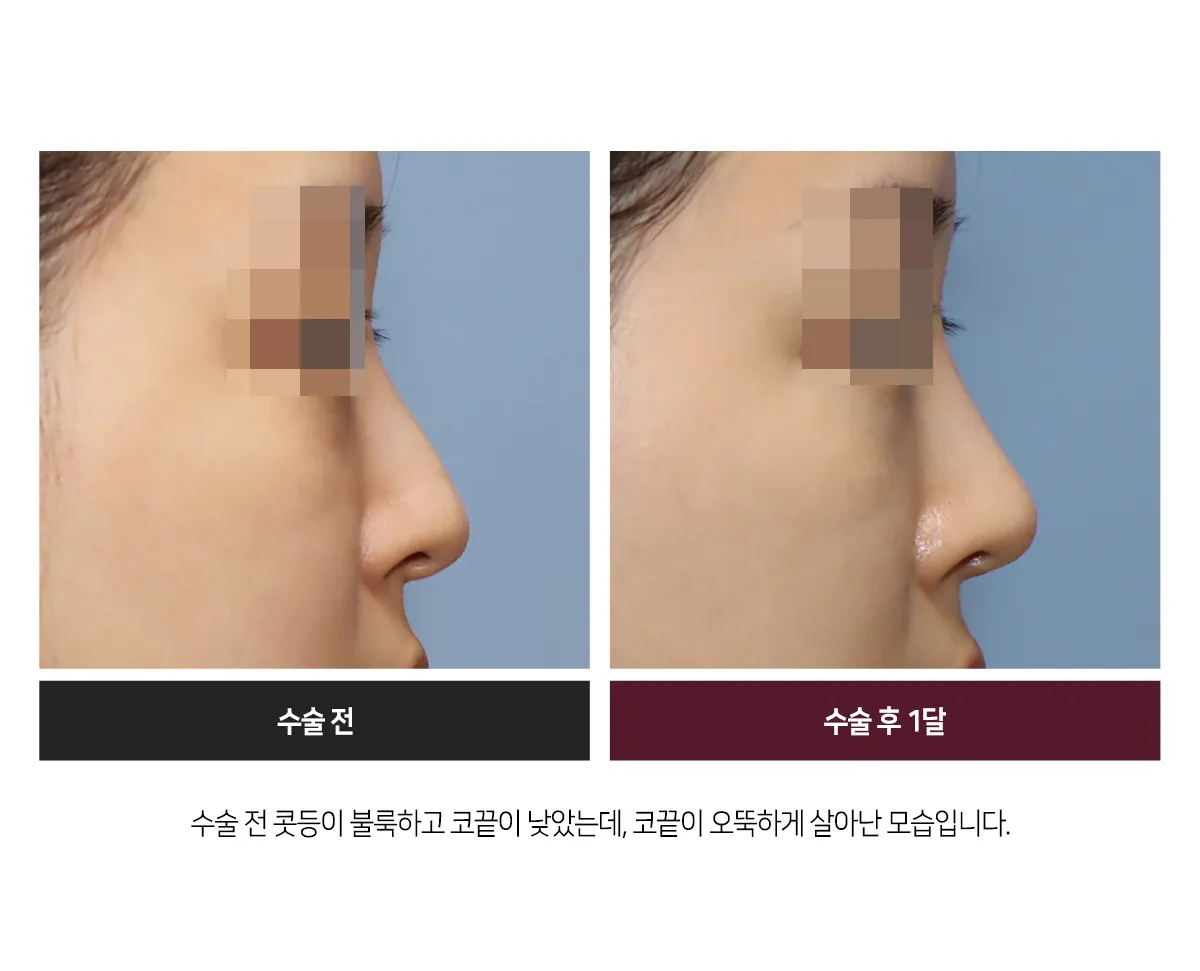
Before surgery the dorsum bulged and the tip was low; the tip now has clear definition.
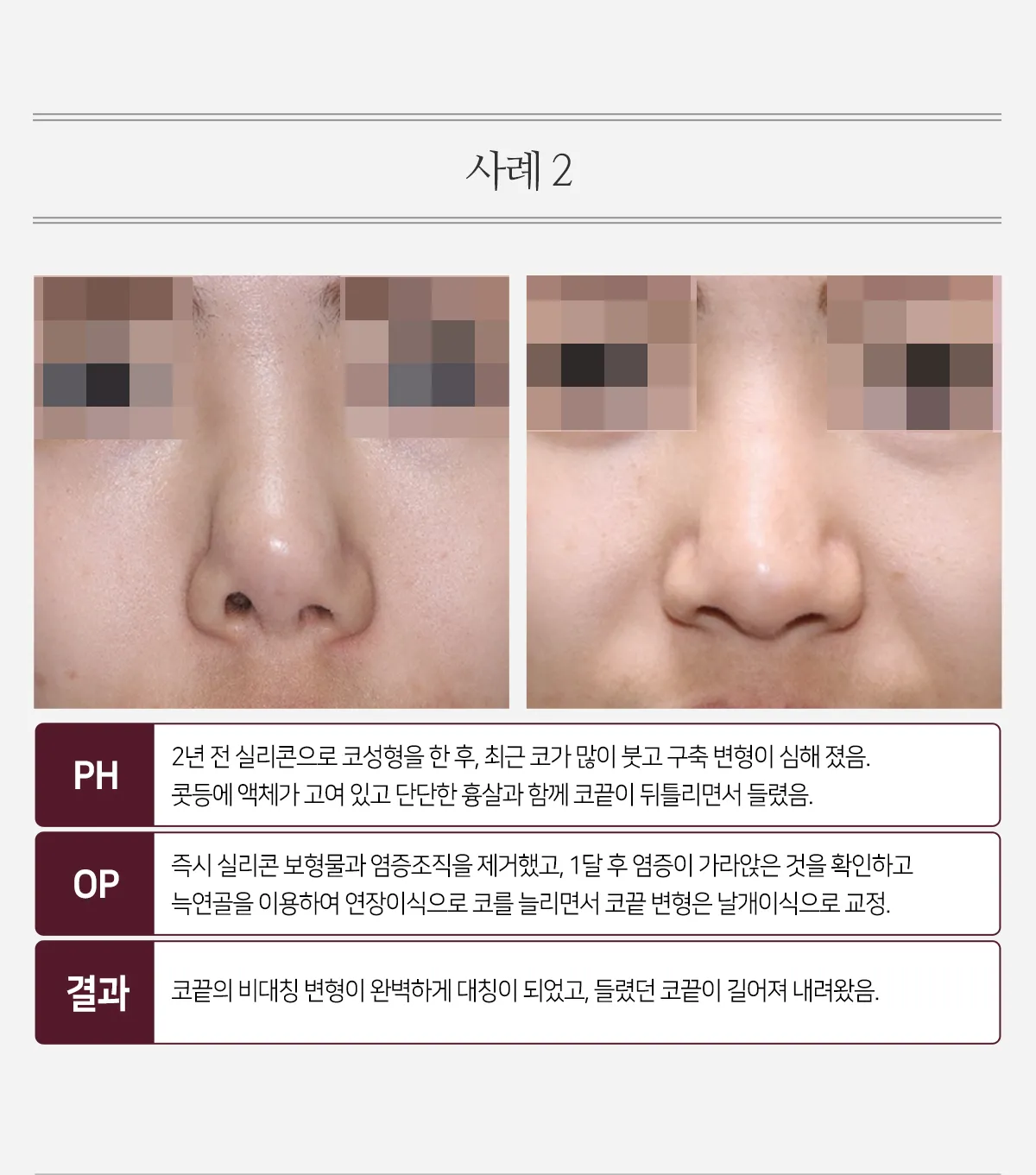
Case 2
PH
2 years earlier, the patient had rhinoplasty with silicone; recently the nose had become very swollen and the contracture deformity had worsened.
Fluid had collected on the dorsum, and, along with firm scar tissue, the tip was twisted and upturned.
OP
The silicone implant and inflamed tissue were removed immediately, and 1 month later, after confirming that the inflammation had subsided,
the nose was lengthened with an extension graft using costal cartilage, and the tip deformity was corrected with a lateral crural strut graft.
Results
The silicone implant and inflamed tissue were removed immediately, and 1 month later, after confirming that the inflammation had subsided,
the nose was lengthened with an extension graft using costal cartilage, and the tip deformity was corrected with a lateral crural strut graft.
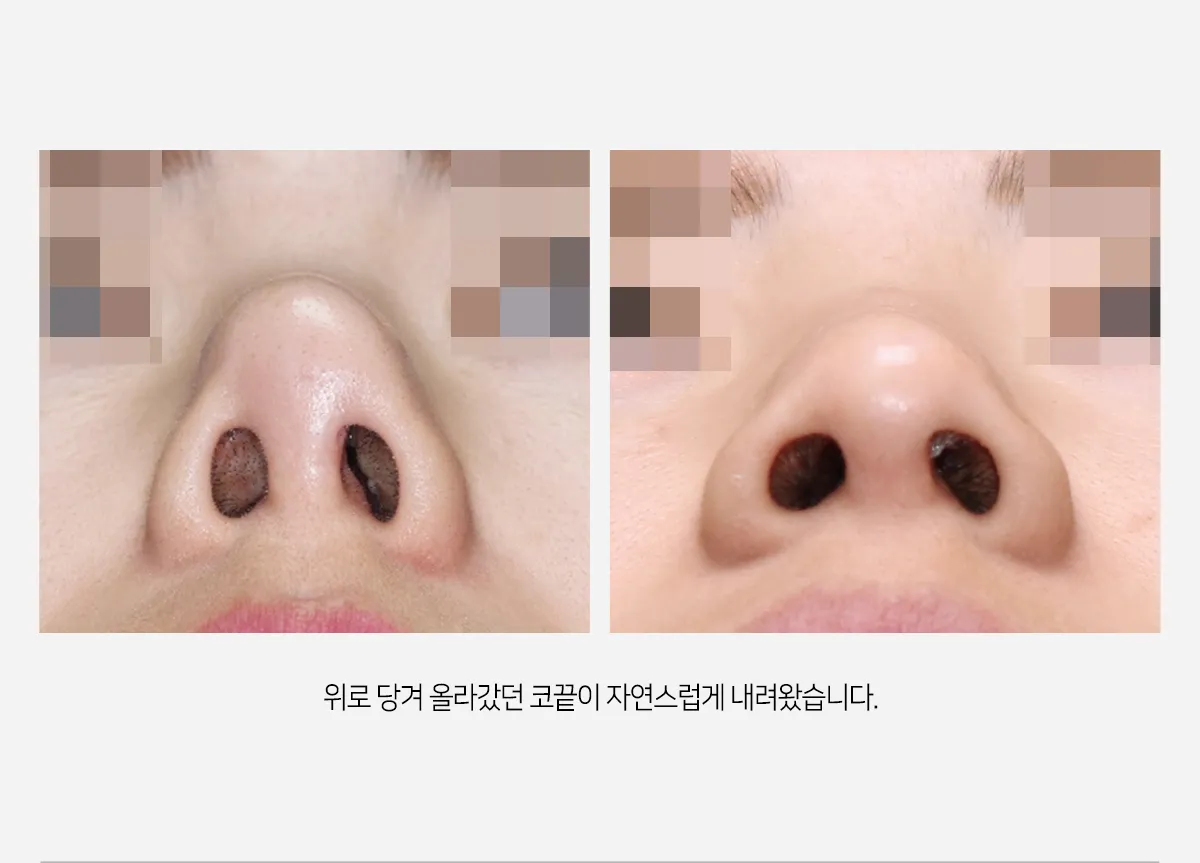
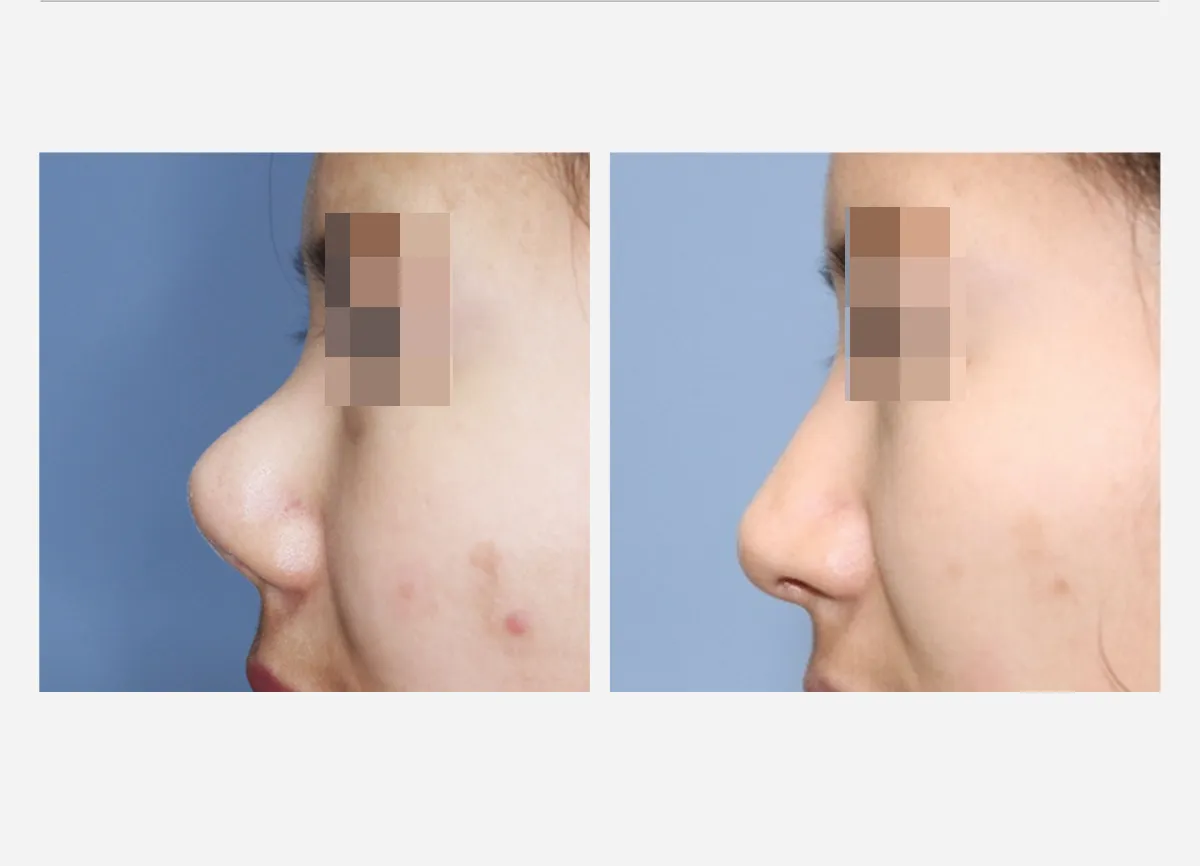
The tip, which had been pulled upward, came down naturally.
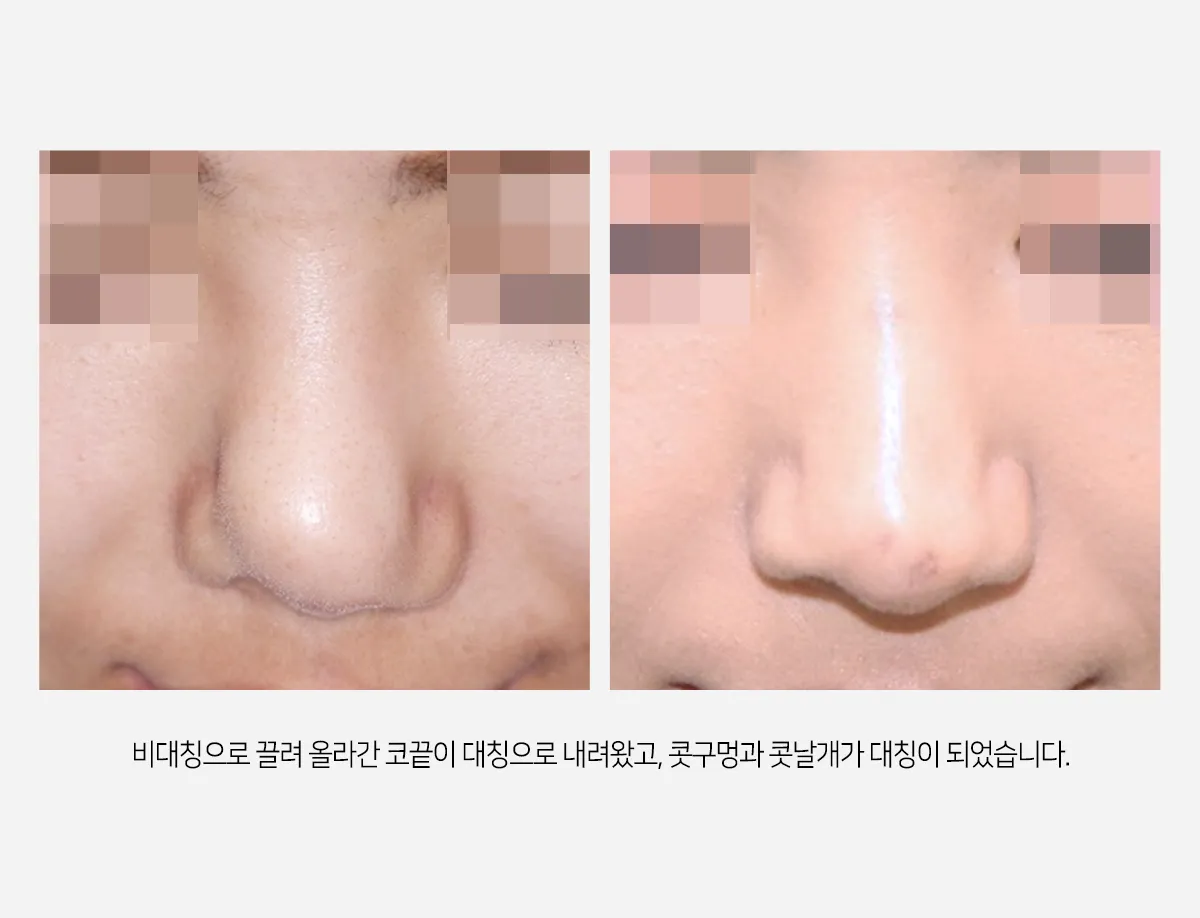
The tip, which had been pulled up asymmetrically, came down symmetrically, and the nostrils and alae became symmetrical.
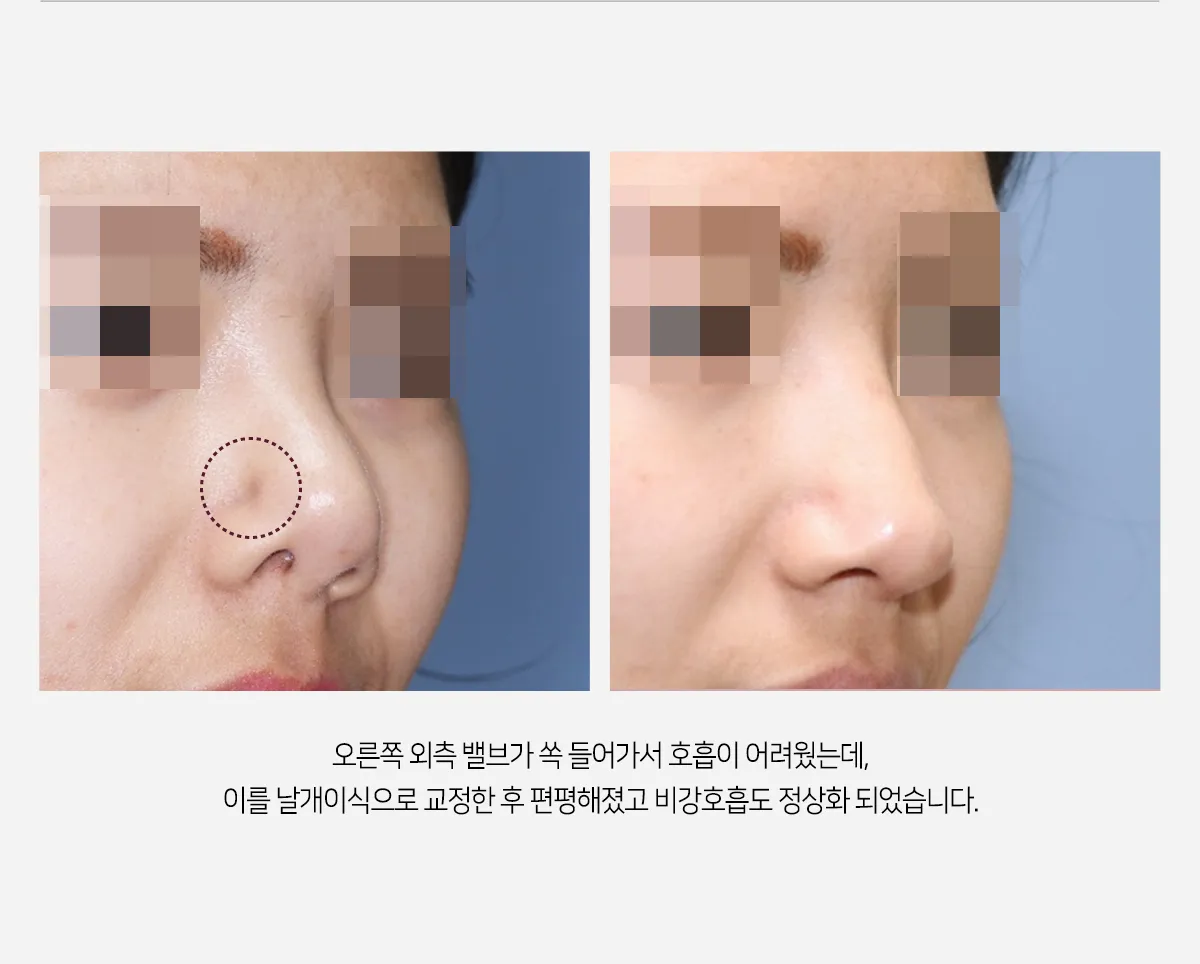
The right external valve had been sunken in, making breathing difficult;
after it was corrected with a lateral crural strut graft, it became flat and nasal breathing returned to normal.
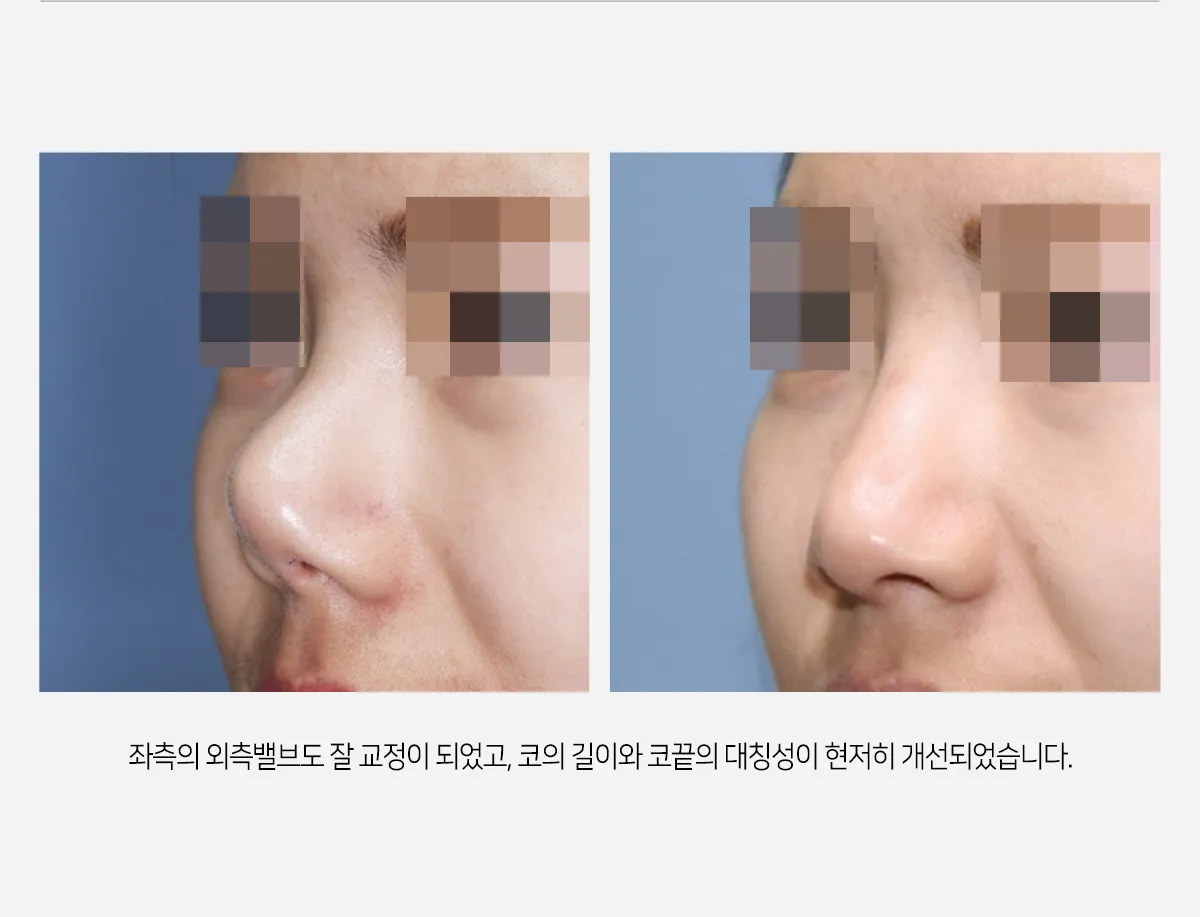
The left external valve was also well corrected, and the length of the nose and the symmetry of the tip improved markedly.
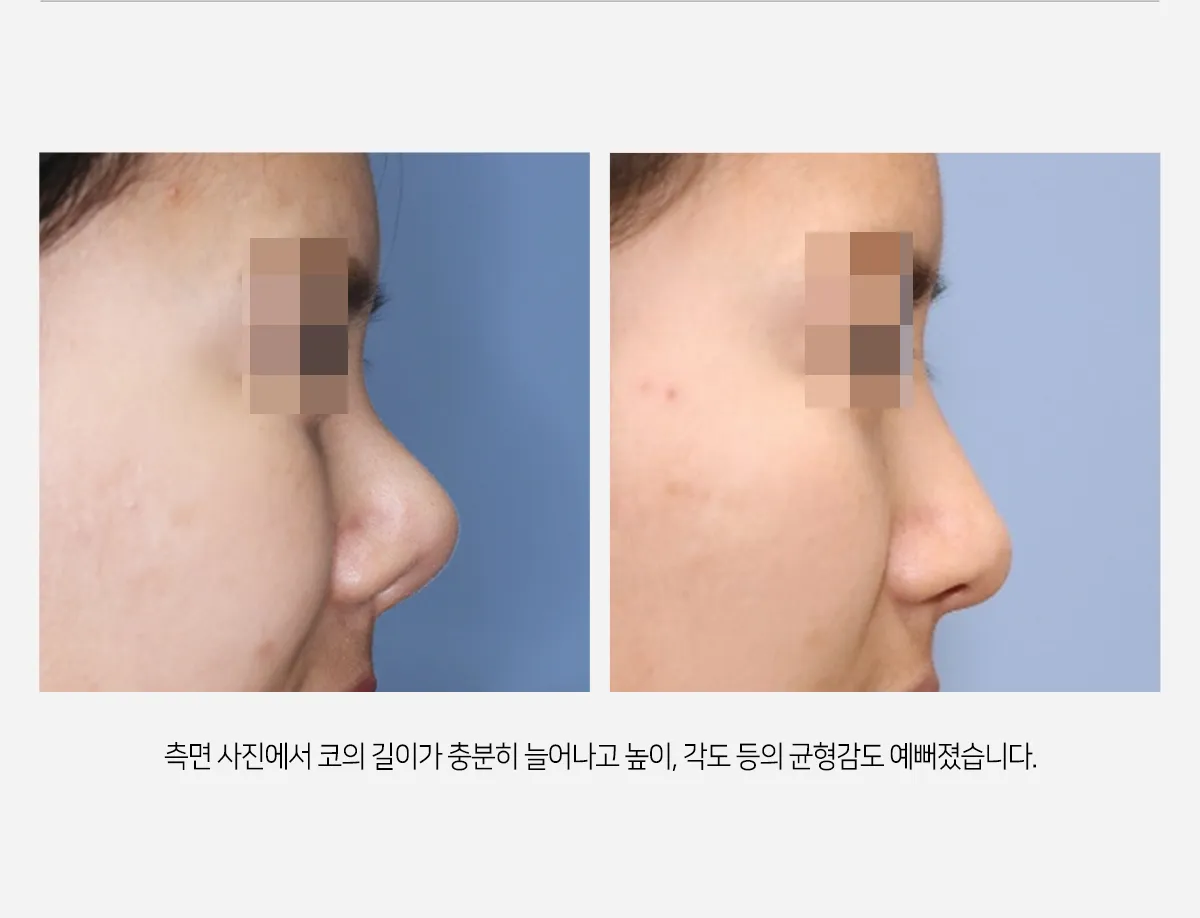
In the lateral photo, the nose has gained sufficient length, and the balance of height and angle has also improved.
Case 3
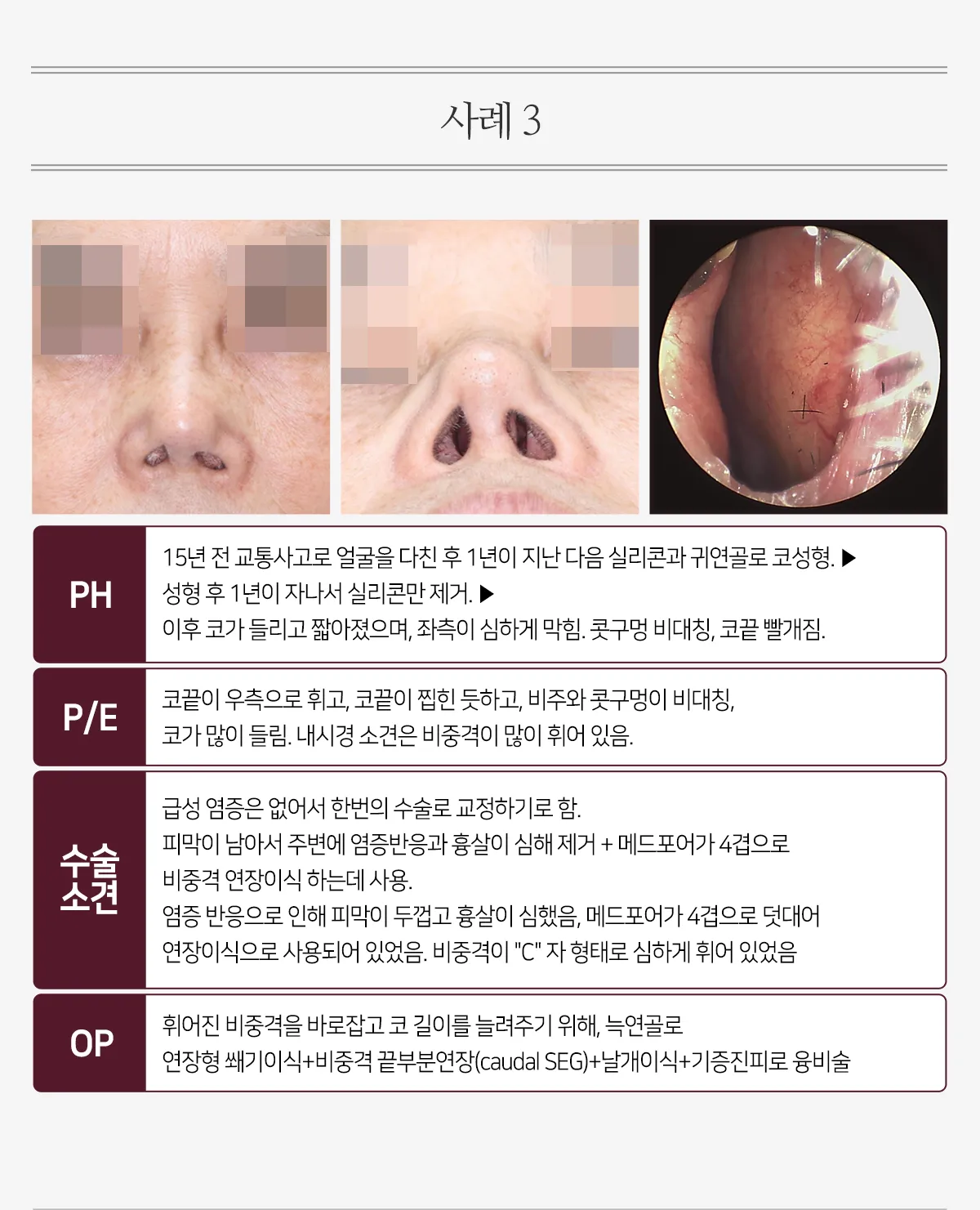
PH
15 years earlier, the patient injured the face in a traffic accident and, 1 year later, had rhinoplasty with silicone and ear cartilage. ▶
1 year after that surgery, only the silicone was removed. ▶
The nose then became upturned and short, with severe obstruction on the left. Nostril asymmetry and redness of the tip.
P/E
The tip was deviated to the right and appeared pinched, the columella and nostrils were asymmetric,
and the nose was markedly upturned. Endoscopy showed a severely deviated septum.
Operative Findings
As there was no acute inflammation, we decided to correct the nose in a single operation.
Residual capsule had caused a marked inflammatory reaction and scar tissue around it, which were removed + Medpor had been used in 4 layers
for the septal extension graft.
Because of the inflammatory reaction, the capsule was thick and scar tissue was severe, and Medpor had been layered in 4 sheets
and used as an extension graft. The septum was severely deviated in a "C" shape.
OP
To straighten the deviated septum and lengthen the nose, costal cartilage was used for
an extended wedge graft + caudal septal extension (caudal SEG) + lateral crural strut graft, with augmentation rhinoplasty using acellular dermal matrix
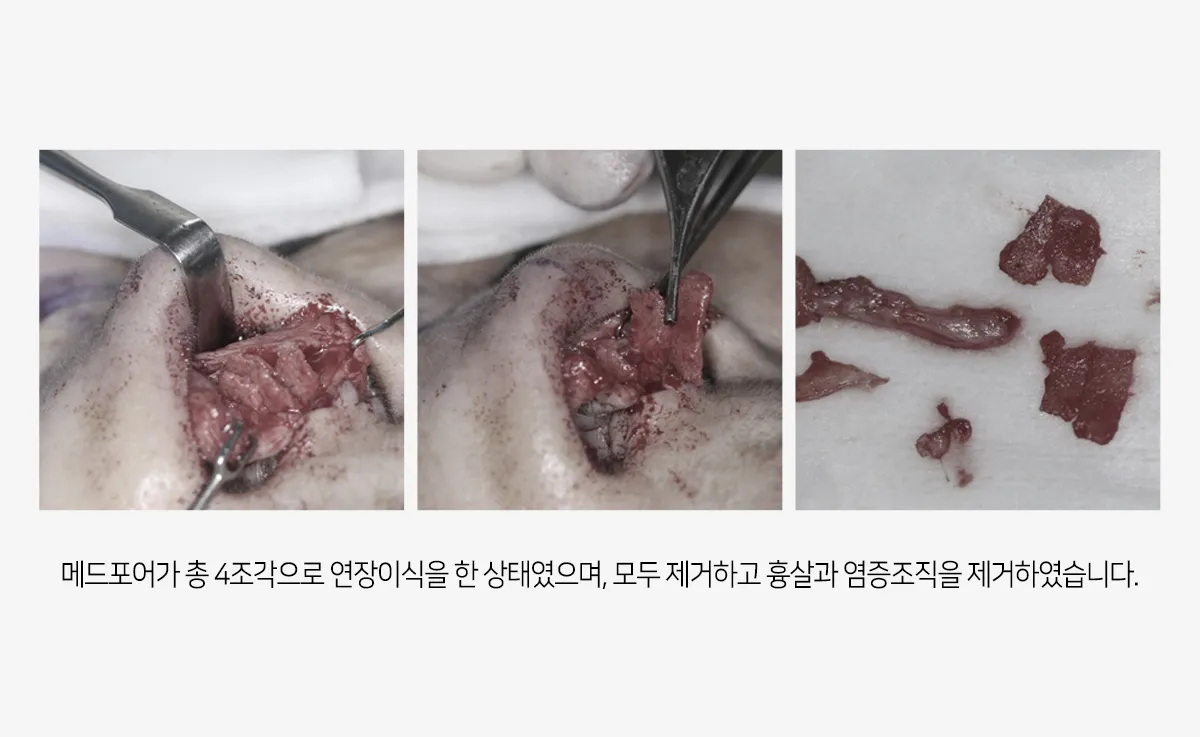
A total of 4 pieces of Medpor had been used for the extension graft; all were removed, along with the scar tissue and inflamed tissue.
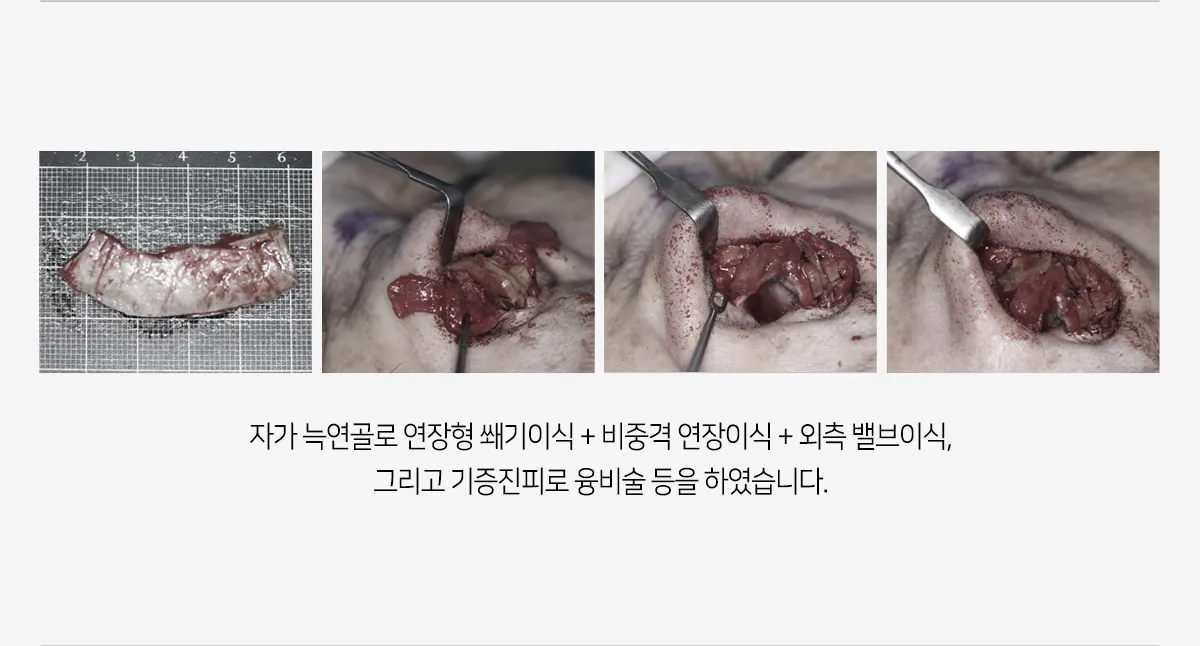
An extended wedge graft + septal extension graft + external valve graft were performed with autologous costal cartilage,
together with augmentation rhinoplasty using acellular dermal matrix.
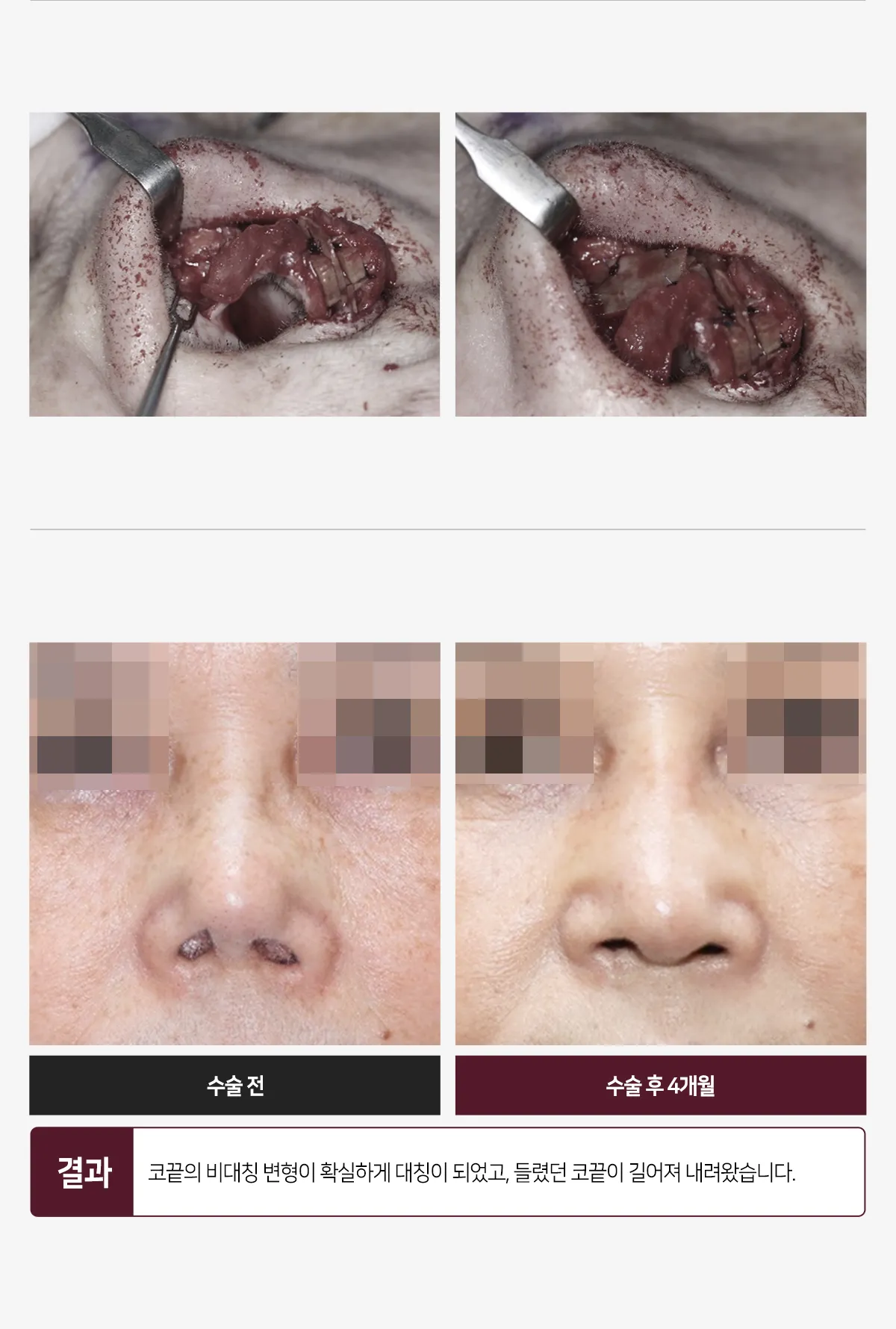
Results
The asymmetric tip deformity became clearly symmetrical, and the upturned tip lengthened and came down.
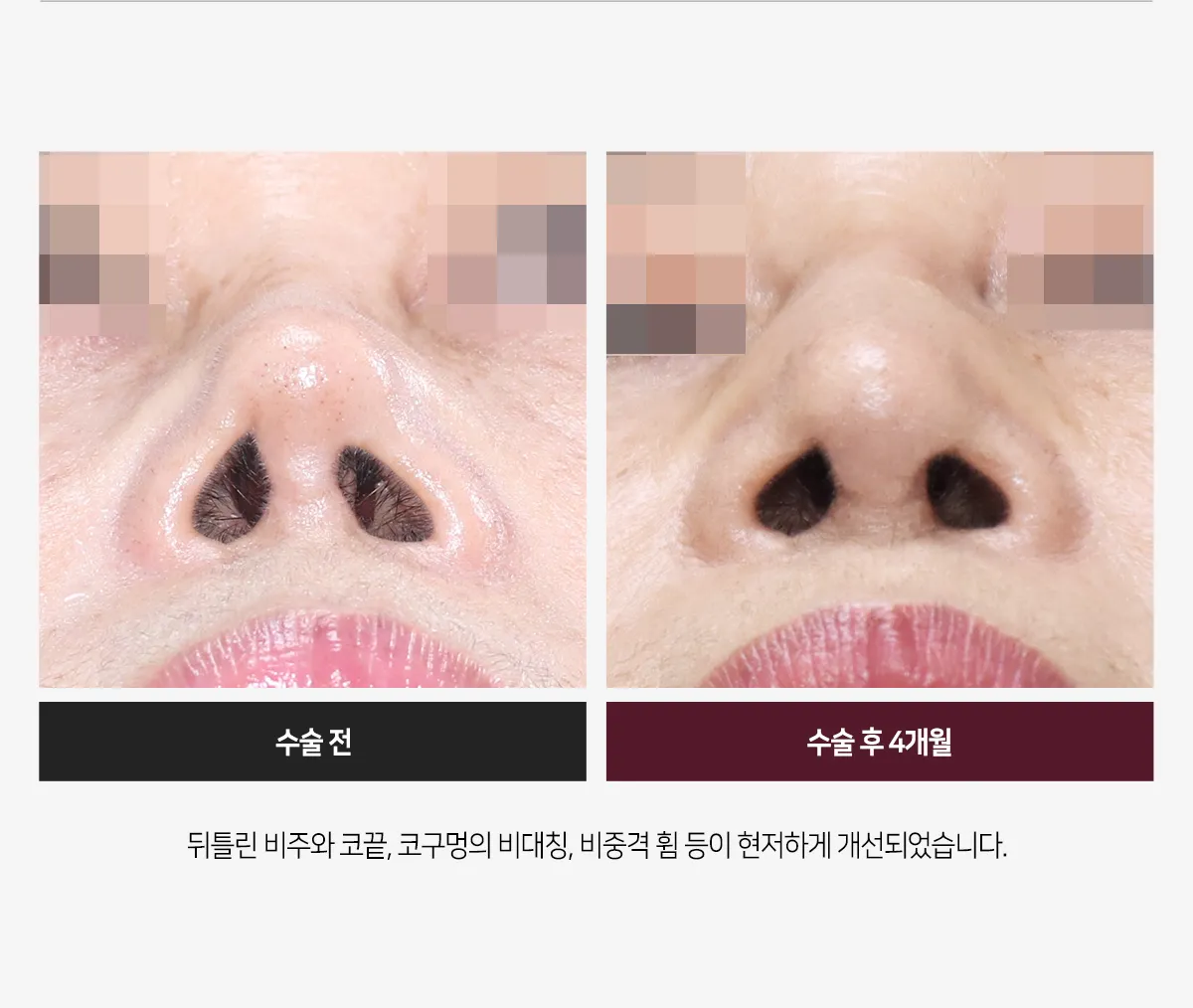
The twisted columella and tip, the nostril asymmetry, and the septal deviation all improved markedly.
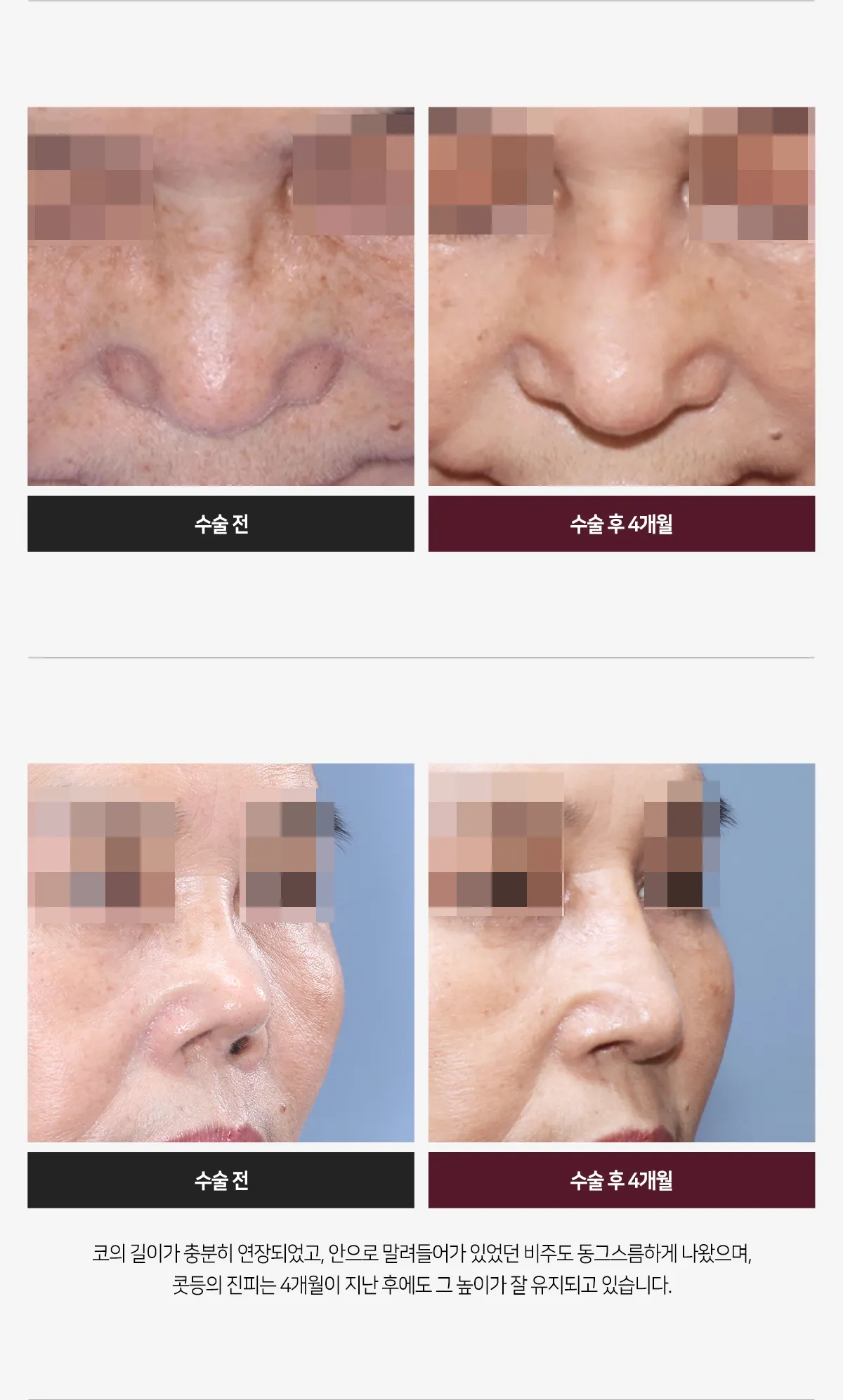
The nose was sufficiently lengthened, the columella, which had been retracted inward, came out in a rounded shape,
and the dermis on the dorsum has maintained its height well even after 4 months.
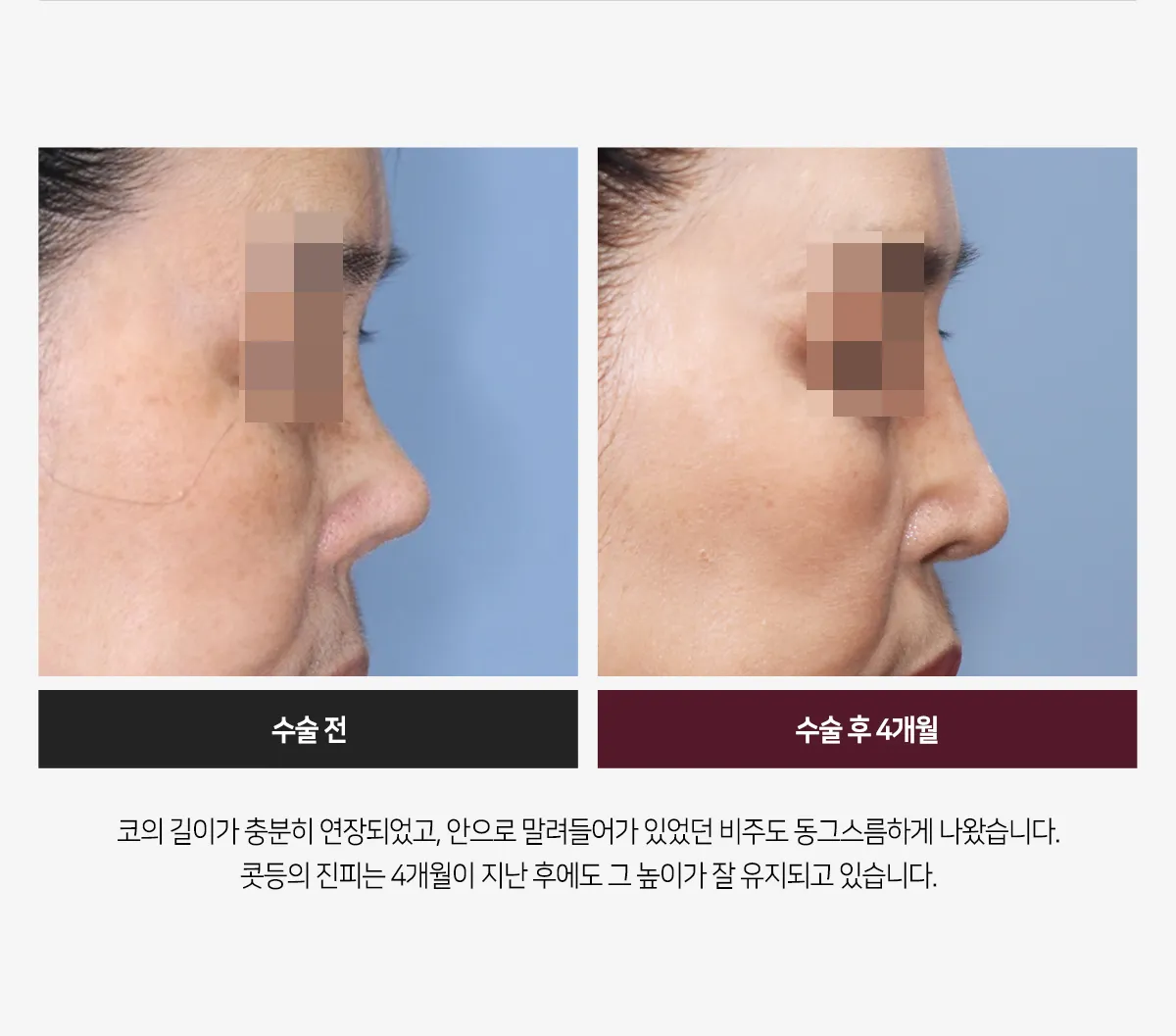
The nose was sufficiently lengthened, and the columella, which had been retracted inward, came out in a rounded shape.
and the dermis on the dorsum has maintained its height well even after 4 months.
B. Contracted Nose Correction with a Derotation Graft
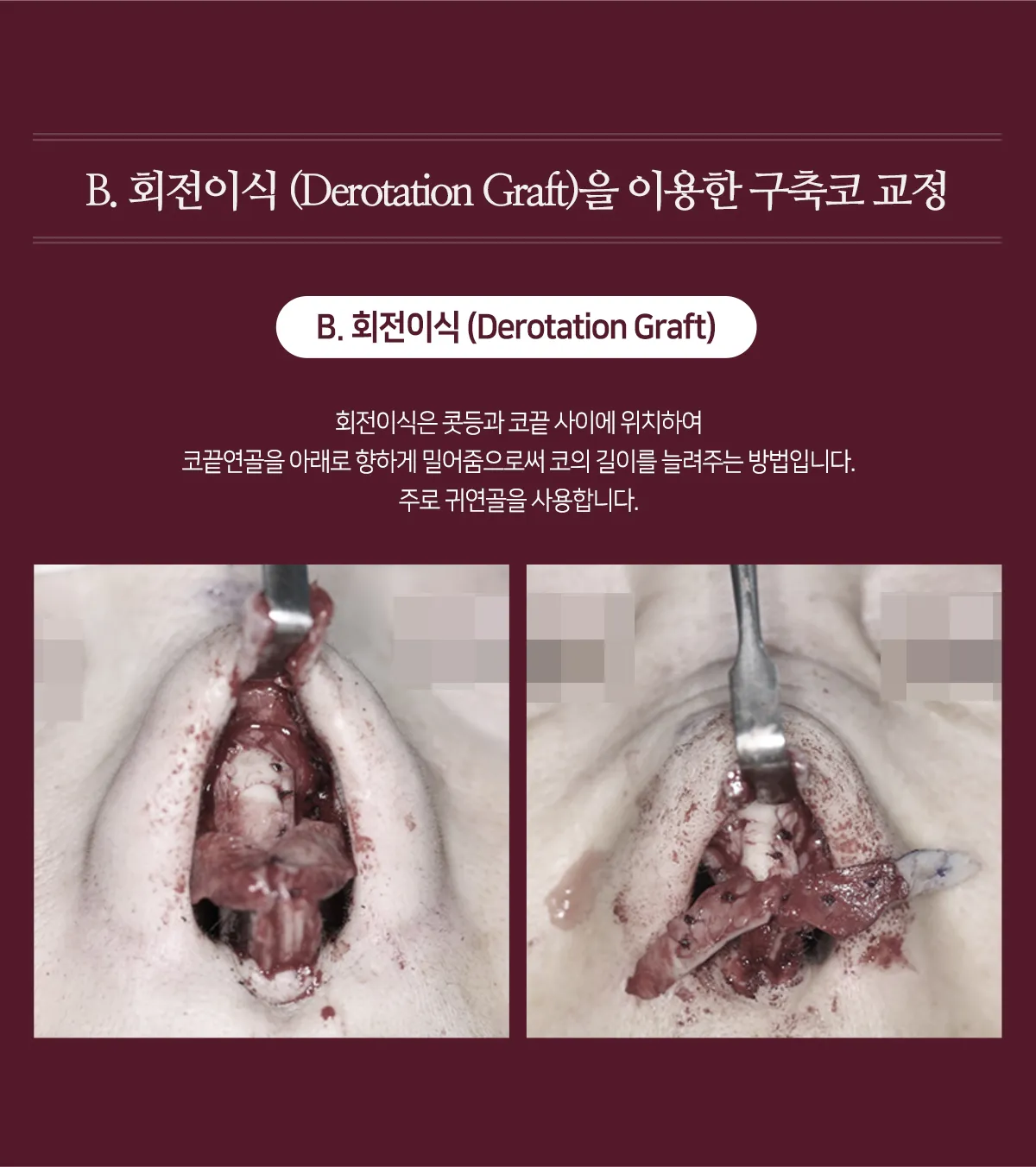
B. Derotation Graft
A derotation graft is placed between the dorsum and the tip
and pushes the tip cartilages downward, thereby lengthening the nose.
Ear cartilage is mainly used.
B. Contracted Nose Correction with a Derotation Graft
Case 1
PH
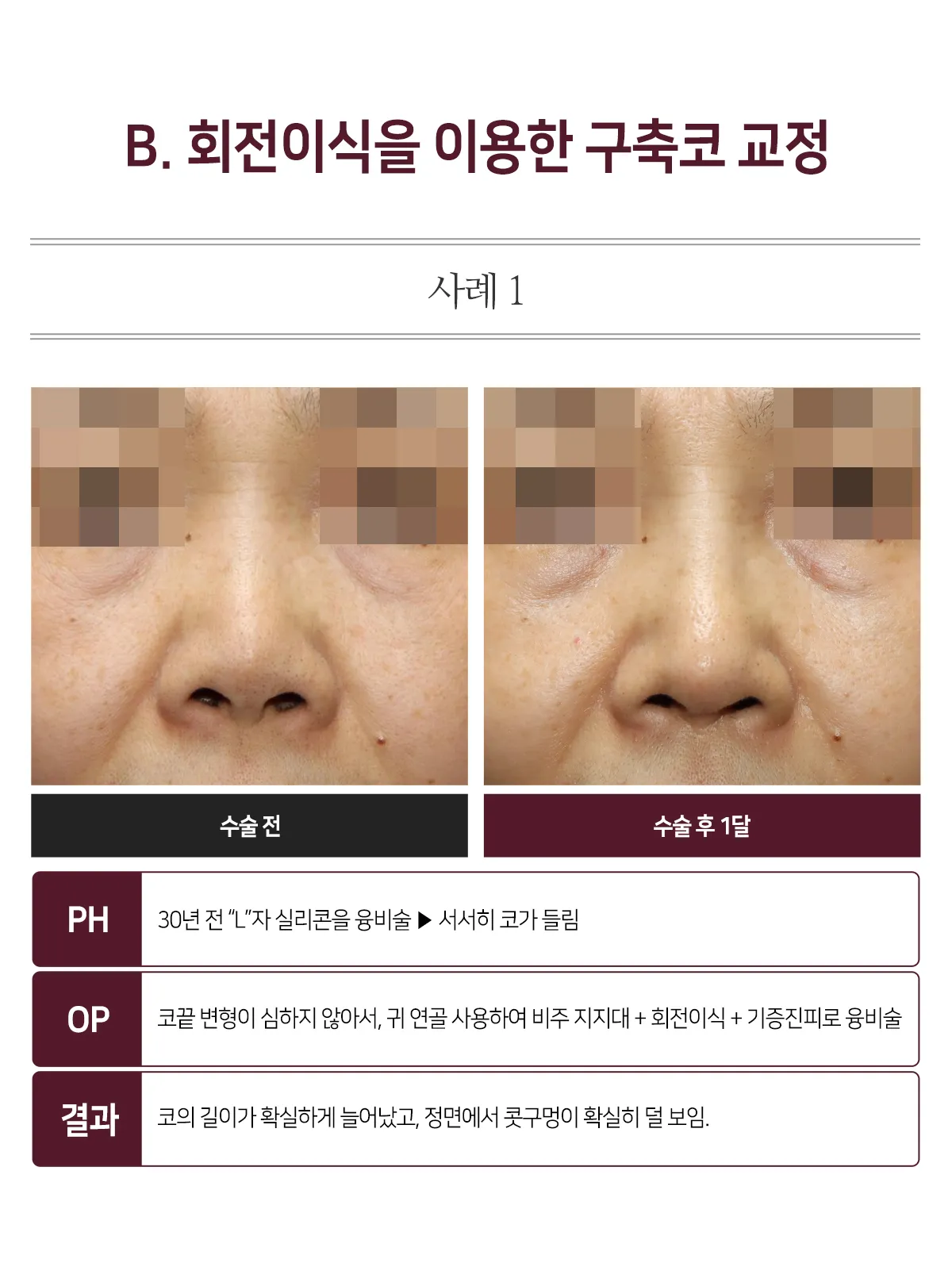
30 years earlier: augmentation rhinoplasty with an “L”-shaped silicone implant ▶ the nose gradually became upturned
OP
Because the tip deformity was not severe, ear cartilage was used for a columellar strut + derotation graft, with augmentation rhinoplasty using acellular dermal matrix
Results
The nose was clearly lengthened, and the nostrils were clearly less visible from the front.
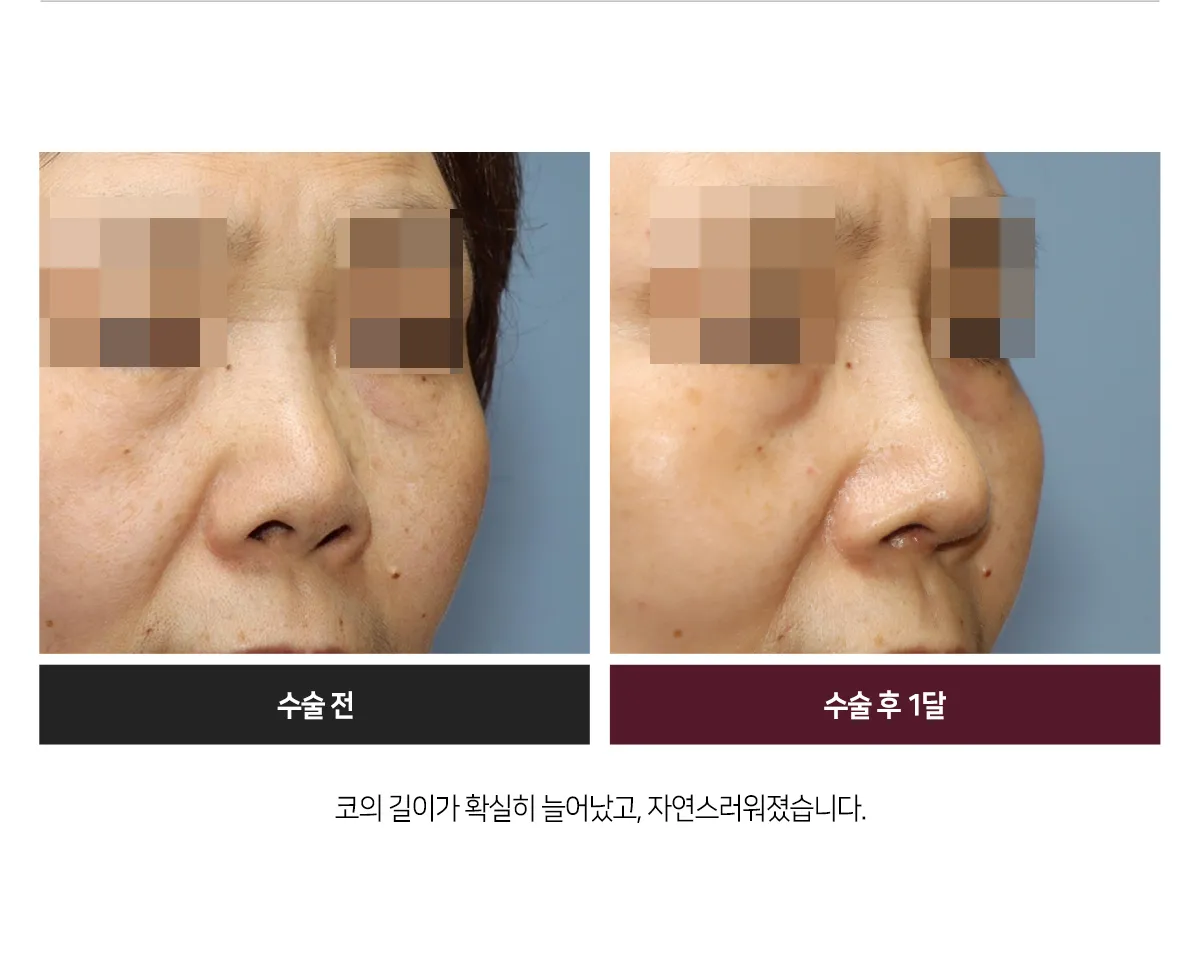
The nose was clearly lengthened and looks natural.
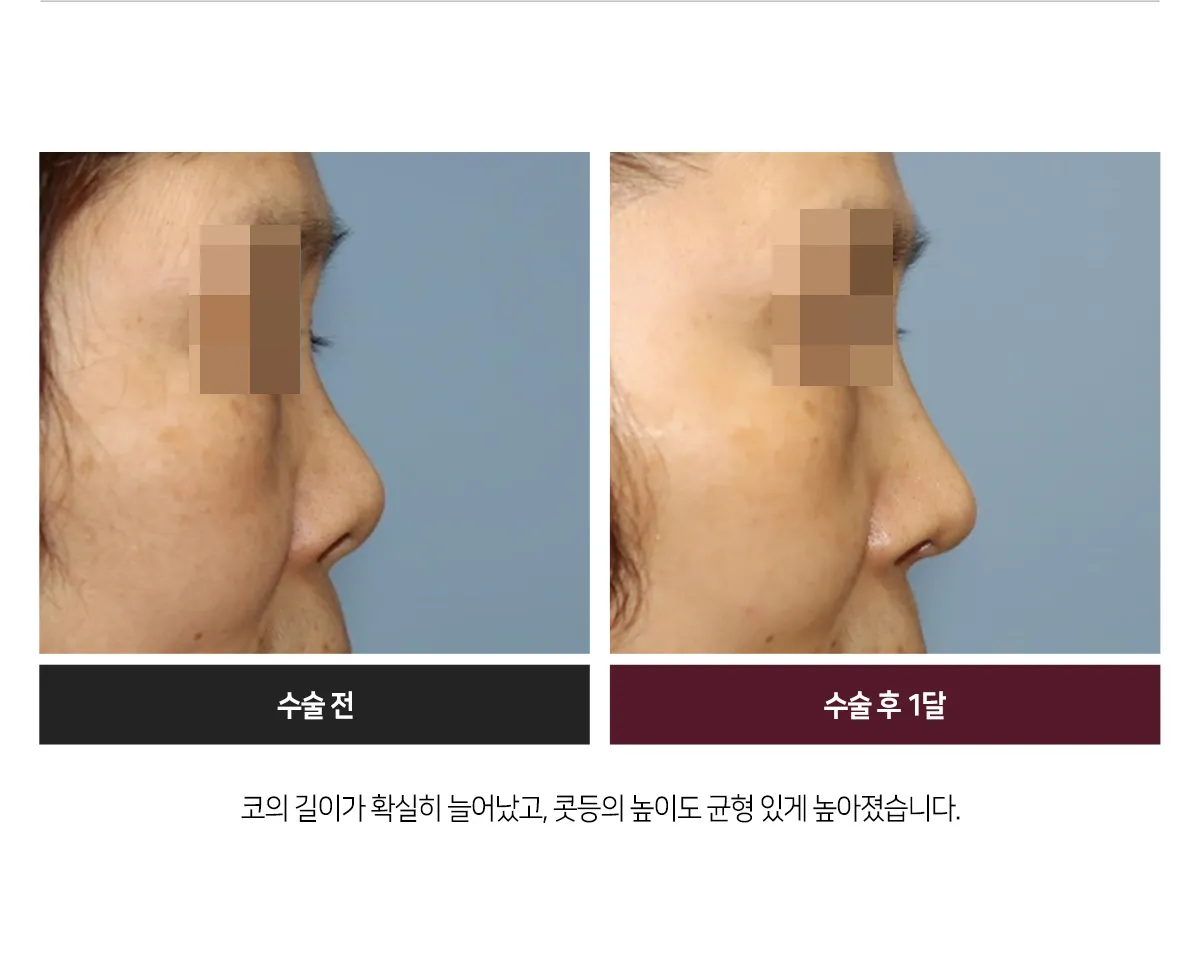
The nose was clearly lengthened, and the dorsum was raised in a balanced way.
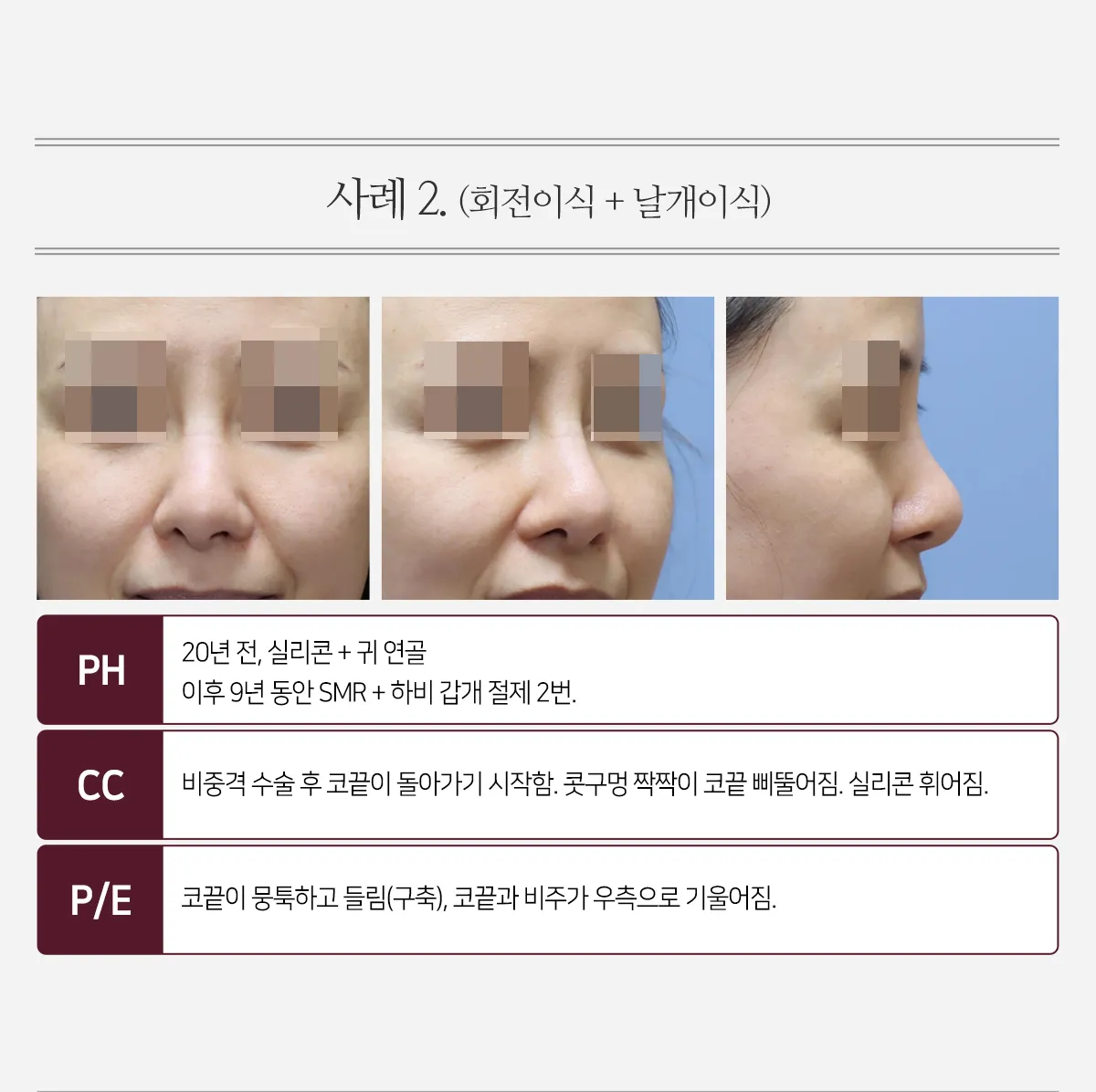
Case 2. (Derotation Graft + Lateral Crural Strut Graft)
PH
20 years earlier: silicone + ear cartilage
Over the following 9 years: SMR + inferior turbinate resection, 2 times.
CC
After the septal surgery, the tip began to turn. Nostril asymmetry and a crooked tip. The silicone was bent.
P/E
The tip was bulbous and upturned (contracture), and the tip and columella leaned to the right.
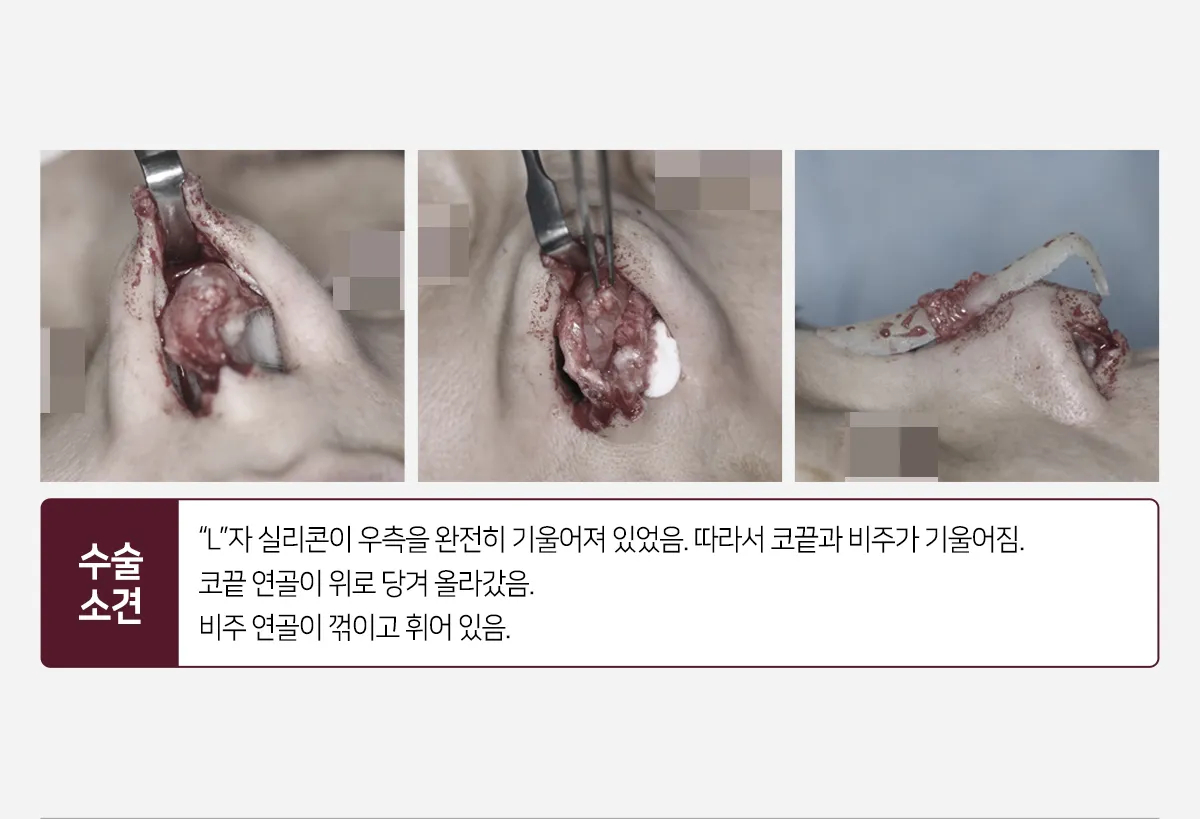
Operative Findings
The “L”-shaped silicone implant was tilted completely to the right. As a result, the tip and columella were tilted.
The tip cartilages had been pulled upward.
The columellar cartilages were bent and deviated.
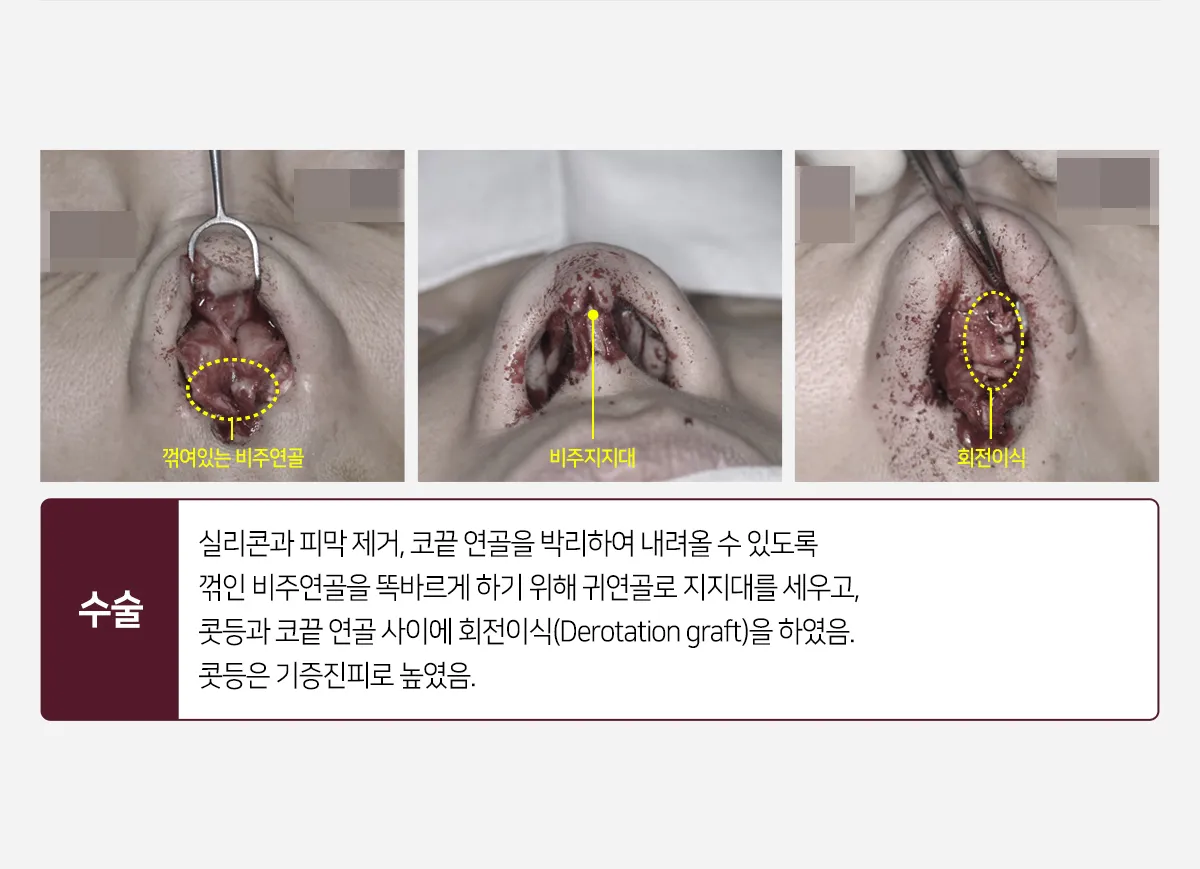
Surgery
The silicone and capsule were removed, and the tip cartilages were dissected so that they could come down;
a strut made of ear cartilage was placed to straighten the bent columellar cartilages,
and a derotation graft was placed between the dorsum and the tip cartilages.
The dorsum was raised with acellular dermal matrix.
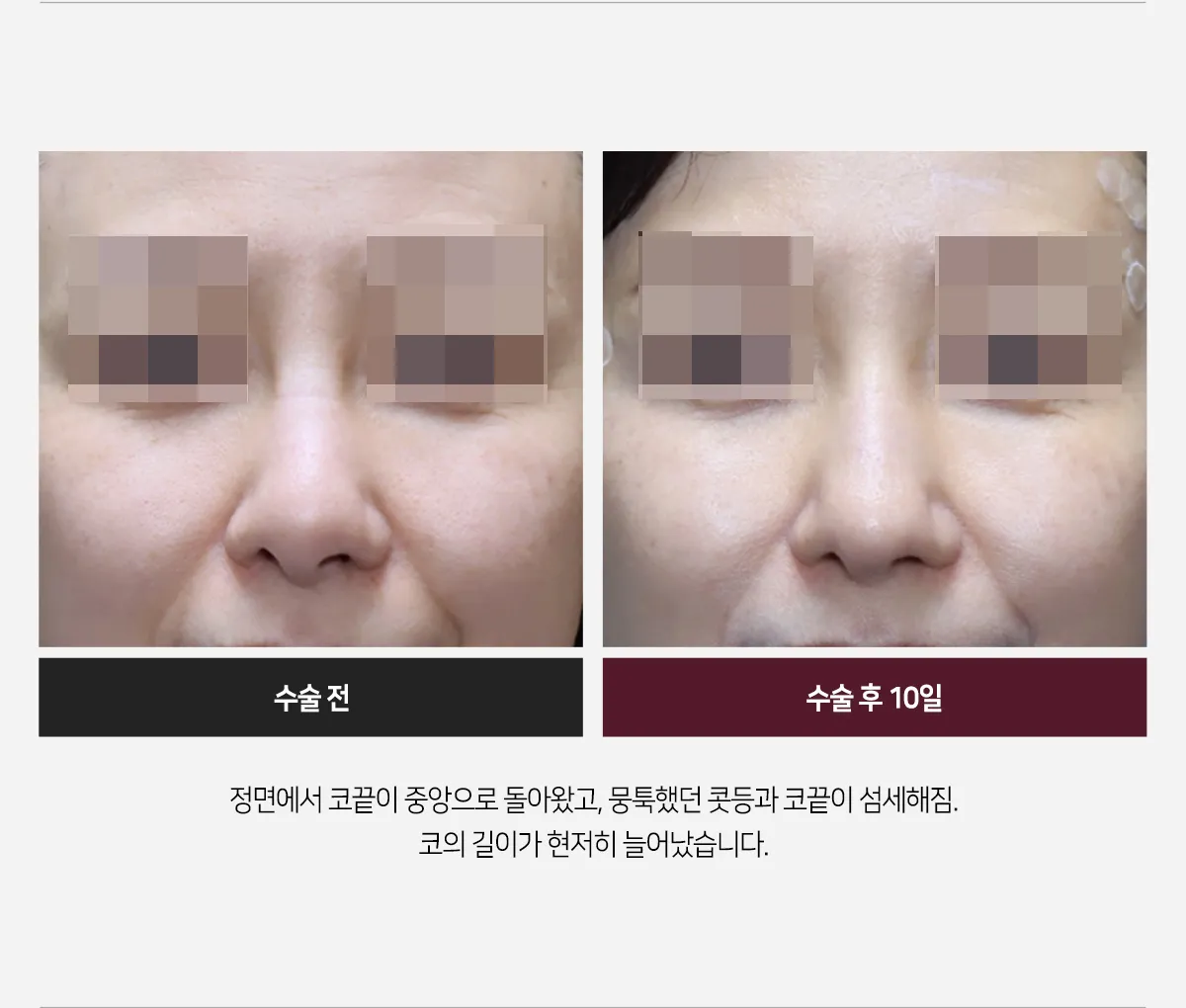
From the front, the tip returned to the center, and the dorsum and tip, which had been bulbous, became refined.
The nose was lengthened markedly.
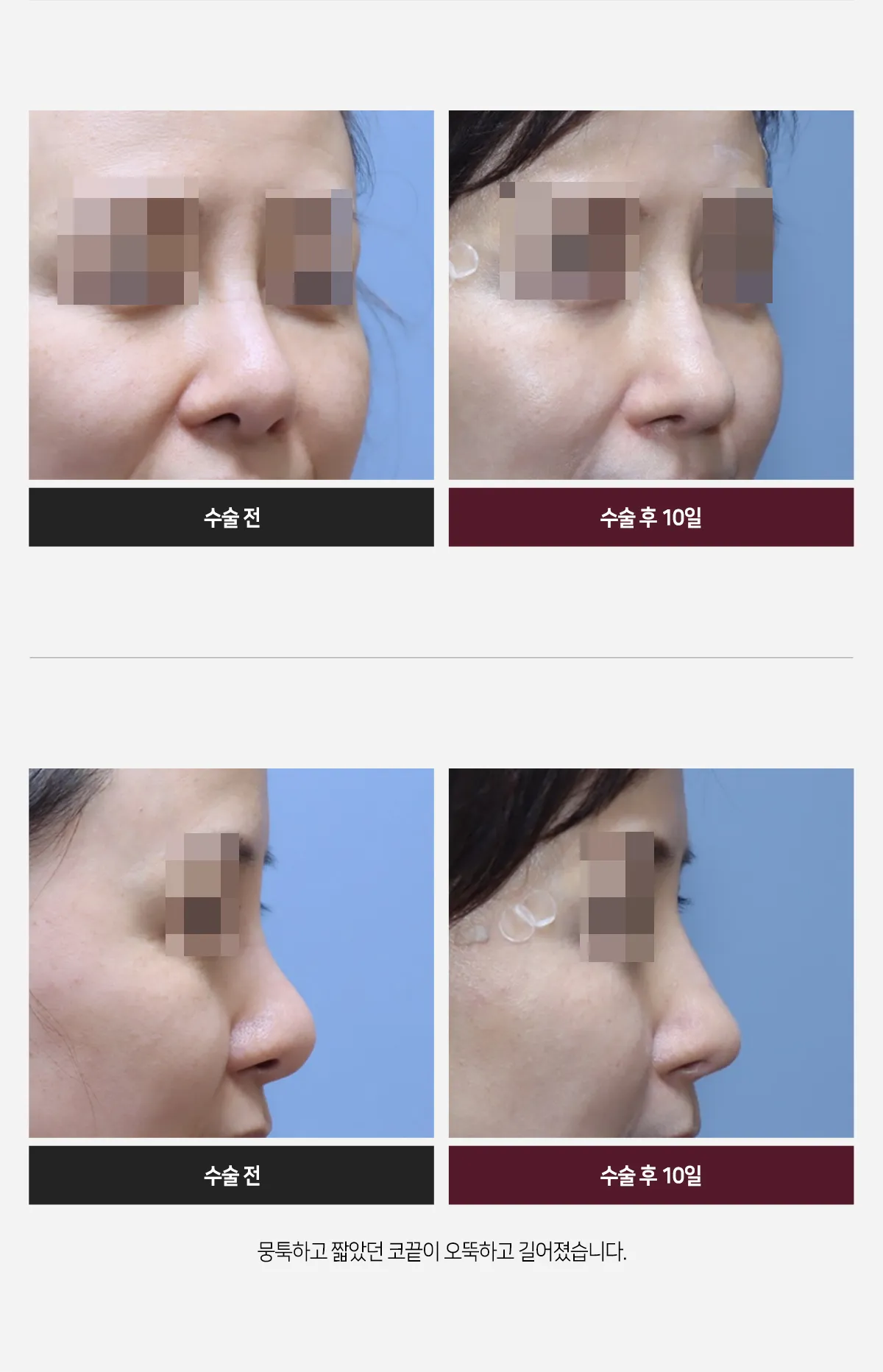
The tip, which had been bulbous and short, became well defined and longer.
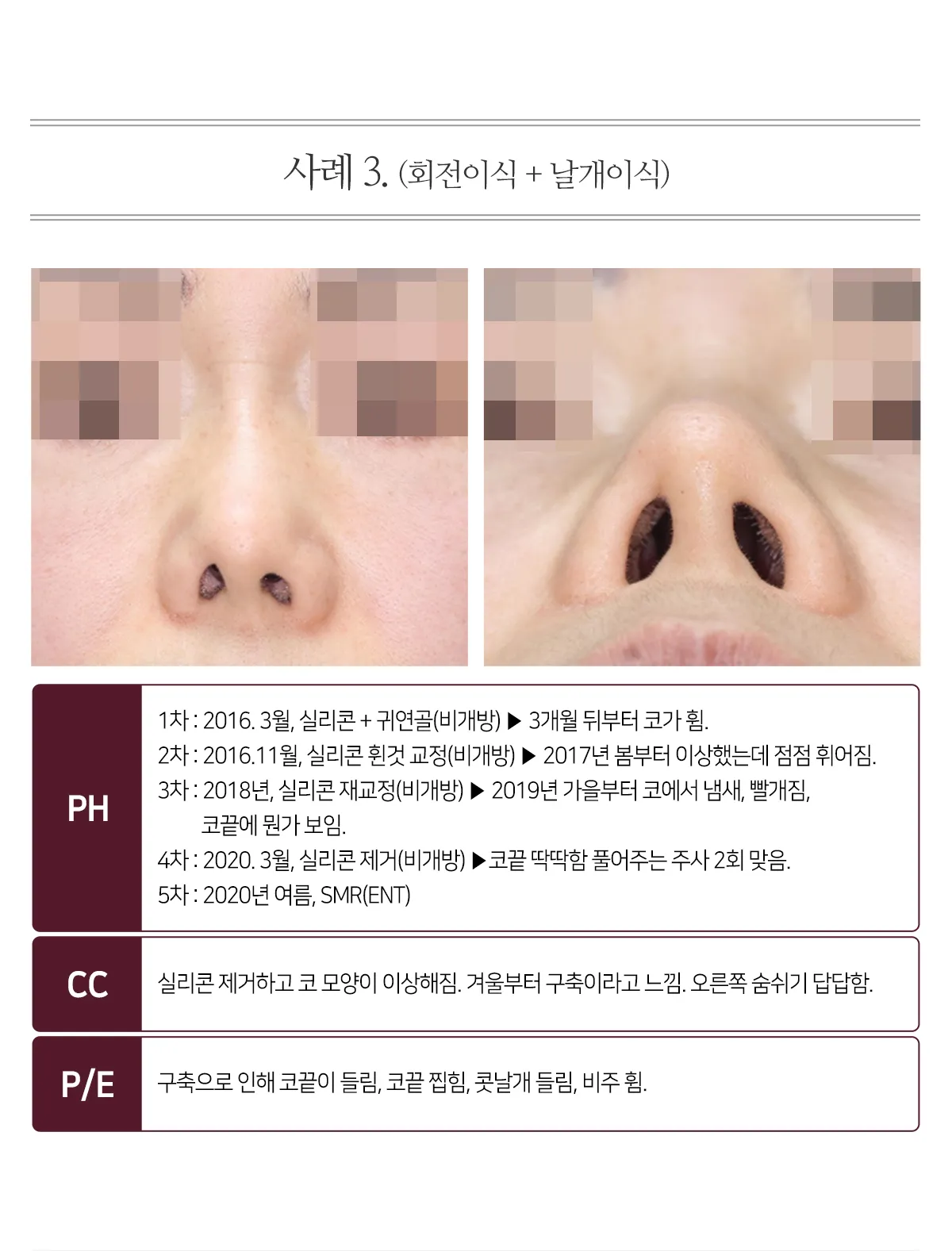
Case 3. (Derotation Graft + Lateral Crural Strut Graft)
PH
1st : March 2016, silicone + ear cartilage (closed approach) ▶ the nose began to deviate 3 months later.
2nd : November 2016, correction of the bent silicone (closed approach) ▶ something felt wrong from spring 2017, and the nose gradually deviated.
3rd : 2018, repeat correction of the silicone (closed approach) ▶ from fall 2019, an odor from the nose, redness,
and something visible at the tip.
4th : March 2020, silicone removal (closed approach) ▶ received 2 injections to soften the hardened tip.
5th : Summer 2020, SMR (ENT)
CC
After the silicone was removed, the shape of the nose became abnormal. From winter, the patient felt it was contracture. Breathing felt blocked on the right.
P/E
Because of contracture: upturned tip, pinched tip, alar retraction, and deviated columella.
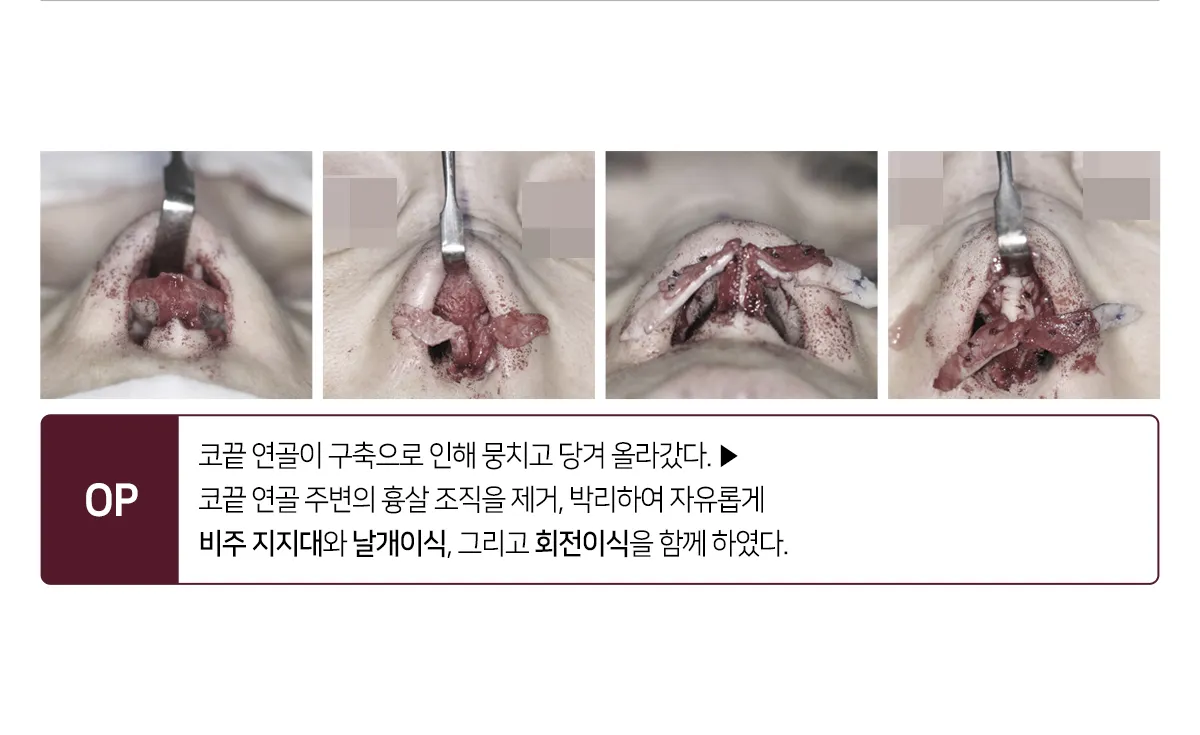
OP
The tip cartilages were bunched together and pulled upward by contracture. ▶
The scar tissue around the tip cartilages was removed and the cartilages were dissected free;
a columellar strut, a lateral crural strut graft, and a derotation graft were then performed together.
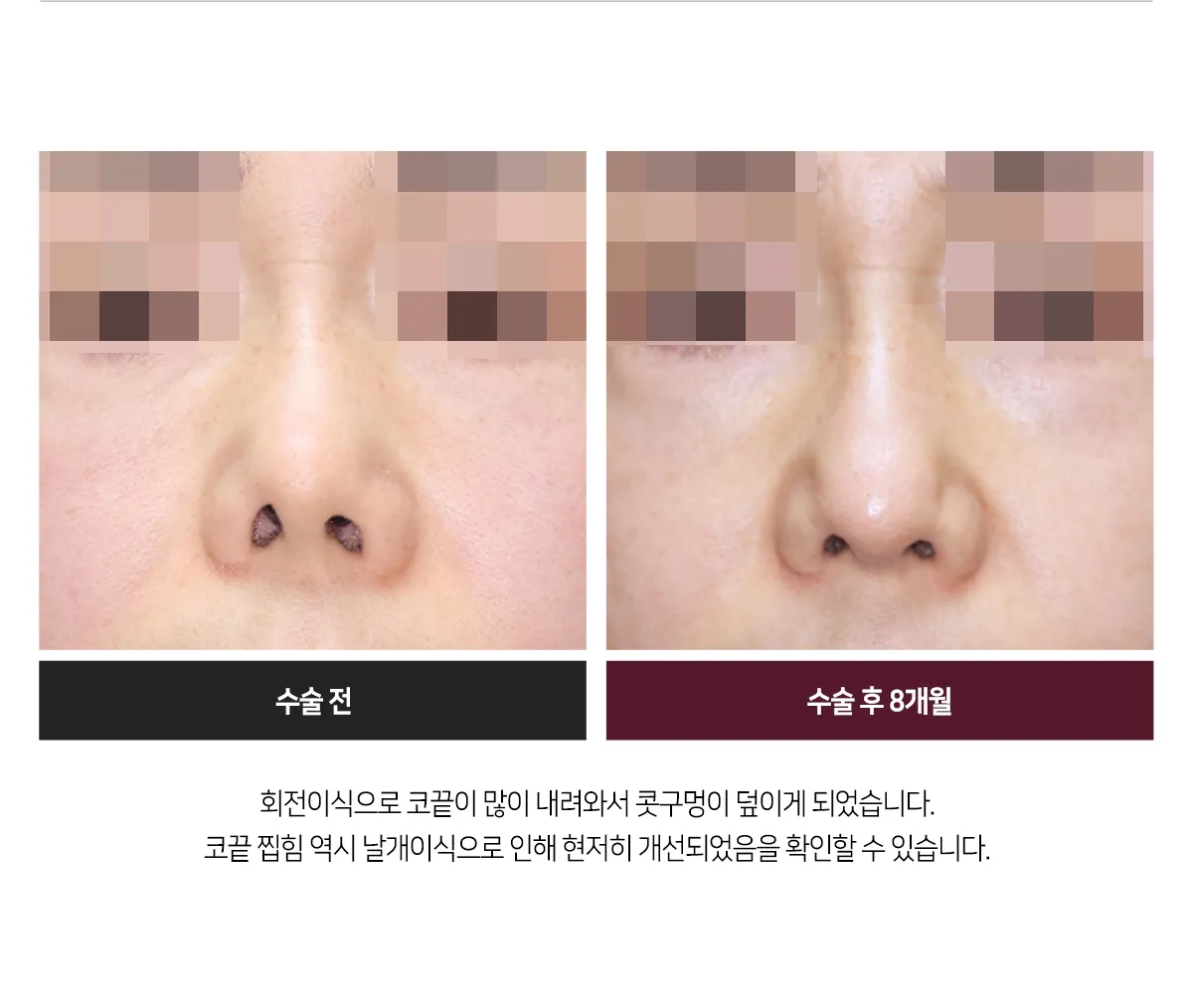
With the derotation graft, the tip came down considerably, so the nostrils are now covered.
The pinching of the tip can also be seen to have improved markedly with the lateral crural strut graft.
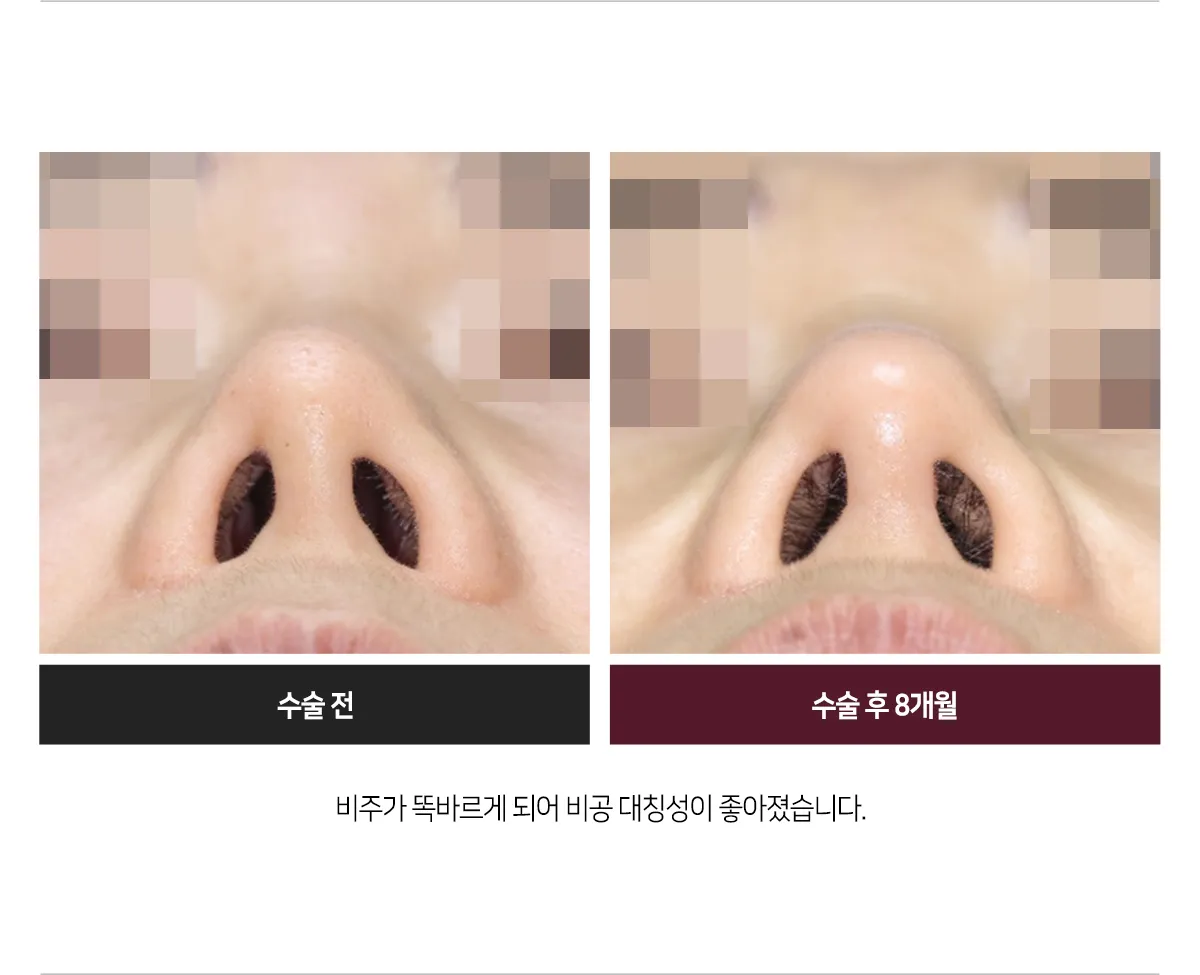
The columella became straight, and nostril symmetry improved.
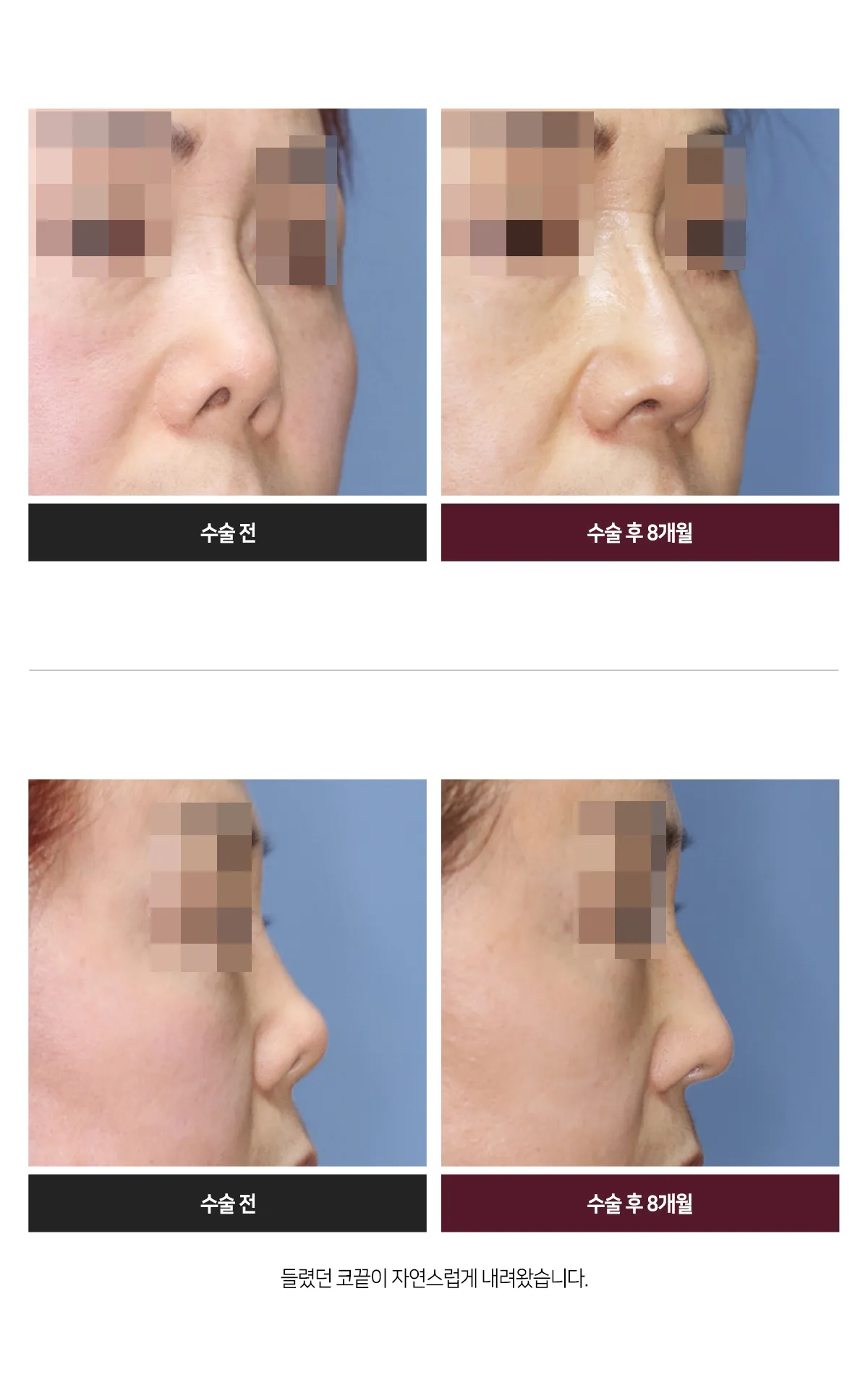
The upturned tip came down naturally.