

"L"-Shaped Silicone Implant Removal Case
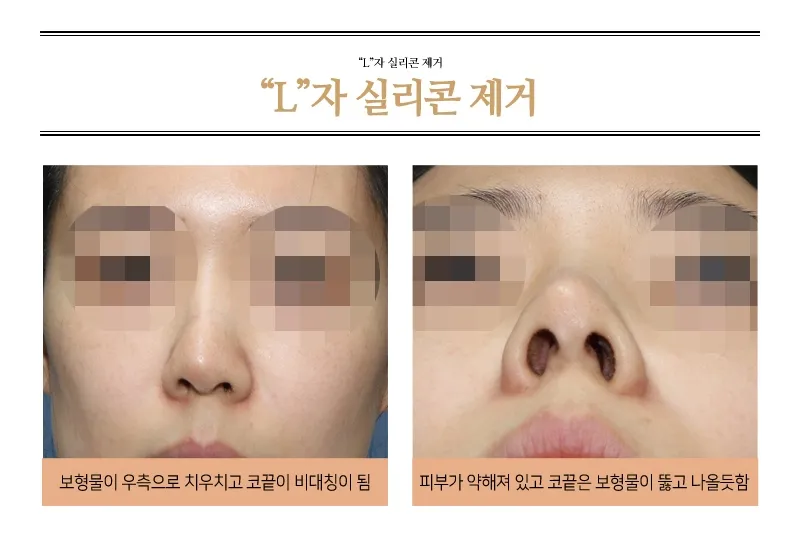
Among nasal implants, the “L”-shaped silicone implant not only puts considerable pressure on the nasal tip but also often leads to deformity of the tip .
The patient above underwent augmentation rhinoplasty with an “L”-shaped silicone implant at another clinic 10 years ago.
However, the implant has now shifted to the right, and the nostrils are asymmetric as well.
At the nasal tip, the skin has thinned, and the implant is showing through.
Symptoms not visible from the outside included headaches, a sense of pressure, and a persistent foreign body sensation.
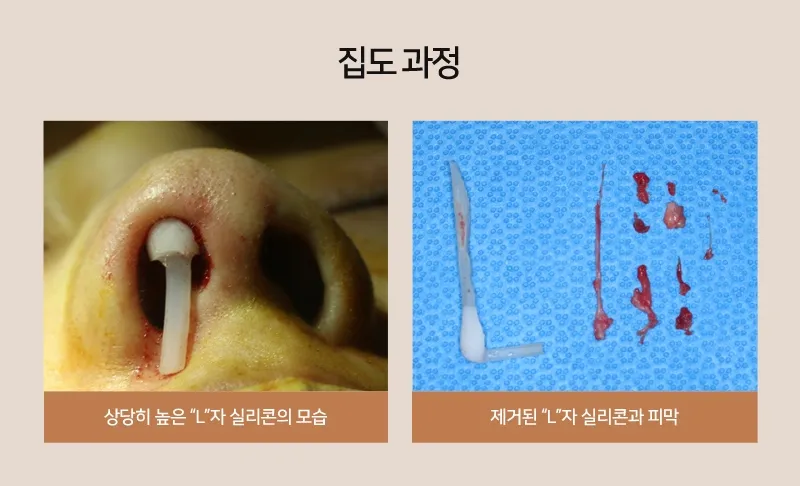
The plan was to restore a natural-looking nose by removing the “L”-shaped silicone implant
and to relieve the headaches, pressure, foreign body sensation, and other symptoms the patient reported.
The “L”-shaped silicone implant used in the earlier surgery and its capsule were carefully removed.
The entire process was performed through a closed approach.

This is the appearance 4 months after surgery.
From the front, the nasal axis, columella, and nostrils can be seen to have straightened.
The thinned skin of the tip has also normalized and looks stable.
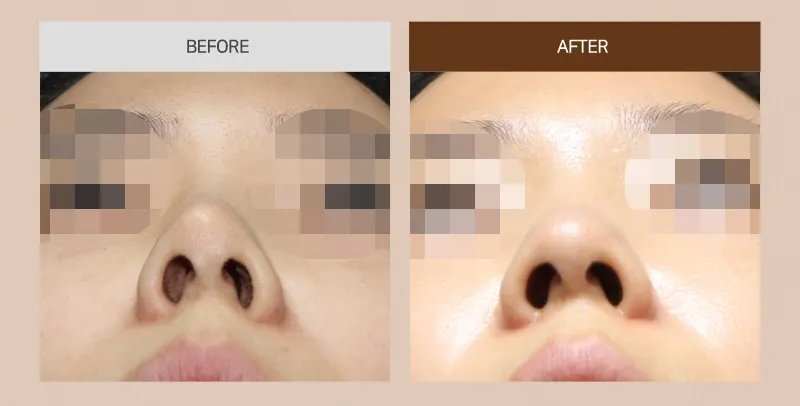
From below as well, the columella and nostrils can be seen to be straight and symmetrical.
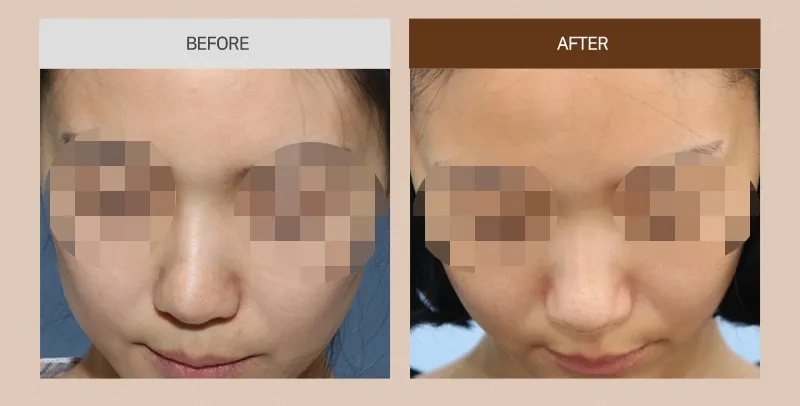
The nasal axis, which had deviated markedly to the right, has also settled straight in the midline.
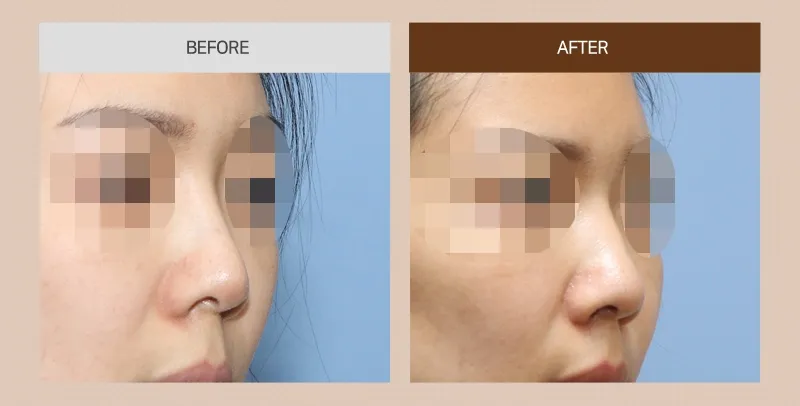
After silicone removal, the height of the bridge and the dorsal line have settled much more naturally,
and the thinned soft tissue of the dorsum has fully recovered.
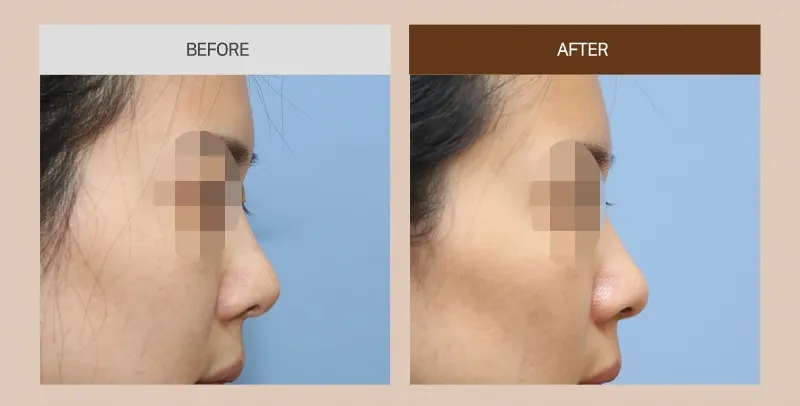
Before removal, the line connecting the tip point and the columella was kinked,
but after removal the compressed tip cartilages were released and now form a natural curve.
Even after removal of the “L”-shaped silicone implant, the nose did not become shorter;
rather, it looks naturally a little longer, and the commonly feared contracture did not occur.
The bridge did not become too low or sink in, and a natural appearance was achieved.
In addition, the headaches, pressure, and foreign body sensation the patient had reported have resolved.