

Double Eyelid Surgery Overview, Part 1 (Non-Incisional and Incisional Methods / Cases)

Double eyelid surgery is the most commonly performed cosmetic surgery, yet it is a very demanding procedure,
and there is no doubt that a good result is not easy to achieve.
The reasons are:
First, the eyelid is not a fixed structure but a dynamic one.
Second, there are two eyes, one on each side, and they must be symmetrical.
Third, the tissues around the eyes are connected to one another, so age-related
changes affect one another, and unexpected results can occur.

Non-Incisional vs. Incisional
Most of the patients who come to me prefer the non-incisional method to the incisional method.
The reasons are that,
naturally, recovery is quick, the result looks natural, re-correction is simple, and there is no concern about anything going seriously wrong.
It also has drawbacks, however: the crease is more likely to come undone, and the resulting double eyelid is smaller.
The incisional method, on the other hand, has a relatively slower recovery,
correction is complicated when something goes wrong, and the incidence of various side effects is higher.
Its advantages are that the crease does not come undone easily and the size of the double eyelid can be adjusted easily.
These pros and cons are widely known,
but deciding which method suits which eyes requires highly specialized, multifaceted judgment.
Today, we will look at individual cases to see which eyes are suited to the non-incisional method and which to the incisional method,
and why.

The non-incisional method is ideal for eyes with thin, soft eyelids and little skin sagging.
This patient was in the early 20s, with eyelids that were not thick and with little skin sagging.
However, about 1/3 of the iris was covered, giving the eyes a closed-in look.
We therefore chose non-incisional ptosis correction, that is, the non-incisional method combined with ptosis correction.

After surgery, the crease is a natural in-out crease, and the eyes look longer and more defined.
In mild ptosis such as this, good results can be obtained even with non-incisional (buried suture) ptosis correction.
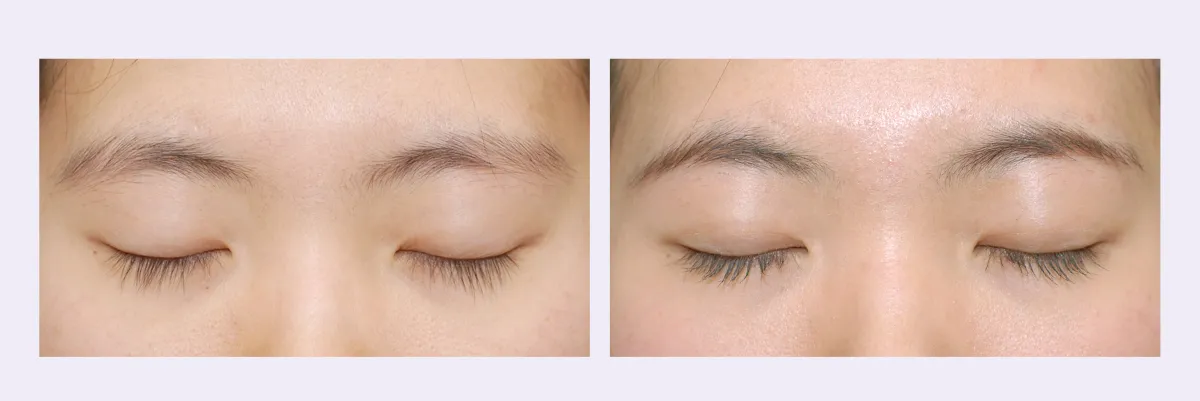
This is the appearance 7 months after non-incisional surgery.
You can see that no surgical marks are visible at all, even with the eyes closed.

This patient likewise has thin eyelids, and the area under the brow is sunken for lack of fat.
These eyes were well suited to the non-incisional method, and a natural in-out crease was formed.
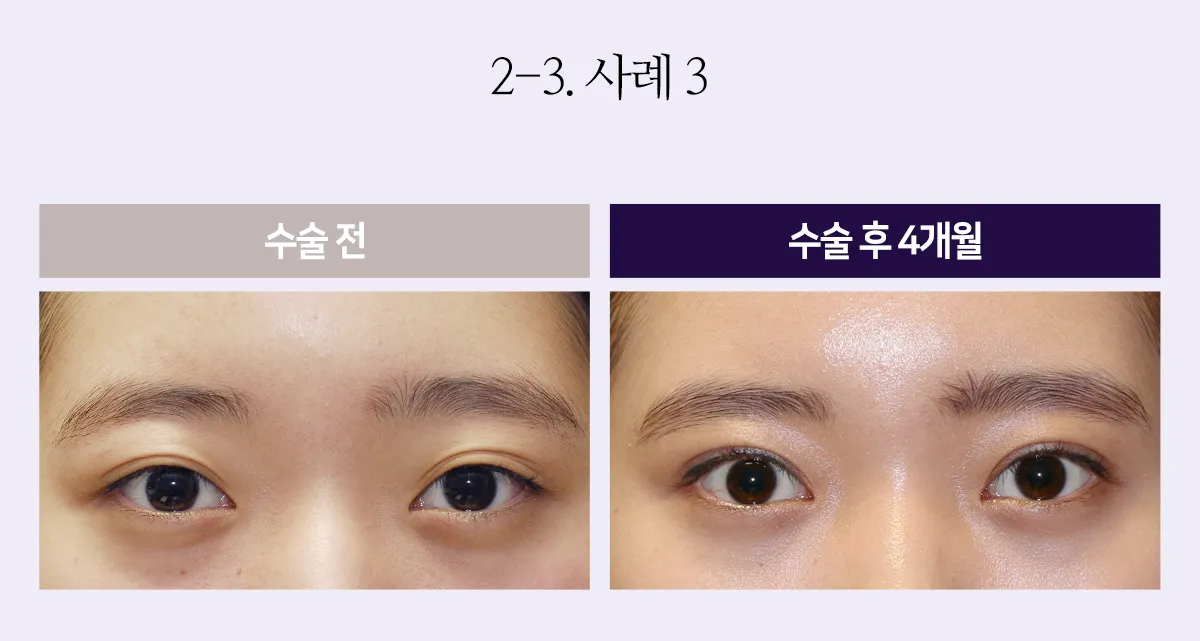
This is a case of double eyelid surgery with non-incisional ptosis correction.
The eyelids were not thick and there was not much skin sagging, making this a suitable case.

This patient, a woman in her 60s, had no crease and drooping in the right eye only, and wanted a crease created on that side alone with the non-incisional method.
The right eyelid was somewhat thick and the skin sagging was marked, so the eye was not especially well suited to the non-incisional method,
but the patient strongly wished for it, so the surgery was performed with the non-incisional method, and the crease settled well within a short time.

This patient, a woman in her 20s, has a full area under the brow and thick eyelids.
In addition, the distance between the eyebrow and the eye was narrow, and the double eyelid narrowed it further,
so the eyes took on a closed-in, angry-looking expression, and the area under the brow became more bulging.
The crease is also expected to gradually come undone over time.

In general, eyes with thick eyelids and a full area under the brow, considerable skin sagging,
and a distance between the eyebrow and the eye that is not narrow are suited to the incisional method.
In this patient, the eyelids and the area under the brow were not thick, but there was a lot of excess skin, so the eyelashes were covered and pressed down by the eyelid skin.
The excess skin was therefore excised with the incisional method, and a natural crease was created.

A woman in her early 30s; a typical case suited to the incisional method.
The eyelids are thick, there is skin sagging, and the eyebrow and the eye are not close together.
Double eyelid surgery with incisional ptosis correction was performed.

A woman in her 20s; the eyelids are full, there is skin sagging, and the distance between the eyebrow and the eye is average.
Incisional double eyelid surgery was performed together with epicanthoplasty.