

Correction of a Pinched Tip Caused by Silicone Contracture (Contracted Nose Correction / Nasal Implant Removal)

A silicone implant causes capsule formation and chronic inflammation inside the nose,
and, depending on their severity and duration, carries a high risk of causing contracture (a shrinking deformity).
Nasal deformities caused by contracture include
i) an upturned tip

In rhinoplasty, the tip is commonly raised and narrowed at the same time.
When round, bulbous tip cartilages are gathered toward the center, they become projected and pointed,
and a groove appears on each side; this is called pinching.
The term means that the tip looks as if it has been pinched with a clothespin.
When the tip cartilages are gathered toward the center in this way, the nostril margin (alar rim) is pulled upward
and the nostril looks triangular; this is called notching or alar rim retraction.
However, although pinching and notching can appear right after surgery,
they more often develop gradually over time, without the patient noticing.
When pinching and notching progress gradually in this way, silicone contracture is the cause.
Silicone contracture thus not only turns the tip upward
but is also often accompanied by pinching and notching as the tip shrinks.
In the case shown in the photos below, the patient had augmentation rhinoplasty with an “L”-shaped silicone implant 15 years earlier, after which the dorsum often bruised and hematomas formed,
and at some point the tip became upturned and pinched.
The most powerful way to resolve this is the lateral crural strut graft (LCSG) of the tip.
This graft uses autologous cartilage (septal, ear, or costal cartilage).

As shown in the illustration, pinching and notching deformities occur when the tip cartilages are crowded toward the center and pulled upward.
Therefore, to make the crowded tip look natural again,
the usual approach is to spread the tip cartilages out to both sides, as in the illustration on the right.
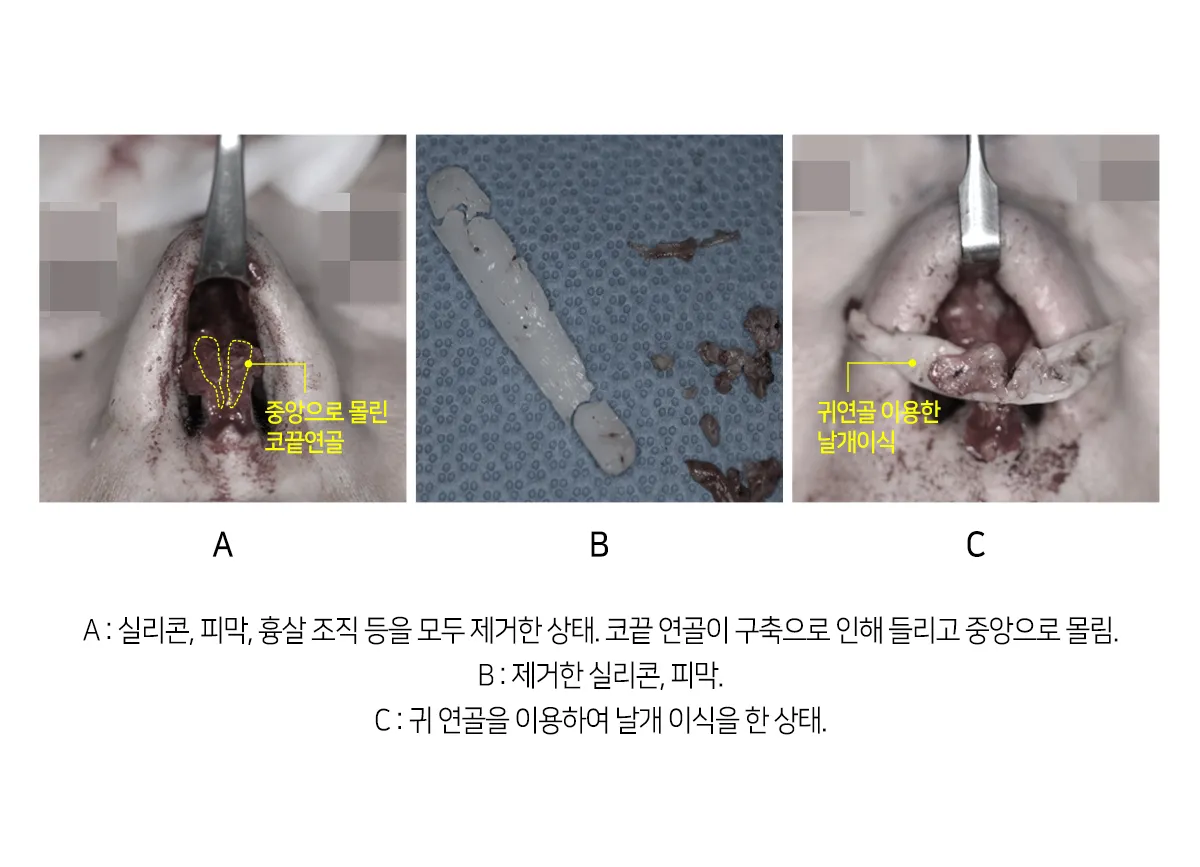
A : After removal of all silicone, capsule, and scar tissue. The tip cartilages had been pulled upward and crowded toward the center by contracture.
B : The removed silicone and capsule.
C : After the lateral crural strut graft with ear cartilage.

OP
After the contracture was resolved by removing the silicone and capsule, the pinched, crowded tip cartilages were released
and a lateral crural strut graft was performed with ear cartilage. The height of the dorsum was reinforced with acellular dermal matrix.
Results
After surgery, the pinched appearance of the tip was released and became gently rounded (pinching corrected),
and the alar rim (nostril margin), which had been pulled up into a “^” shape, came down into a gentle curve. (Notching corrected)
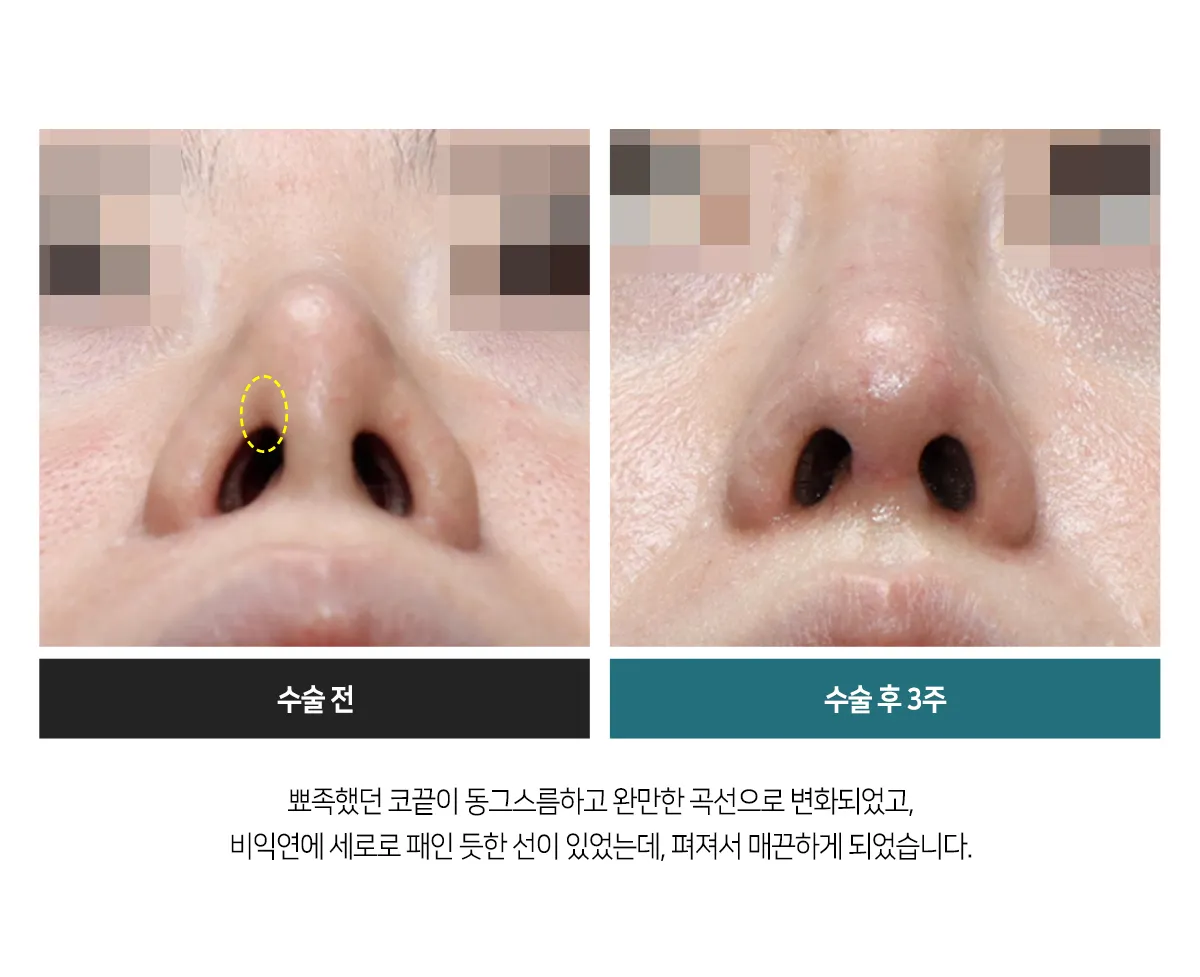
The pointed tip changed into a rounded, gentle curve,
and the vertical groove-like line along the alar rim was flattened and became smooth.

Because of the contracture, there were (1) a pointed tip, (2) a deeply indented line,
and (3) an alar rim (margin of the ala) that looked sharply bent.
After the silicone and capsule were removed and
a lateral crural strut graft was performed with ear cartilage, all three problems, (1), (2), and (3), were resolved.

The tip, which had been upturned and pinched by contracture, became long and natural with a derotation graft and
a lateral crural strut graft (LCSG).

As the upturned tip came down, the nose gained sufficient length.
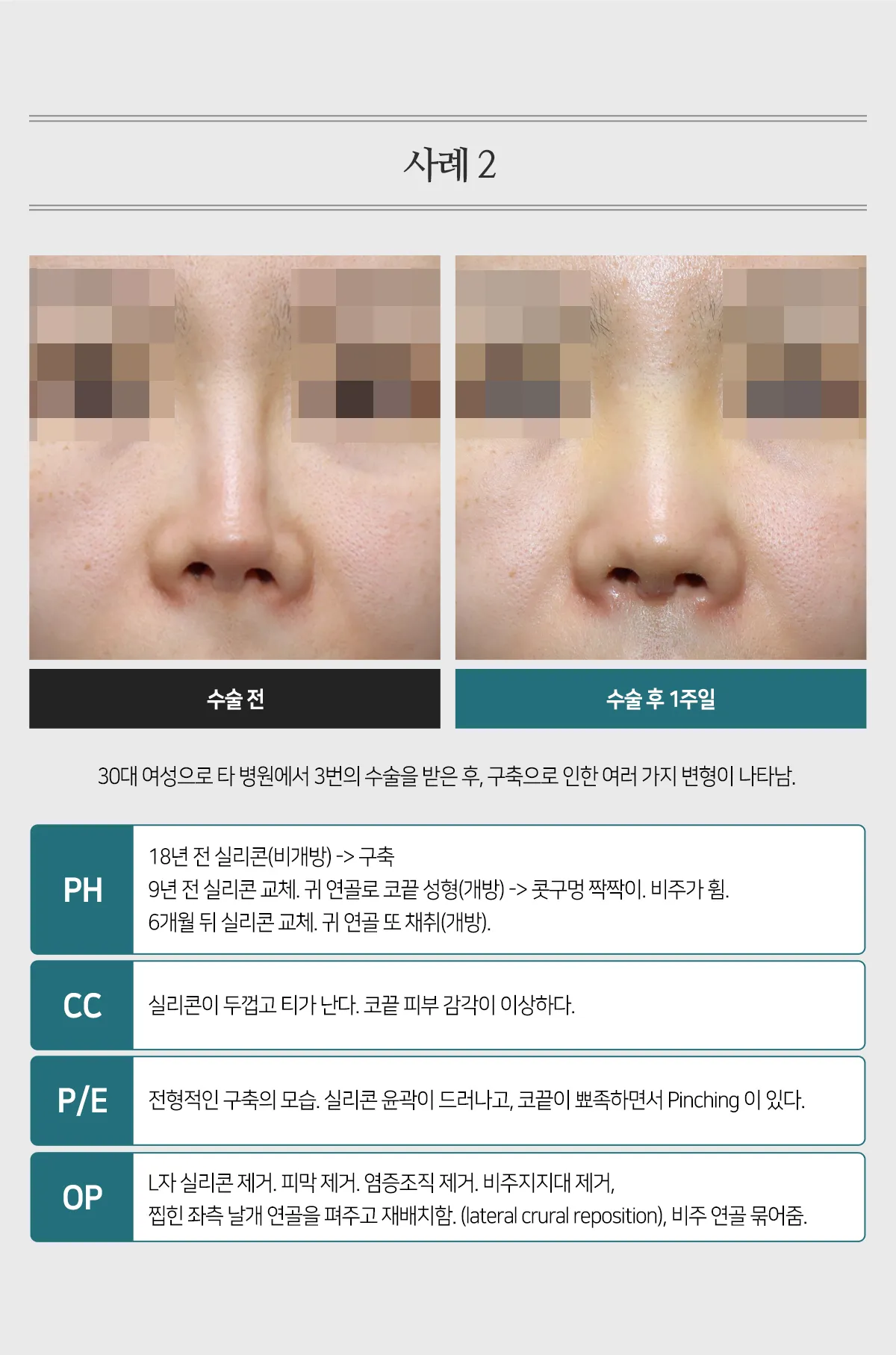
A woman in her 30s who developed various contracture-related deformities after 3 surgeries at other clinics.
OP
18 years earlier: silicone (closed approach) -> contracture
9 years earlier: silicone replaced. Tip plasty with ear cartilage (open approach) -> nostril asymmetry. The columella became deviated.
6 months later: silicone replaced again. Ear cartilage harvested once more (open approach).
CC
The silicone was thick and noticeable. Sensation in the tip skin felt abnormal.
P/E
A typical appearance of contracture. The silicone outline was visible, and the tip was pointed with pinching.
OP
The L-shaped silicone implant, the capsule, the inflamed tissue, and the columellar strut were removed,
the pinched left lateral crus was straightened and repositioned (lateral crural reposition), and the columellar cartilages were sutured together.
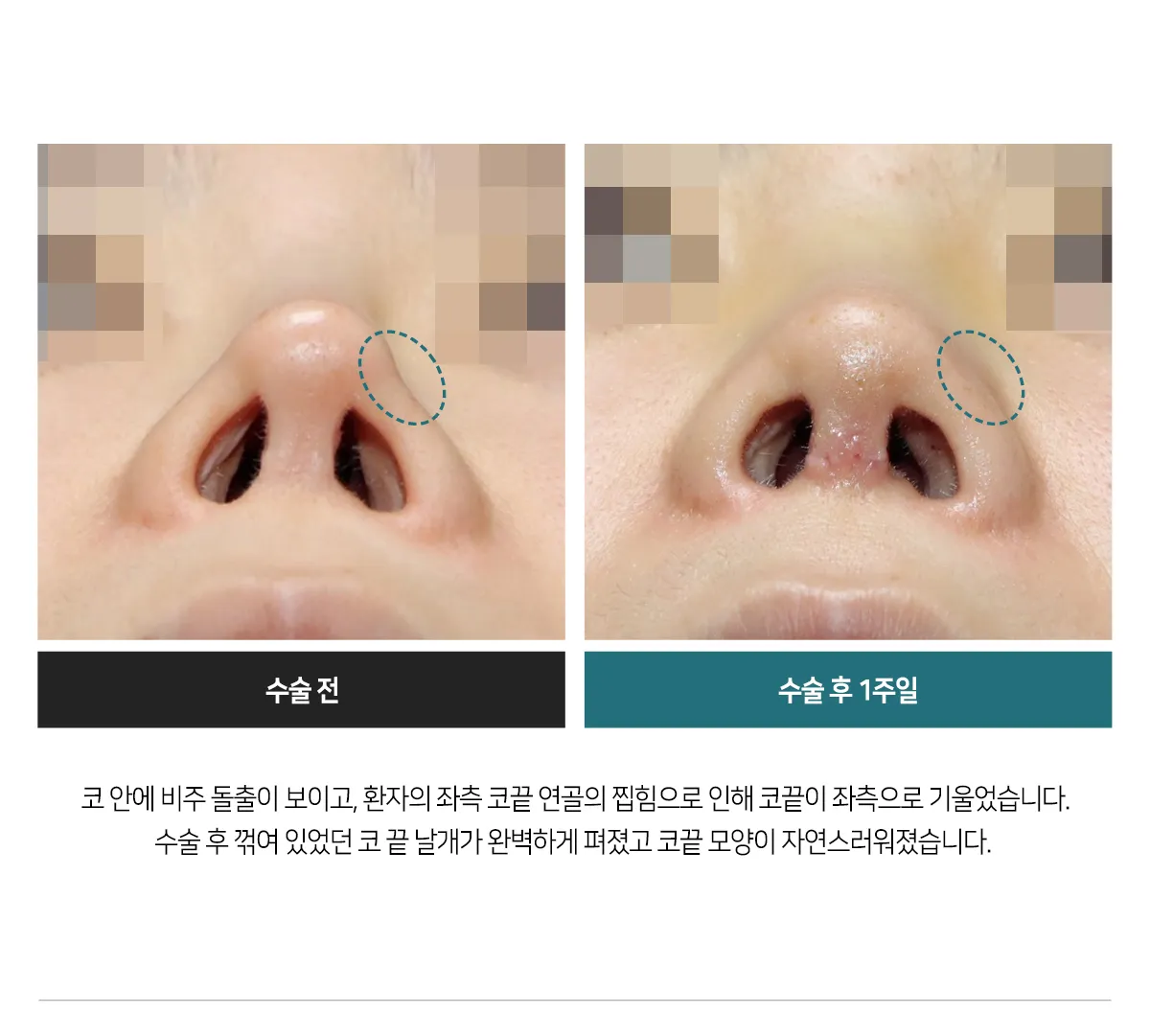
Columellar protrusion was visible inside the nose, and the tip leaned to the left because of pinching of the patient's left tip cartilage.
After surgery, the bent lateral crus of the tip was completely straightened, and the tip shape became natural.

Before surgery, the edge of the silicone on the dorsum was clearly visible,
and the tip showed pinching and notching and was deviated to the left.
After surgery, the dorsum looks natural, the tip deformity is gone, and the tip sits well in the center.
As this case shows, when contracture deforms the tip cartilages and
pinching and notching appear, the axis of the tip often becomes deviated or twisted.
A lateral crural strut graft or lateral crural repositioning is the most powerful solution.

The pointed tip became soft and natural.

Although it is only 1 week after surgery, there is almost no swelling and the nose looks natural.
Columellar retraction was visible before surgery; after surgery, the columella came forward in a soft curve.