

Correction of Various Nasal Tip Deformities #5: Asymmetric Nostrils (Revision Rhinoplasty)
Asymmetric Nostrils
A distinctive feature of our clinic is that many patients, after a first surgery at another clinic went wrong,
come to us for revision surgery.
Patients therefore come with a wide range of problems,
and among them “nasal tip deformity” is, within rhinoplasty,
the most demanding area, and one in which good results are not easy to achieve.
The reason is that “nasal tip deformity”
i) takes many different forms and is complex because the deformity appears in 3 dimensions.
ii) also has a complex course of development and causes, including “contracture,” “damage to and deformation of the tip cartilage from repeated surgery,” and “inflammation,”
among others, which makes the surgery very demanding and difficult.
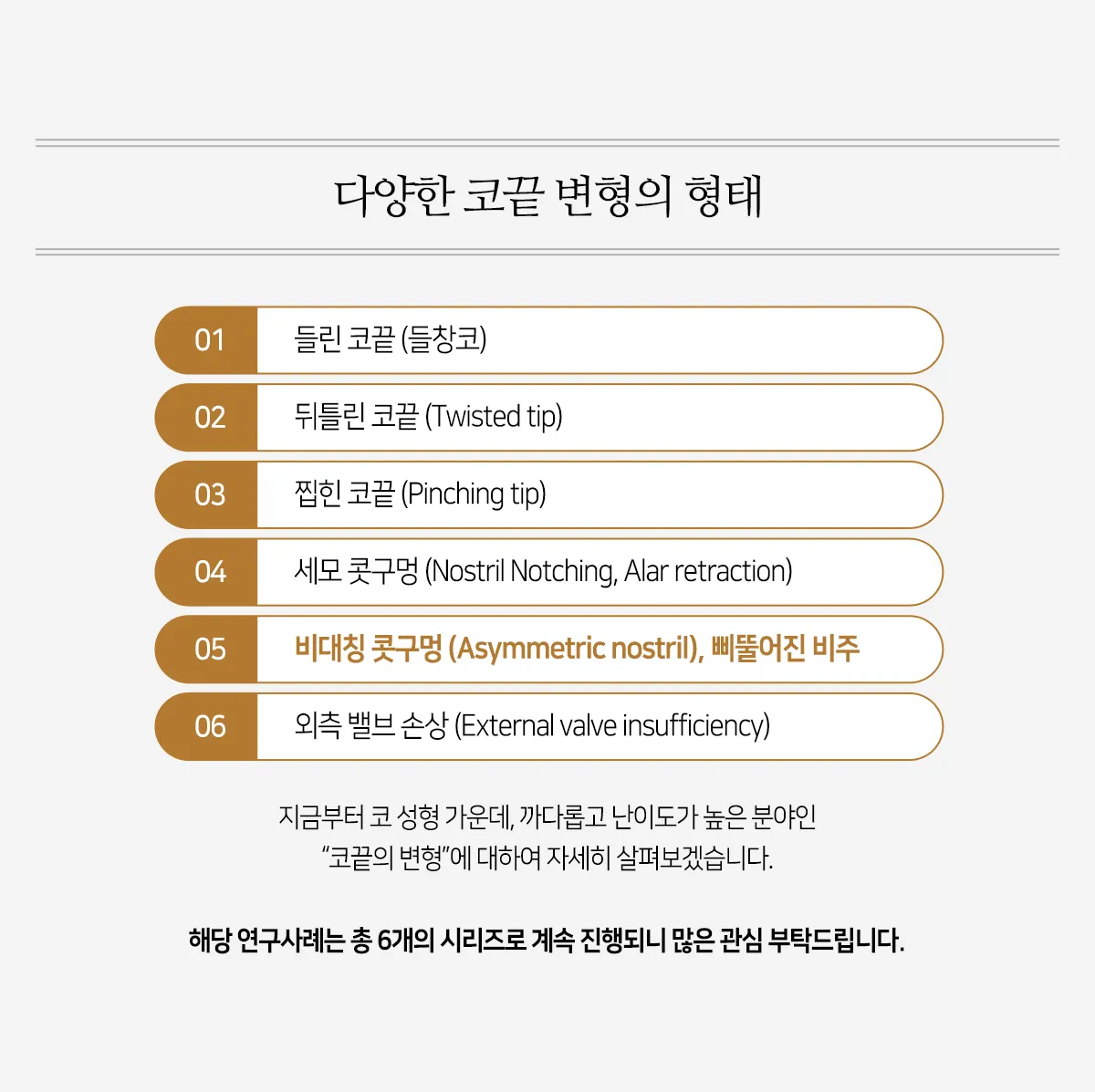
01 Upturned Tip (Upturned Nose)
02 Twisted Tip
03 Pinched Tip
04 Triangular Nostril (Nostril Notching, Alar Retraction)
05 Asymmetric Nostrils, Deviated Columella
06 External Valve Insufficiency
From here, we turn to a demanding and highly difficult area of rhinoplasty,
“nasal tip deformity,” and examine it in detail.
This case study continues as a series of 6 parts in total; we hope you will follow along.
After augmentation rhinoplasty with a silicone implant, the nostrils sometimes become uneven.
Usually the columella tilts to one side and the nostrils become asymmetric in shape and size,
and correcting this is not so simple.
(Causes)
When the implant placed on the dorsum shifts to one side
and presses the tip cartilage in one direction, the tip becomes tilted.
It also occurs when a columellar strut or septal extension graft is placed
and the columellar cartilages are sutured to it asymmetrically.
(Solution)
After removing the septal extension graft and columellar strut, the columellar cartilages are carefully aligned symmetrically,
or, if the tip cartilage is severely deformed, a lateral crural strut graft is performed.
(Materials Used)
Septal cartilage / Ear cartilage / Costal cartilage
For each deformity, the anatomical structure is carefully analyzed and corrected with an appropriate method.

PH
1 month ago, underwent tip plasty with mesh and augmentation rhinoplasty with silicone.
CC
Long, masculine-looking nose; pinched tip,
nostril asymmetry, tilted columella and tip, marked tension in the tip, and a sense of pressure.
P/E
The silicone starts too high; the silicone is tilted; the tip and columella are tilted.
Extension graft with mesh on the left side. Nostril asymmetry (pinching & notching).
The silicone implant and septal extension graft (mesh) were removed,
and tip cartilage repositioning (lateral crural repositioning) and augmentation with acellular dermal matrix were performed.
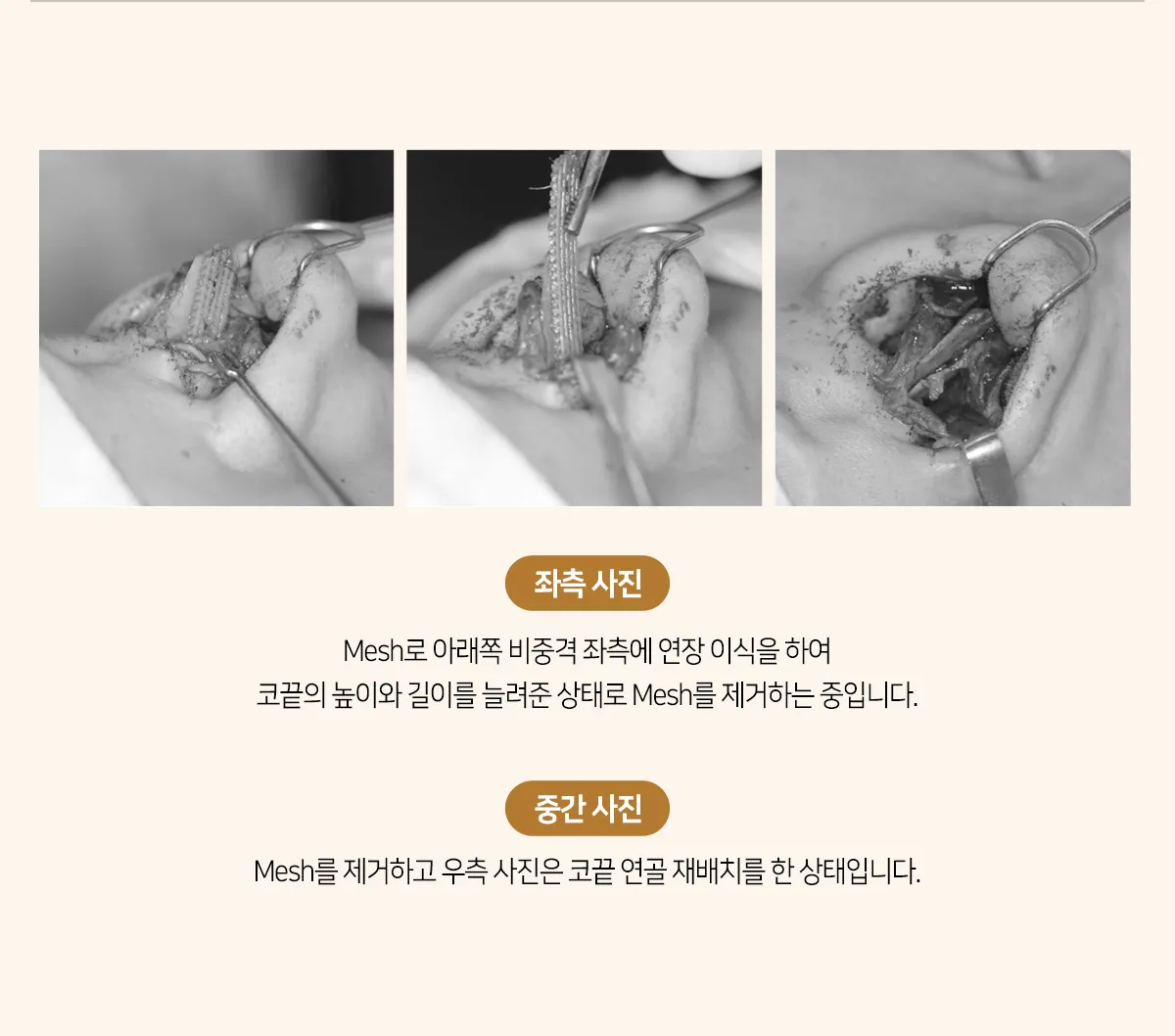
(Left Photo)
An extension graft of mesh had been placed on the left side of the lower septum
to increase the height and length of the tip; the mesh is being removed here.
(Middle Photo)
The mesh has been removed; the photo on the right shows the state after tip cartilage repositioning.
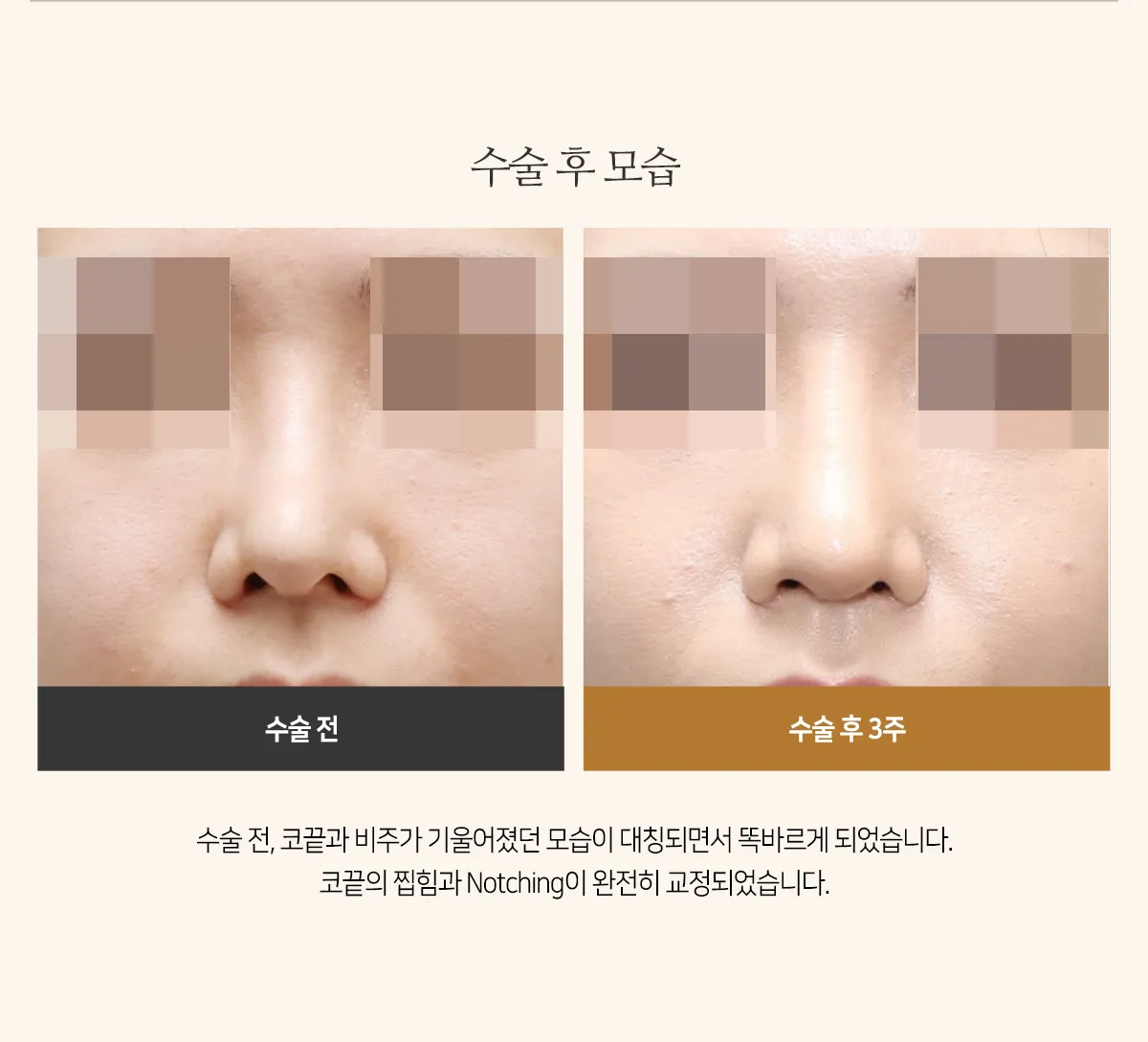
The tip and columella, which were tilted before surgery, have become symmetric and straight.
The pinching and notching of the tip were completely corrected.
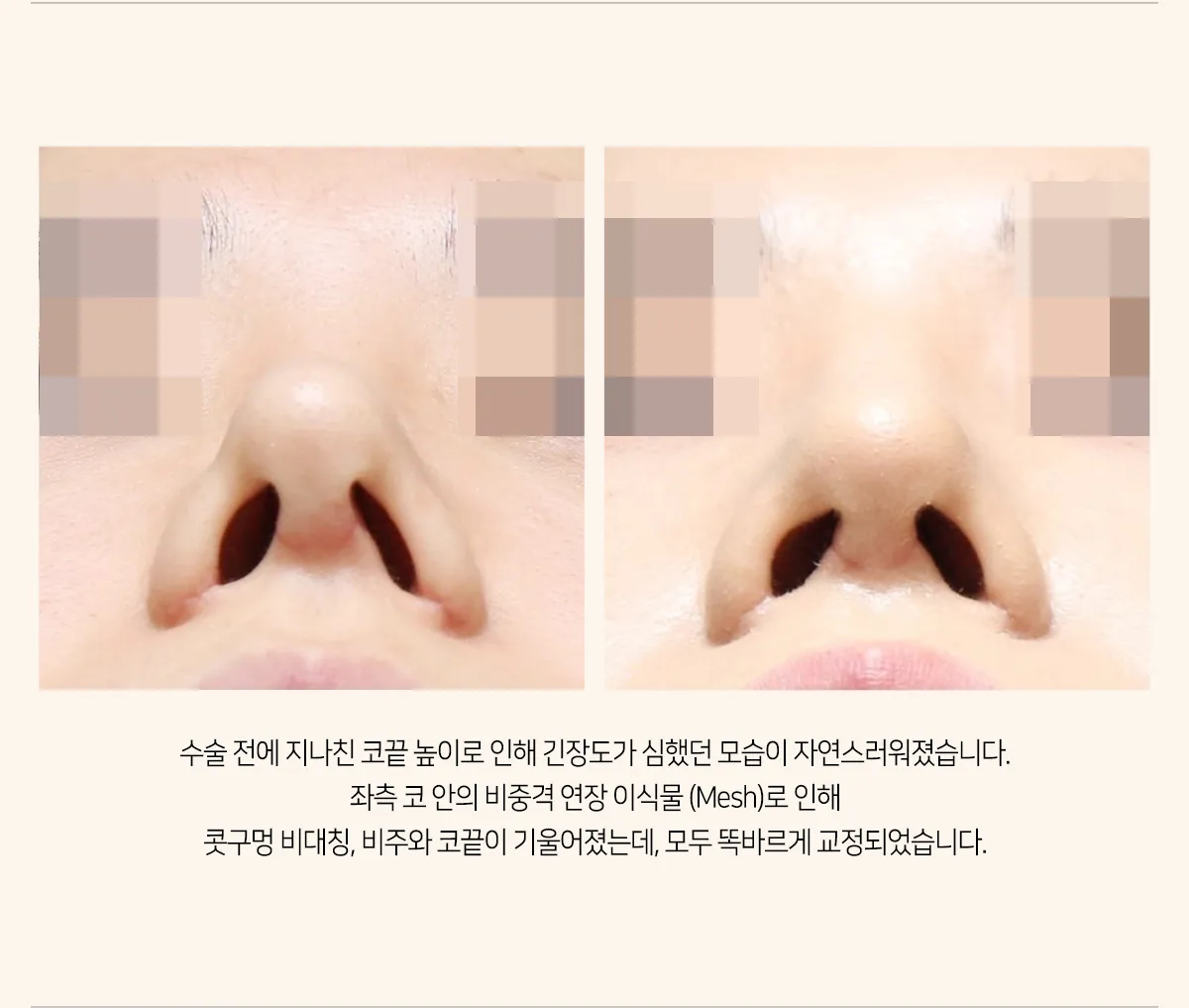
The marked tension caused by excessive tip height before surgery has given way to a natural appearance.
The septal extension graft (mesh) inside the left side of the nose had caused
nostril asymmetry and tilting of the columella and tip, all of which were corrected to a straight position.
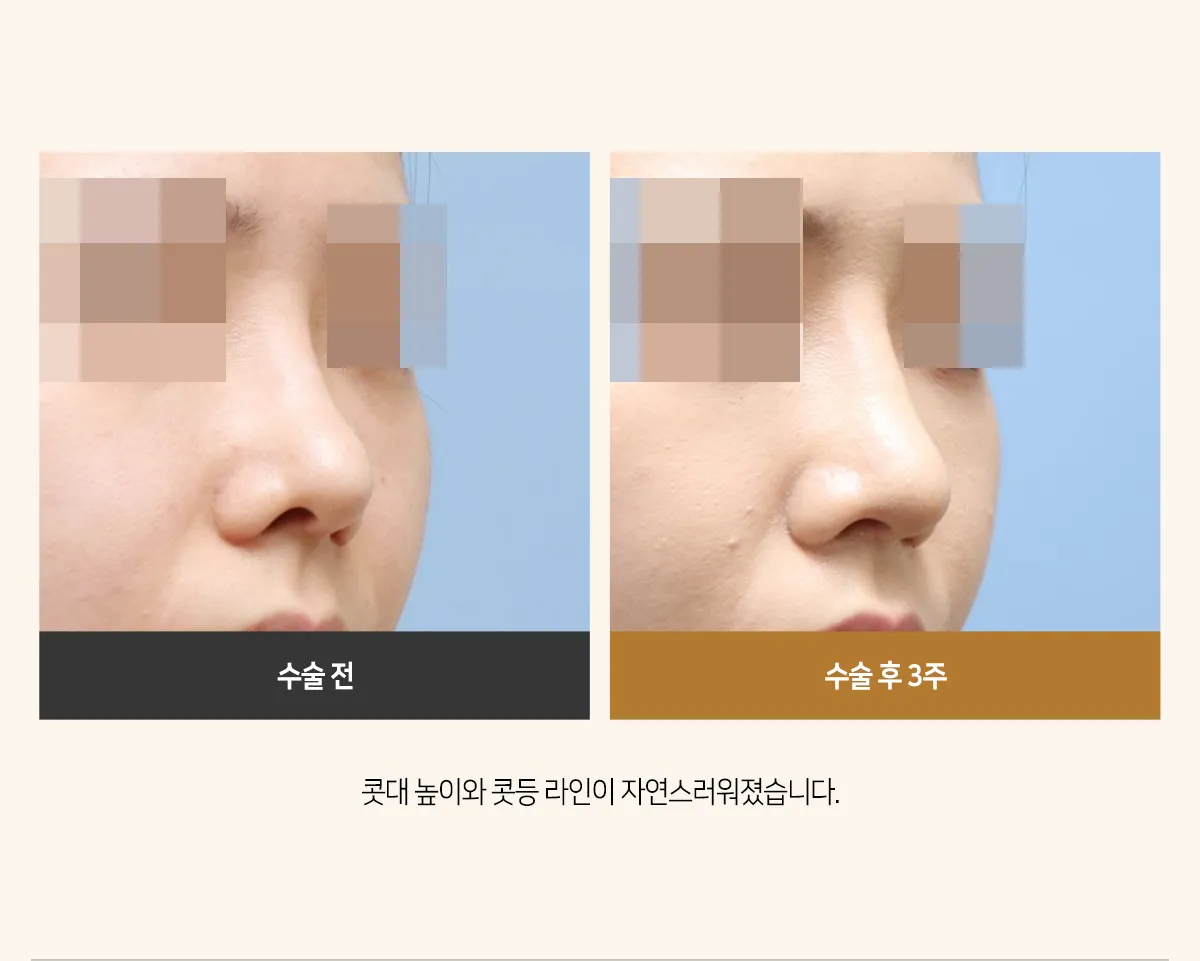
The bridge height and dorsal line look natural.

The excessively high tip now looks natural.

PH
Had tip plasty with ear cartilage at another clinic 3 years ago and, 1 month ago,
a septal extension graft with septal cartilage at yet another (3rd) clinic before presenting to us.
CC
The tip was curved and the nostrils asymmetric, and the tip was so high that it was under marked tension and looked unnatural.
P/E
From the front, the bridge is curved and the tip is displaced to the patient’s left (caudal septal deviation).
From the side, the tip is too high relative to the dorsum, a typical Pinocchio nose.
The bridge and tip were curved because the septal extension graft had been made too high and too long,
placing the tip skin under high tension, so that the extended septal cartilage went crooked and the tip curved.
=> The septal extension graft at the tip was removed, and tip cartilage repositioning was performed.

(Surgical Plan)
Because only 1 month had passed since the most recent surgery, complex surgery was avoided, and the plan was to
i) remove the septal extension graft to reduce the height and length of the tip,
ii) and, so that the line broken at the supratip would be evened out, use the removed septal cartilage for
an onlay graft.
iii) The incision was made with a closed approach.
The tip point tilted to the patient’s left,
because the septal extension graft cartilage had been placed on the right side only, upsetting the balance.
The skin is under very high tension, and the tip is stiff and hard.

The septal extension graft removed from the tip through a closed approach

Simply by removing the septal extension graft through a closed approach,
the curved tip and dorsal line became straight.
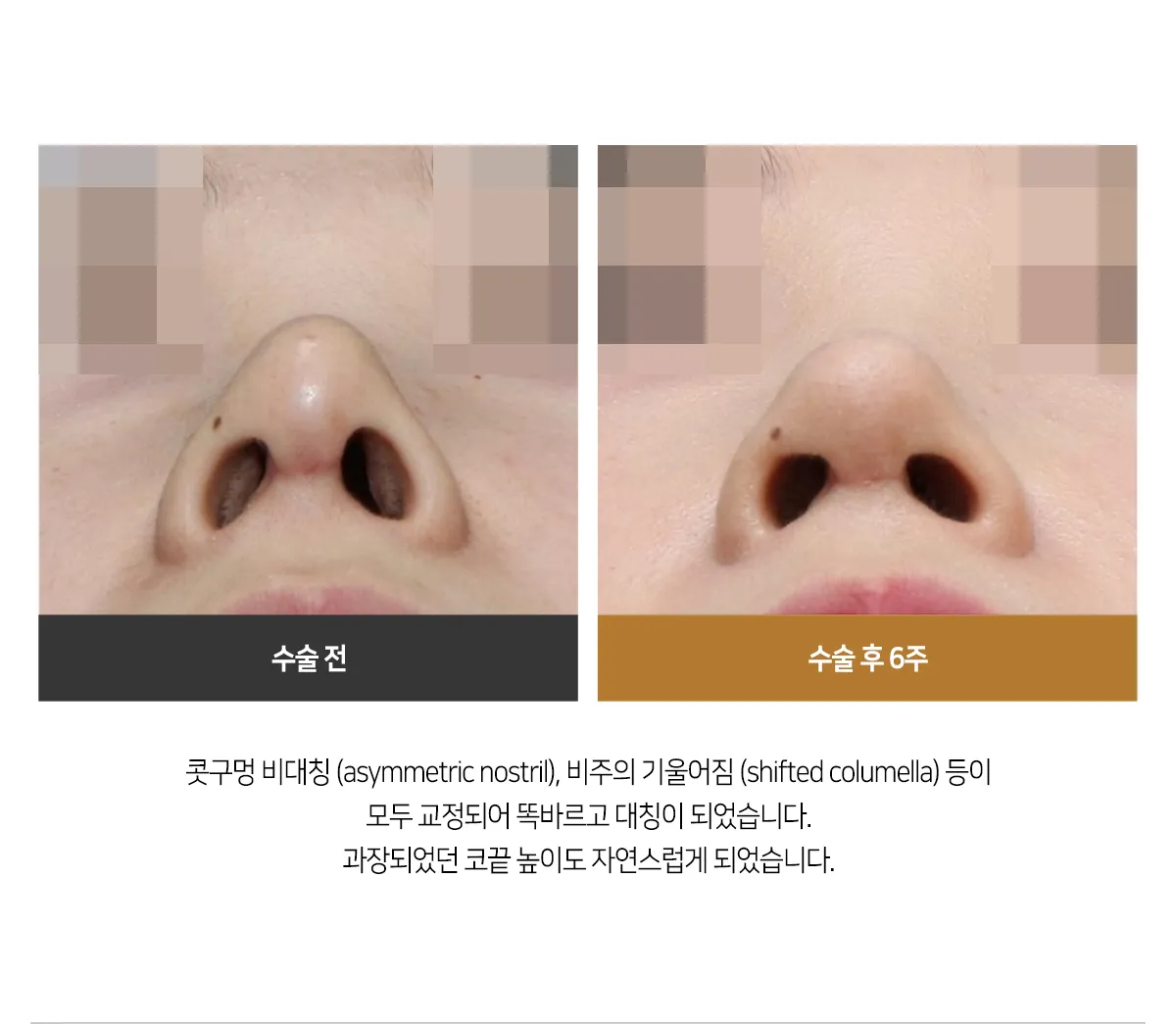
The nostril asymmetry and shifted columella, among others,
were all corrected, becoming straight and symmetric.
as well as the exaggerated tip height, now look natural.
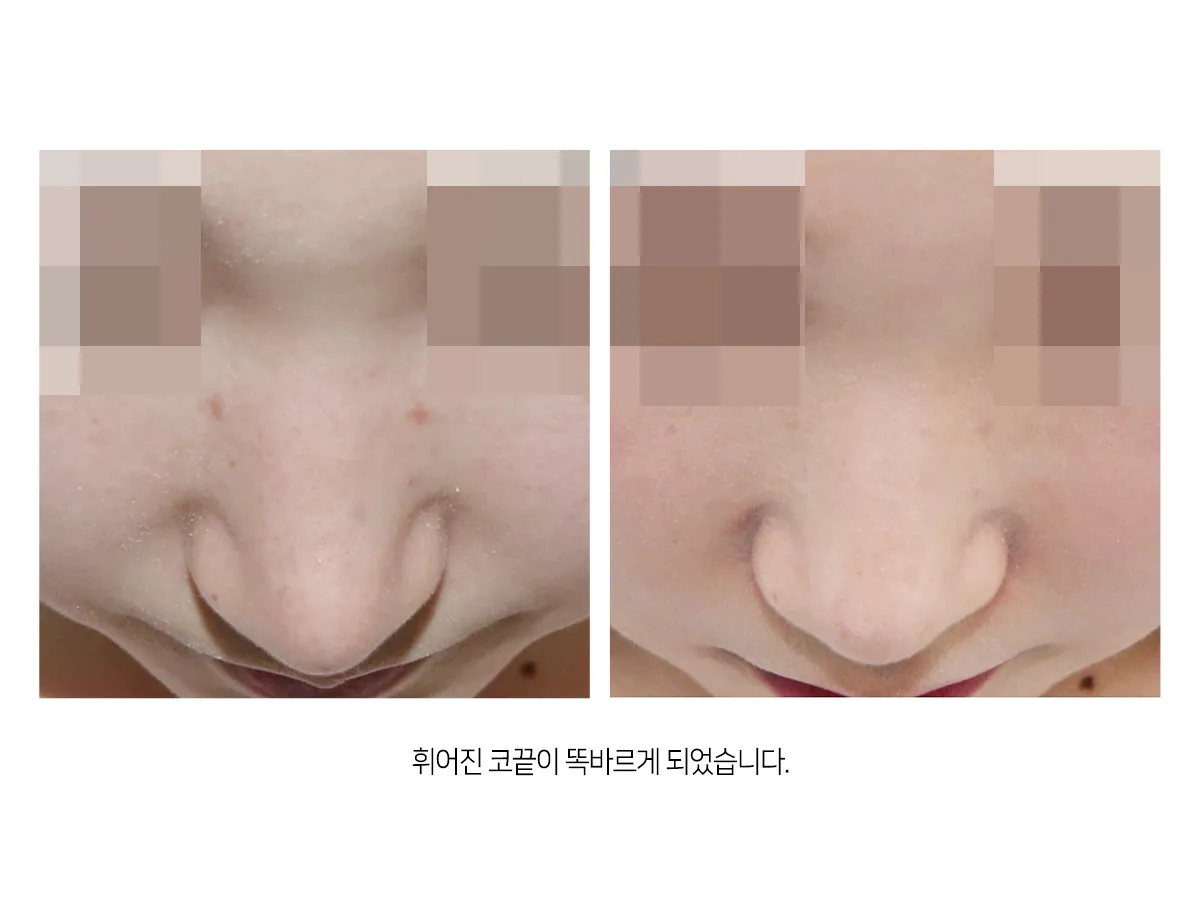
The curved tip became straight.


The tip, exaggerated like a cartoon character’s nose, changed to a straight, natural appearance.
The broken dorsal line has also been evened out.

PH
Underwent augmentation rhinoplasty with silicone at another clinic several years ago.
CC
Silicone showing through on the dorsum; tilted tip and nostril asymmetry. Right-sided nasal obstruction.
P/E
The bridge was narrow with the silicone showing through, and the silicone extended to the tip
and was displaced to the left, pushing the tip cartilage leftward and making the nostrils asymmetric.
The silicone and capsule are removed, and symmetry is established with tip cartilage repositioning.
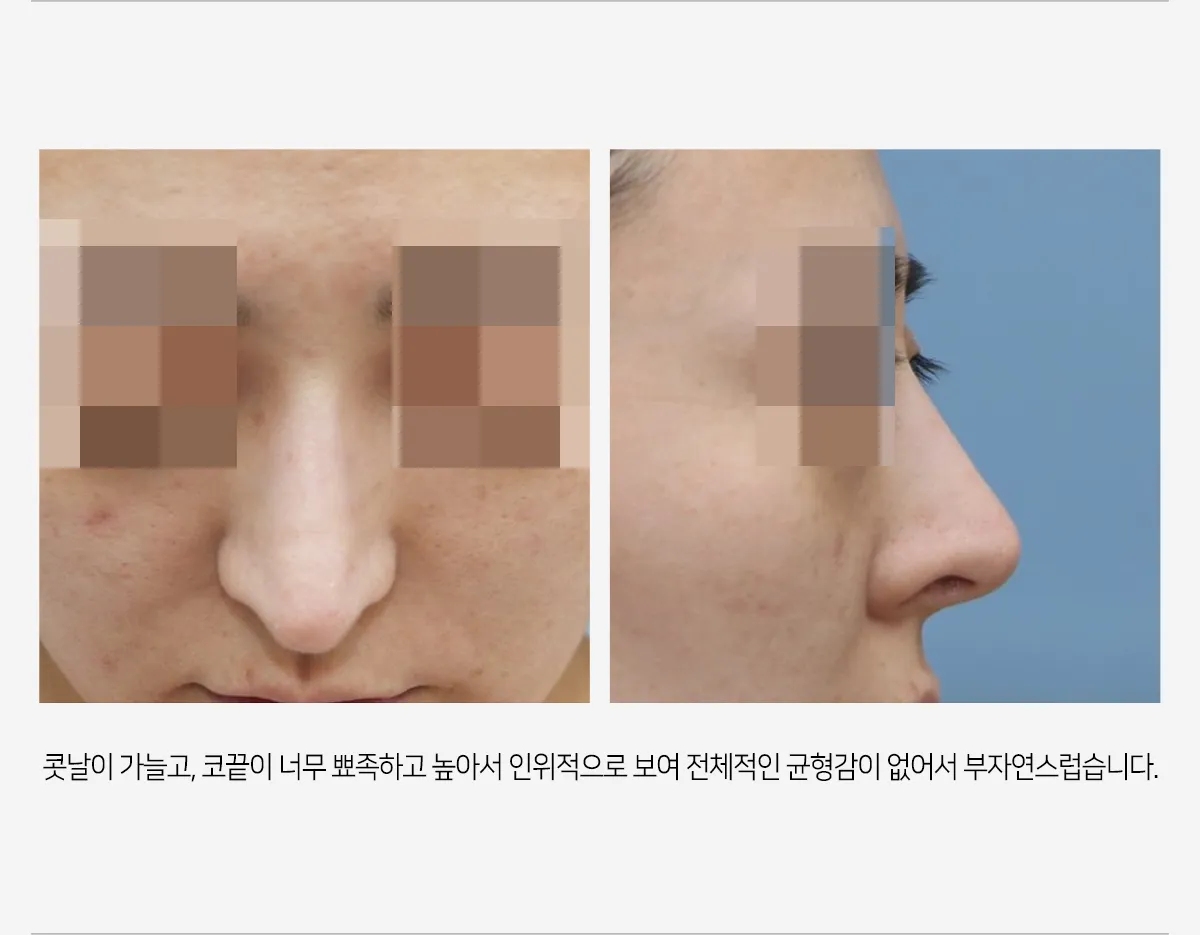
The bridge is narrow and the tip too pointed and high, so the nose looks artificial, lacks overall balance, and appears unnatural.
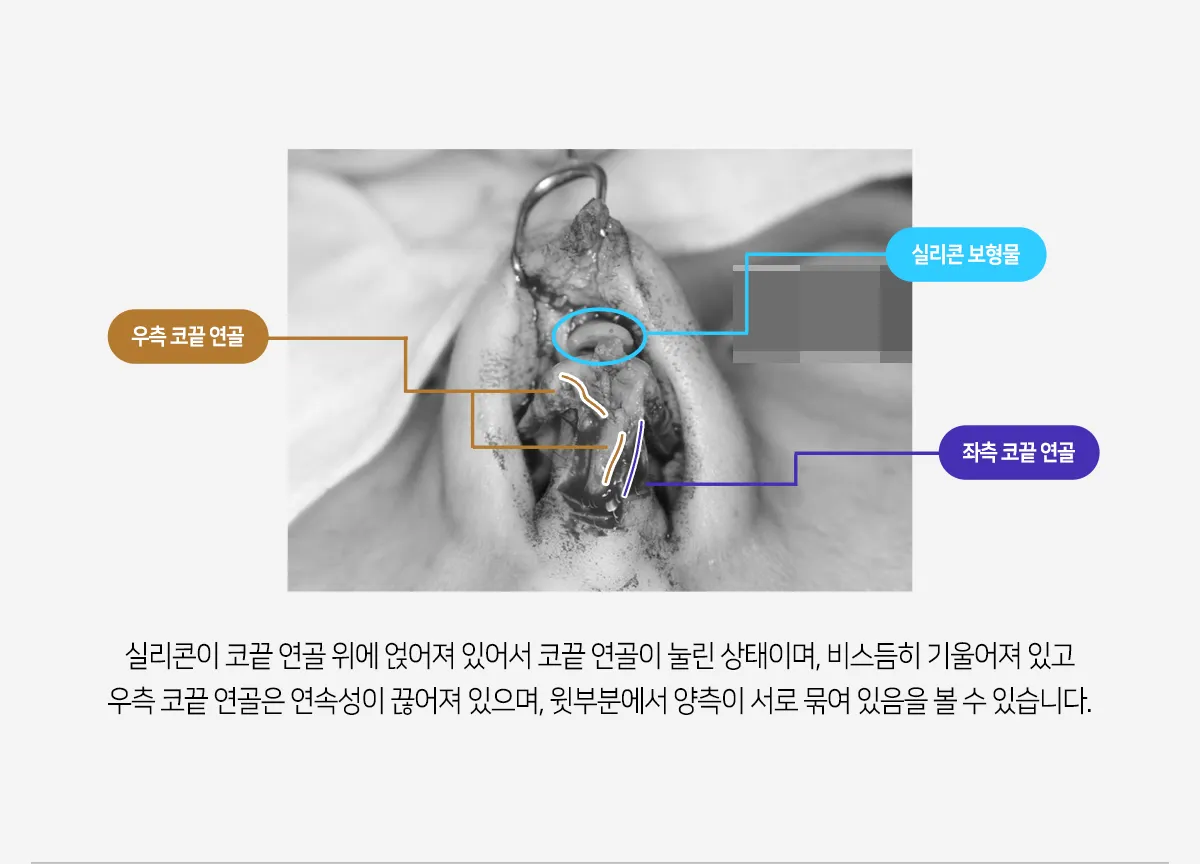
The silicone rests on the tip cartilages, compressing them; they are tilted at a slant,
the right tip cartilage has lost its continuity, and the two sides can be seen sutured together at the upper part.
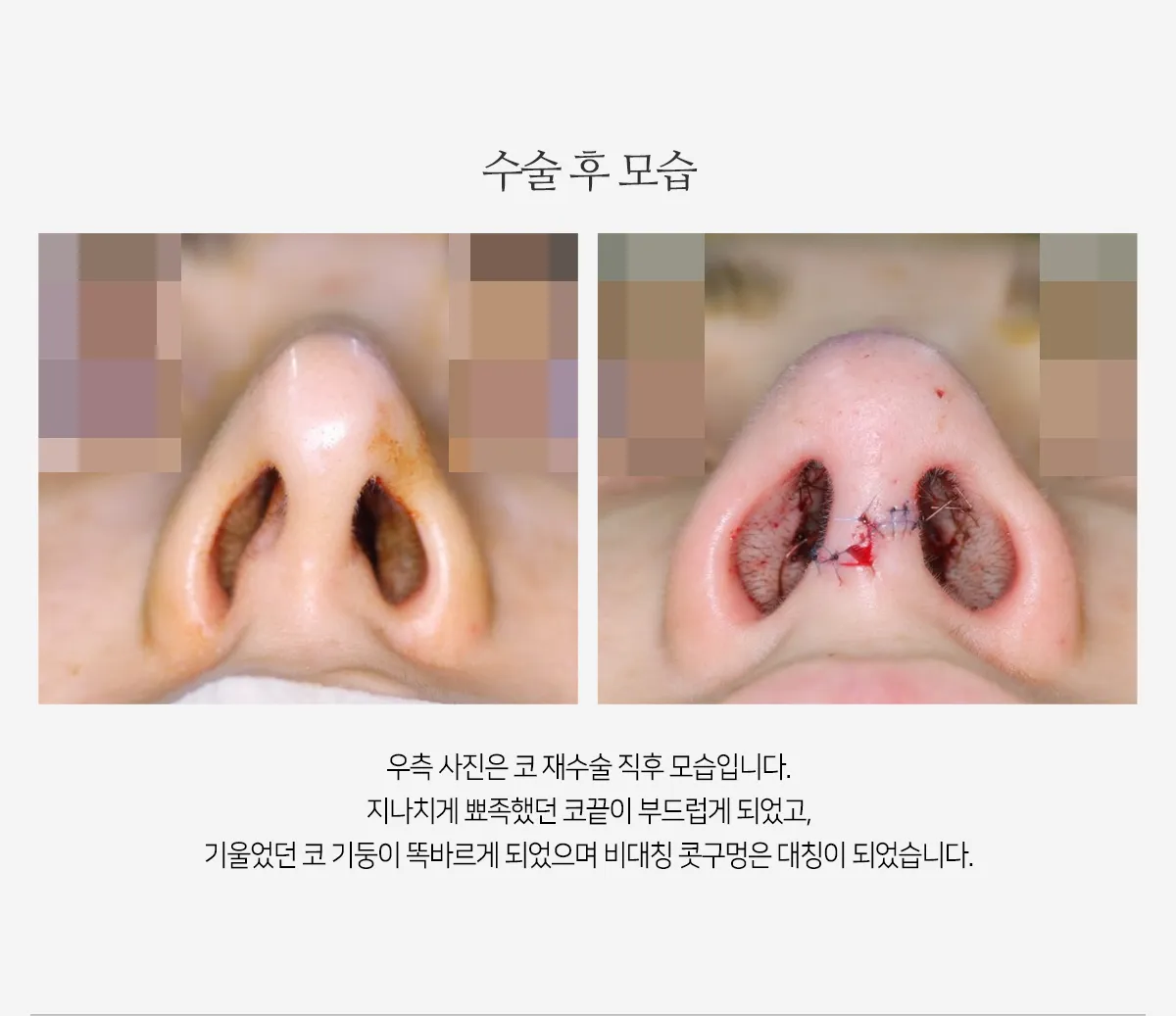
The photo on the right shows the appearance immediately after revision rhinoplasty.
The overly pointed tip has softened,
the tilted columella has straightened, and the asymmetric nostrils have become symmetric.
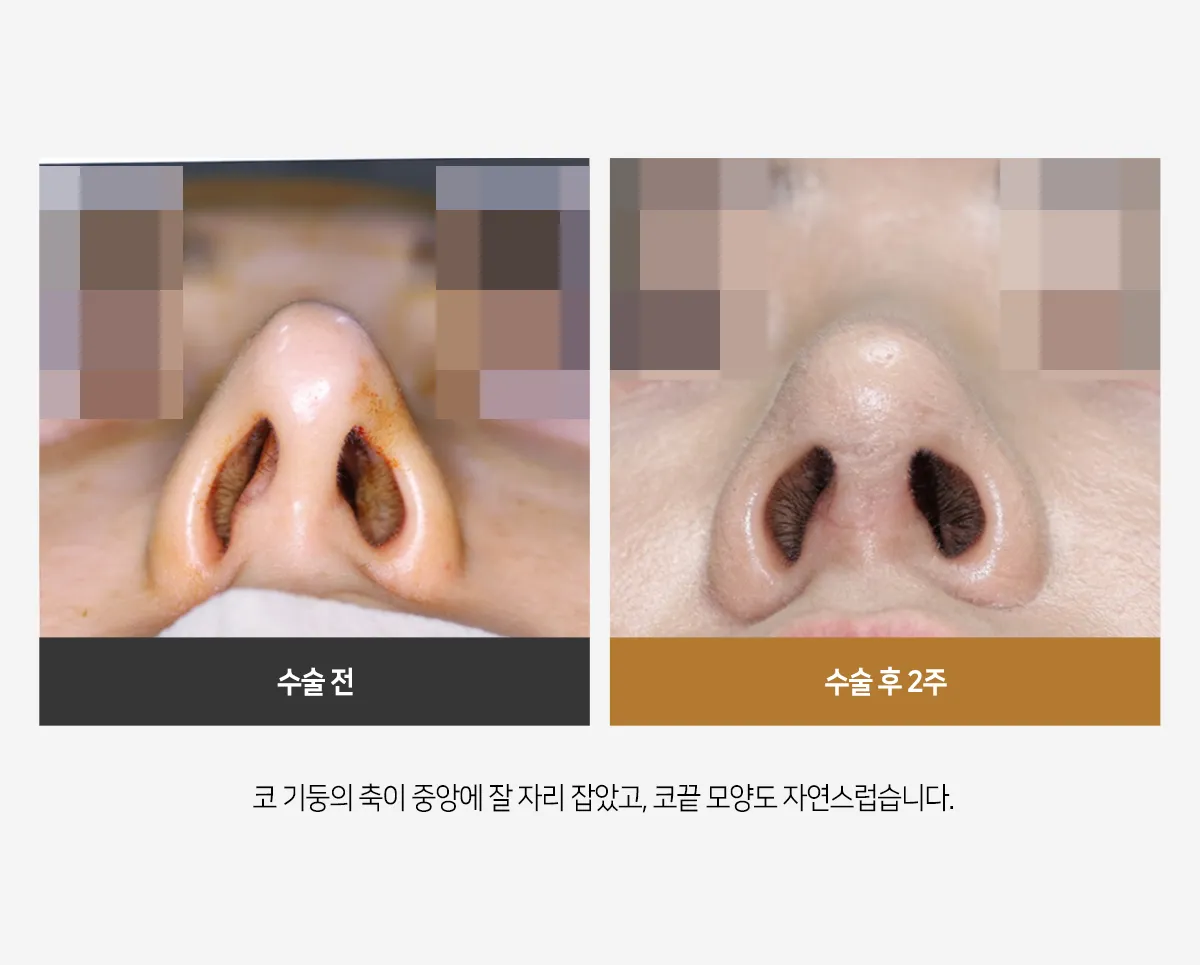
The axis of the columella sits well in the midline, and the tip shape also looks natural.
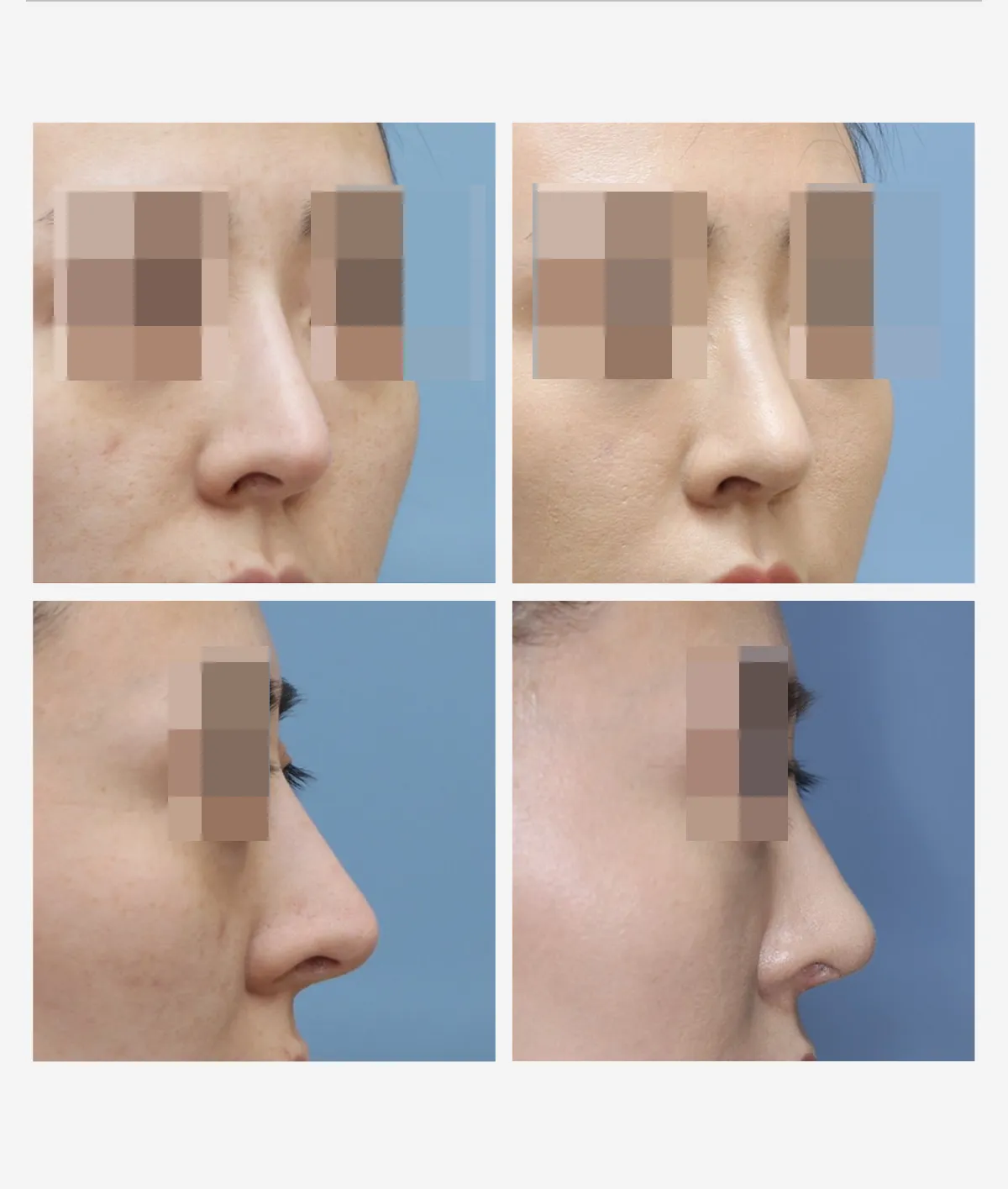
After removal of the silicone, the dorsal line can be seen to be more natural and softer.