

Correction of Various Nasal Tip Deformities #1: Upturned Tip (Upturned Nose, Short Nose)

A distinctive feature of our clinic is that more than 90% of our nasal surgery patients come for revision surgery.
Patients therefore come with a wide range of problems, and among them “nasal tip deformity” is, within rhinoplasty,
the most demanding area, and one in which good results are not easy to achieve.
The reason is that “nasal tip deformity”
i) takes many different forms and is complex because the deformity appears in 3 dimensions.
ii) also has a complex course of development and causes, including “contracture,” “damage to and deformation of the tip cartilage from repeated surgery,” and “inflammation,”
among others, which makes the surgery very demanding and difficult.

01 Upturned Tip (Upturned Nose)
02 Twisted Tip
03 Pinched Tip
04 Triangular Nostril (Nostril Notching, Alar Retraction)
05 Asymmetric Nostrils, Deviated Columella
06 External Valve Insufficiency
From here, we turn to a demanding and highly difficult area of rhinoplasty,
“nasal tip deformity,” and examine it in detail.
This case study continues as a series of 6 parts in total; we hope you will follow along.

1. Upturned Tip (Upturned Nose, Short Nose)
In most cases, after augmentation rhinoplasty with a silicone implant, capsule formation, an inflammatory response,
tissue damage from repeated surgery, and similar factors lead to “contracture,” which causes this deformity.
It can also occur when, during tip plasty, the tip cartilages are sutured together too tightly or pulled upward and fixed.
The tip is brought down with techniques such as a septal extension graft, a derotation graft, or an L-strut.
Septal extension graft ▶ septal cartilage, costal cartilage | Derotation graft ▶ ear cartilage | L-strut ▶ costal cartilage
Depending on how upturned (short) the nose is, the advantages and disadvantages of each method, the patient’s skin,
the condition of the cartilage available for harvest, and other factors must be weighed together to select the most appropriate surgical method.

PH
10 years ago, a nasal bone fracture from external trauma was followed by rhinitis and sinusitis.
The patient then underwent 4 surgeries with silicone implants at another clinic.
CC
Upturned tip with nostril show. Thick dorsum.
The dorsum felt heavy, with pressure and headaches. Nasal obstruction was severe on both sides.
P/E
The dorsum was thick and bunched. The nose was short and upturned. The nostrils were pulled upward.
Because severe contracture had left the tip markedly upturned, an “L-strut” was built with autologous costal cartilage to lengthen the nose,
and the twisting and deformity of the tip were restored with a “lateral crural strut graft.”

The silicone, capsule, and scar tissue were removed.
The 7th costal cartilage and perichondrium are harvested from below the right chest.
An “L-shaped” framework was made from autologous costal cartilage to rebuild the nasal framework and secure the desired length,
and the tip deformity was restored with a lateral crural strut graft using costal cartilage.
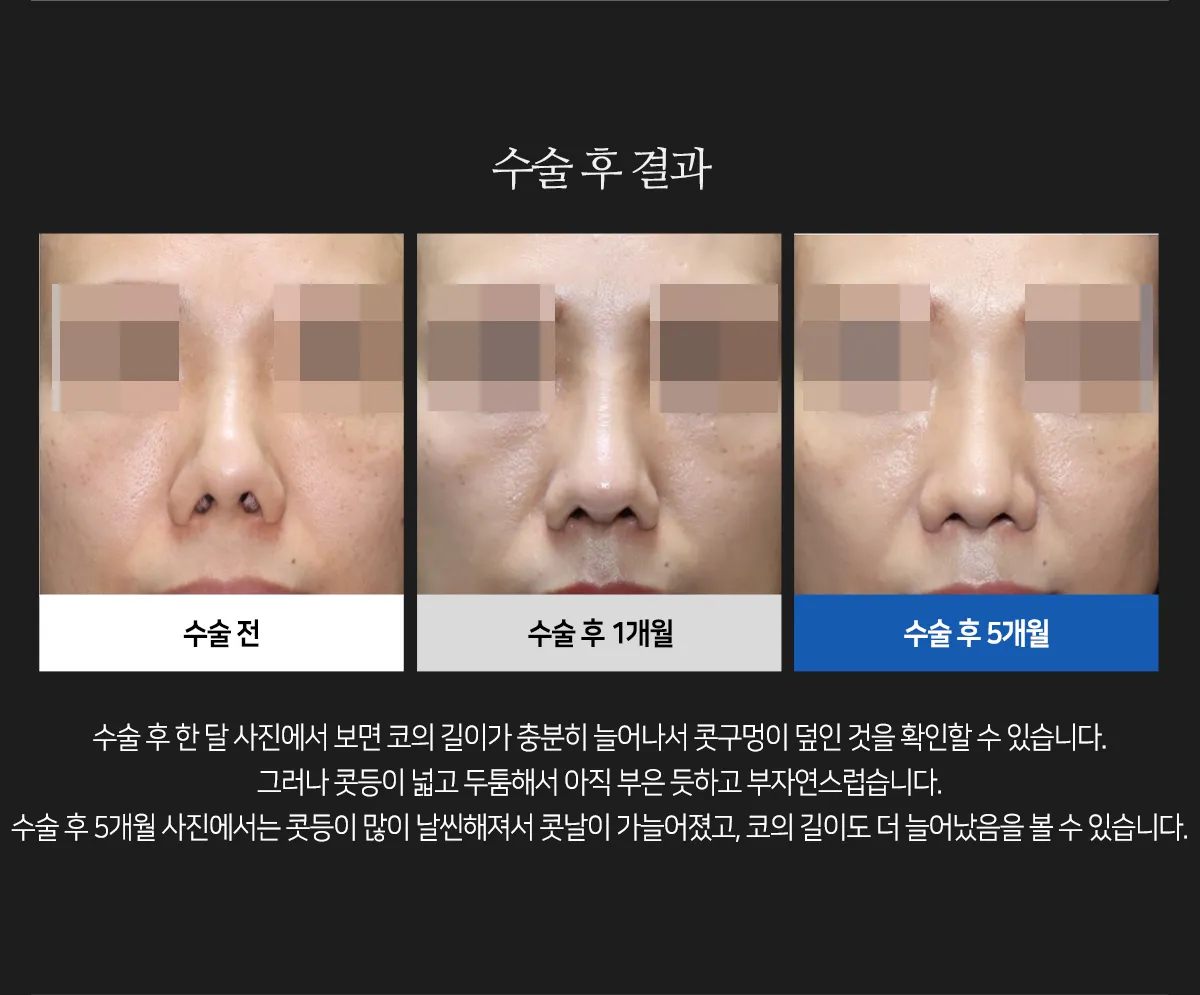
The photo taken one month after surgery shows that the nose has lengthened sufficiently and the nostrils are covered.
However, the dorsum was wide and thick, still appearing swollen and unnatural.
In the photo at 5 months after surgery, the dorsum has slimmed considerably, the bridge is narrower, and the nose has lengthened further.

At 5 months after surgery, the nasal tip and dorsum have slimmed, and the surgical mark on the columella is barely visible.
Before surgery the tip was pulled upward and the nostrils were stretched long, like the number “11,”
but at 5 months after surgery they look natural.

The nose has lengthened sufficiently and extends straight.
The bridge also slimmed gradually after surgery, and the height of the dorsum, augmented with acellular dermal matrix,
had not decreased much even in the photo at 5 months after surgery.
Supplementing the height of the dorsum with acellular dermal matrix after removal of the silicone and capsule, as in this case.
has the advantage of restoring both height and skin thickness in patients whose skin has thinned.

The nose lengthened a little more as time passed after surgery.
This is thought to be because the swelling and scar tissue decreased, leaving extra nasal skin that allowed the nose to lengthen.
The length, height, and angles of the nose have become natural.

PH
Underwent surgery with a silicone implant at another clinic 10 years ago.
Began to notice about 1 year ago that the nose had become upturned.
CC
Upturned tip with nostril show. Thick dorsum.
Heaviness of the dorsum with a sense of pressure and headaches. The tip was bent.
P/E
The dorsum was thick, and as the silicone migrated upward the tip became short and upturned. The tip was bent and bulbous.
Because contracture caused by the silicone had left the tip upturned and deformed, the silicone implant,
capsule, and scar tissue were removed, and a “derotation graft” and a “lateral crural strut graft” were performed with autologous ear cartilage to lengthen the nose
and restore the deformed tip.
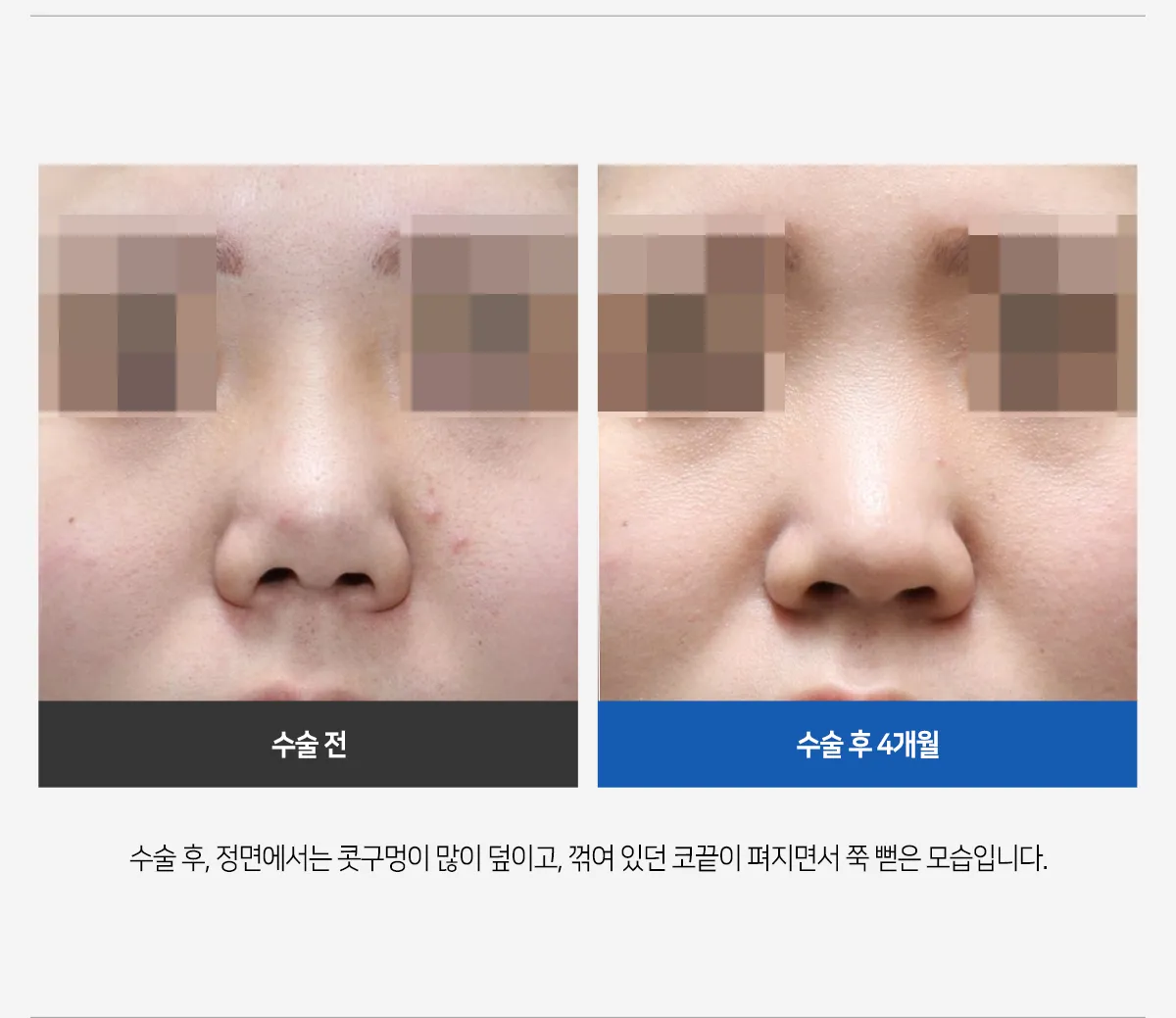
After surgery, in the frontal view the nostrils are largely covered, and the bent tip has straightened into a smooth, extended line.
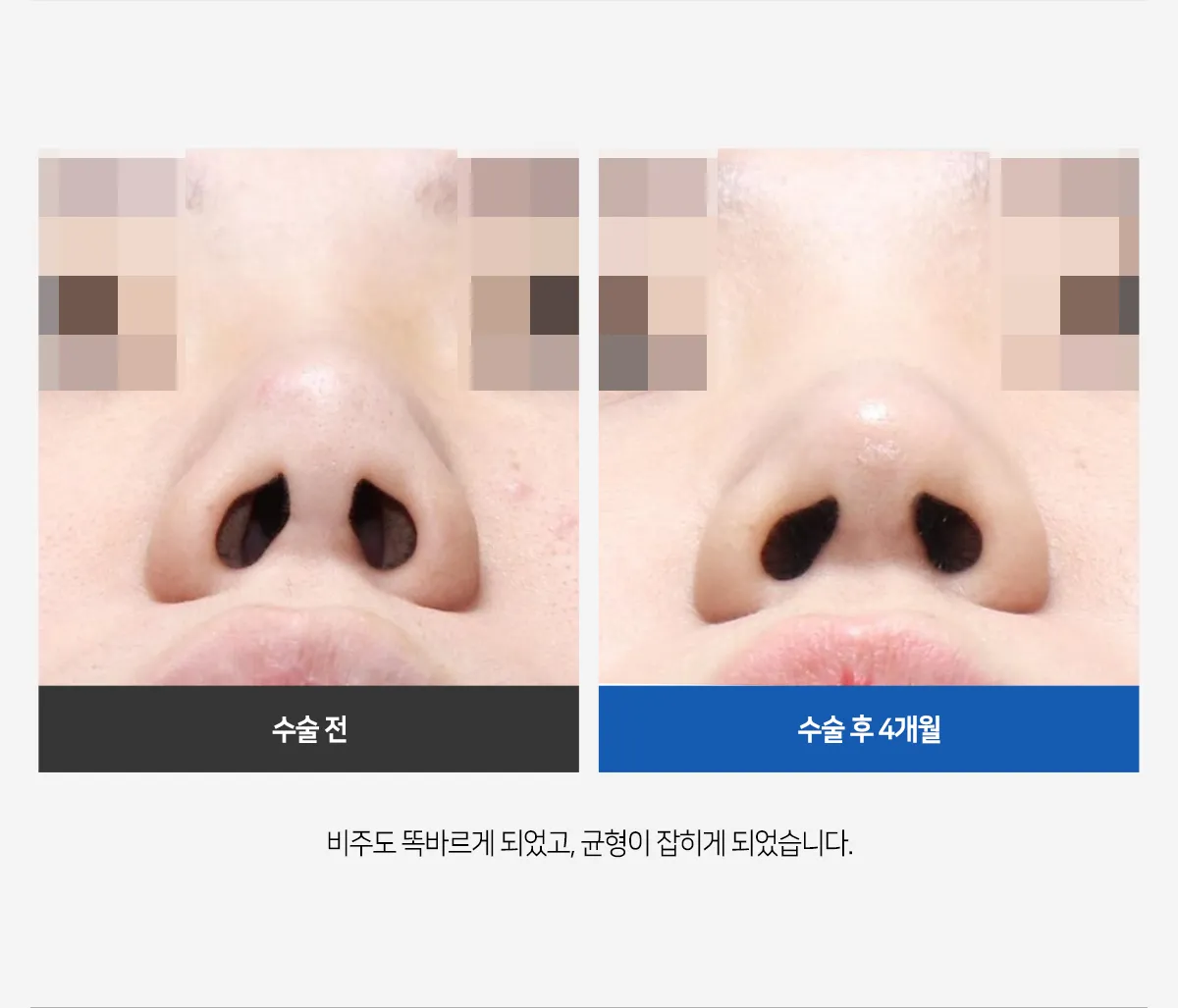
The columella has also straightened, and the nose is now balanced.

Because the nose lengthened sufficiently and the tip took on a natural shape,
no further implant was placed on the dorsum, yet the patient reports no sense at all that the dorsal height is lacking.

The nose now extends straight overall, and the previously bent tip has become natural and soft in shape.