Silicone implants remain, in Asia and
It is the most widely used material worldwide for raising the dorsum.
The association is so direct that "rhinoplasty" brings "silicone" to mind.
In Asia in particular, when it comes to "rhinoplasty," both doctors and patients
I often see it taken for granted that silicone will be used.
In rhinoplasty, this is a highly inappropriate and even dangerous notion.
For example, even in rhinoplasty whose goal is not to raise the bridge, such as dorsal hump correction or deviated nose surgery,
I see many patients in whom silicone was used even in such rhinoplasty.
When such patients come for a revision consultation and are examined, we often find that the silicone
In many cases it has been of no help at all and has instead caused side effects.
In fact, having seen many side effects from silicone and artificial materials over years of revision rhinoplasty,
I had long wanted to organize this systematically and present it someday.
So today, under the title "Reasons I Dislike Using Nasal Silicone (in Rhinoplasty)!",
I have prepared case studies on each of the side effects.
Side Effects Caused by Silicone Implants After Rhinoplasty
1. Silicone breaking through the skin of the nasal tip or the mucosa inside the nose due to physical pressure
2. Acute or chronic inflammation caused by silicone or artificial materials used with it
3. Contracture due to capsule formation and inflammation
4. Silicone repeatedly becoming crooked even after corrective surgery
5. Deformity of the tip cartilages caused by silicone extending to the tip
6. Calcium deposits on the silicone making the dorsum protrude unevenly
7. Dorsal skin thinning and turning red, with the silicone showing through
8. Recurrent hematoma in the dorsum (inside the silicone capsule)
The probability of side effects after rhinoplasty with a silicone implant differs somewhat
among the published papers, ranging fairly widely from 4-36%.
The difference arises from when the side effects were diagnosed.
The most common side effects are contracture (34.8%), implant deviation (30.1%),
inflammation (10.1%), skin thinning (19.9%), and extrusion through a perforation (5%).
This case study will continue as a series of 8 parts, and we hope you will follow it.

From Silicone Extending to the Tip:
Tip Cartilage Deformity (Tip Deformity)
After augmentation rhinoplasty with a silicone implant, the silicone often shifts to one side,
and the tip and columella become crooked as well.
In revision or removal surgery, it is important to straighten not only the crooked bridge
but also the crooked tip and columella.
Because the silicone is long enough to reach the tip, pressing and pushing the tip cartilages to one side
and making the tip and columella crooked, in most cases an open approach is used
and a columellar strut is placed to set the columella upright, which is the more reliable method.
On the other hand, when the deviation of the tip and columella is not severe, a closed approach can be used:
the silicone implant and the cartilage graft laid on the tip are removed,
and the displaced tip cartilages are repositioned to the center, allowing a straight, natural correction.
PH
Woman in her 20s. She had simple augmentation rhinoplasty with silicone 8 years earlier.
P/E
The columella was crooked, and the columellar cartilage was buckled and protruded inside the right nostril.
OP
While removing the silicone and capsule through an incision inside the nose,
the buckled, protruding columellar cartilages inside the right nostril were sutured together and straightened at the same time.
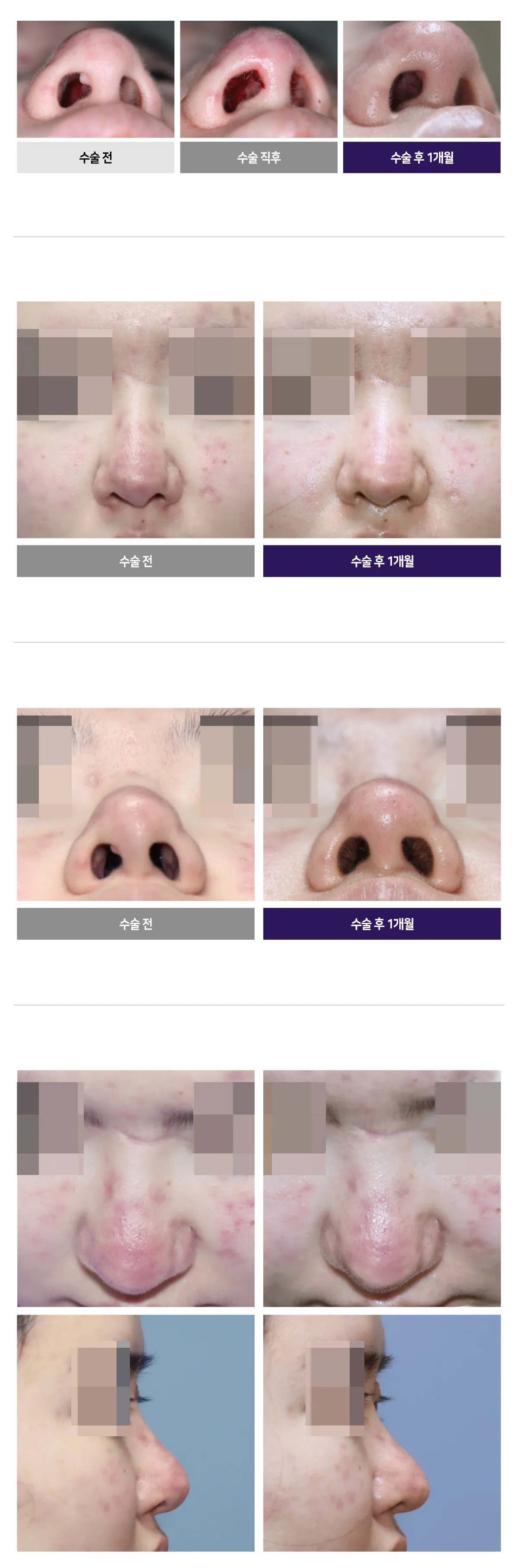
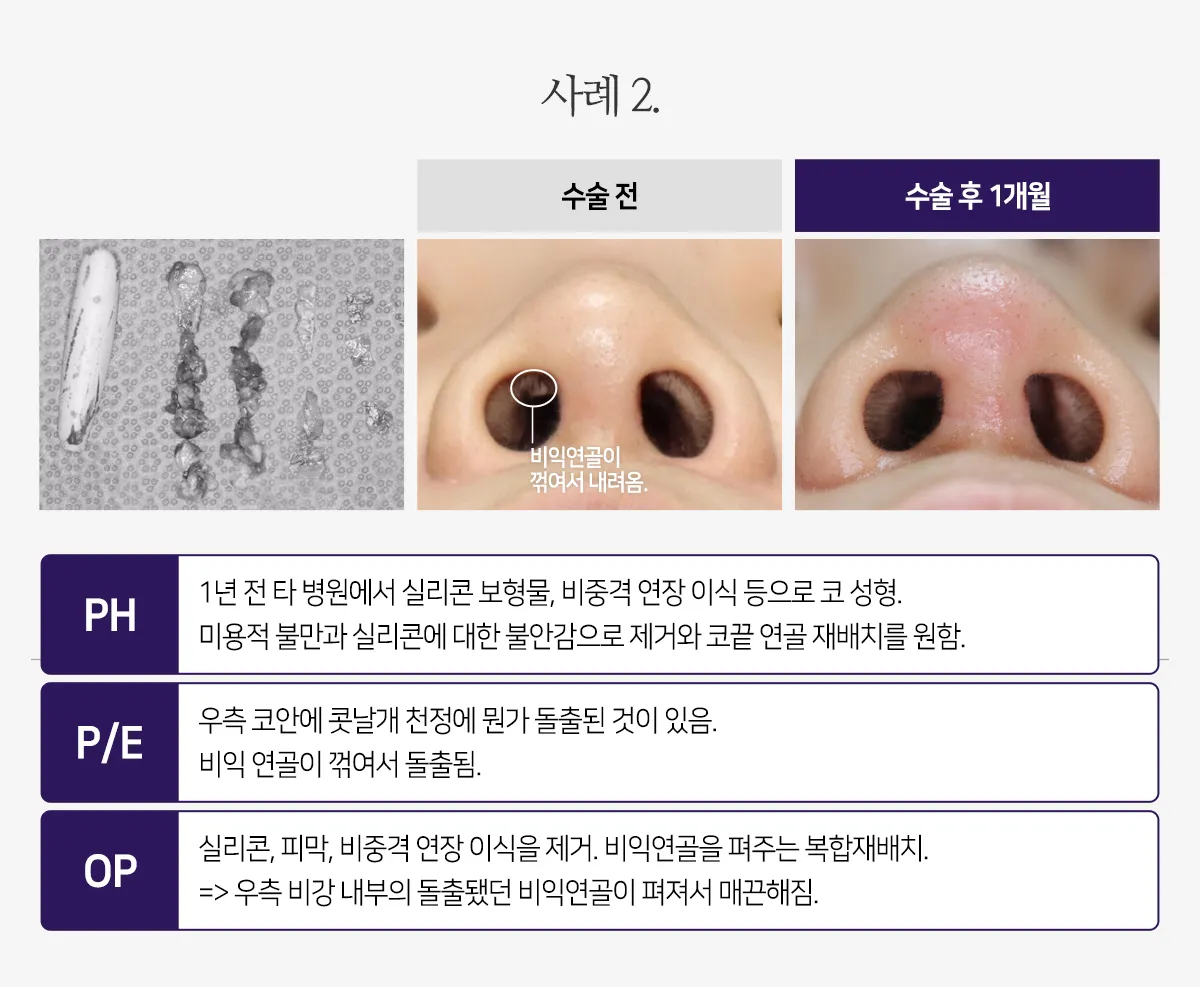
PH
Rhinoplasty at another clinic 1 year earlier with a silicone implant, septal extension graft, and other procedures.
Because of aesthetic dissatisfaction and anxiety about the silicone, she wanted removal and tip cartilage repositioning.
P/E
Something protruded at the roof of the ala inside the right nostril.
The alar cartilage was buckled and protruding.
OP
The silicone, capsule, and septal extension graft were removed. Combined repositioning was performed to straighten the alar cartilage.
=> The alar cartilage that had protruded inside the right nasal cavity was straightened and became smooth.
The protrusion caused by the buckled alar cartilage in the right nasal cavity has cleanly disappeared.
PH
Woman in her 20s. She remembered only that she had surgery with silicone and ear cartilage 10 years earlier.
CC
Once or twice in 1 year, the dorsum felt tight with a foreign body sensation,
and the cartilage grafted at the tip showed through the skin with its outline visible.
The nasal tip is shifted to the left, and the nostrils and columella are tilted and asymmetric.
P/E
The dorsum was wide and thick, the glabella was high, giving a straight dorsal line,
and the tip and columella were tilted to the left.
OP
After an incision inside the nose, the silicone and capsule were removed
and, at the same time, combined repositioning was performed to return the tilted tip cartilages to an upright position.
The dorsal line was straight and the glabella was too high, giving a strong, artificial impression.
These are the removed "L"-shaped silicone and capsule, and the ear cartilage that had been laid on the tip.
The dorsum, which was thick and crooked before surgery, has become straight and slim.
The tip that had leaned to the left and the cartilage graft showing through above it are gone, and the tip is now natural and straight.
The tilted columella, nostrils, and tip have all become straight.
The absence of a surgical scar on the columella after surgery shows that a closed approach was used.
The dorsal line, which had looked long and straight with an overly high glabella, has changed to a natural, soft appearance.
After removal, the tip came down slightly and the dorsal line became natural.