

Contracted Nose Correction Case (Revision Rhinoplasty, Nasal Implant Removal, Nasal Contracture)
A contracted nose is always a concern in rhinoplasty using silicone and is its most common side effect.
Many surgeons therefore perform revision surgery in a variety of ways,
but several points must be clearly organized and understood in order to make a sound surgical plan and achieve a good result.
01 Degree of contracture: how far the tip is upturned and how much the nose has shortened
02 Skin condition
03 Deformity of the tip
- When lengthening of up to 10 mm is desired, a derotation graft using ear cartilage may be a good option.
- Based on the degree and form of the tip deformity, whether a lateral crural strut graft (LCSG) is needed
and whether a columellar strut or the like is needed must be examined closely.
- All of these were removed, the remaining scar tissue was also removed, and then a columellar strut was made from costal cartilage,
a derotation graft and lateral crural strut grafts were made from ear cartilage, and the dorsal height was reinforced with acellular dermal matrix (MegaDerm).

PH
1st surgery: 2018, silicone augmentation rhinoplasty and tip plasty with autologous costal cartilage (open)
=> Warping of the costal cartilage, pointed and upturned tip
2nd surgery: 2020, removal surgery (open) due to inflammation caused by the silicone implant => contracture developed
3rd surgery: 2021, contracture correction with ear cartilage (open)
CC
Since the 3rd surgery, the nose has gradually turned upward due to contracture.
PLAN
Because the upturning was not severe, the plan was to lengthen the nose with a derotation graft using ear cartilage.
Raising the dorsum was considered advisable, so augmentation was performed with acellular dermal matrix.

The tip is upturned due to contracture.
A slightly pinched tip (Pinching tip)

The patient underwent a 4th surgery at our clinic,
The left photo above was taken during surgery and shows the tip cartilages compressed and splayed.
The right photo shows that costal cartilage had been placed as a columellar strut,
and septal cartilage had been used as an extension graft.
All of these were removed, the remaining scar tissue was also removed,
and then a columellar strut was made from costal cartilage, and a derotation graft and lateral crural strut grafts from ear cartilage.

This shows the derotation graft and lateral crural strut grafts made from ear cartilage to correct the pinched tip.
In addition, the left photo shows that acellular dermal matrix 5-6 mm in height was placed on the dorsum to raise the bridge.
The right photo shows the removed capsule, scar tissue, and cartilage fragments.

The nose has lengthened considerably.
The bridge line is slim, and the dorsum has been raised naturally with acellular dermal matrix.

The flat, broad dorsum is now well defined and slim, and the nose is markedly longer.
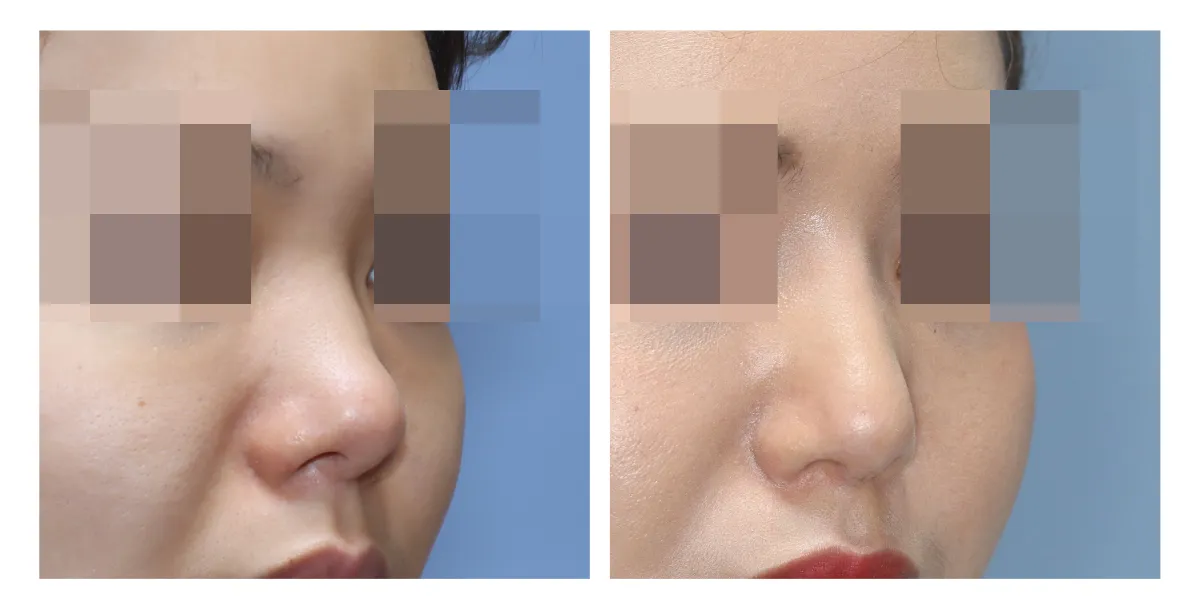
After surgery, the nose has lengthened, and the tip is projected yet extends naturally.

After surgery, the dorsal line can be seen to be straight and long.